Micro Influencers Are Bagging Brand Deals and Building Community

If you’re on the internet, you’ve probably noticed that micro influencers (creators with between 10k and 100k followers) are having a moment. There are many reasons for this, but the main one is that they’re flat-out good for business.
Micro influencers have an average engagement rate of almost 4%, which is notably higher than that of mega influencers (1%). They’re also less expensive to work with than macro or mega influencers, leading them to deliver the highest ROI in influencer marketing campaigns.
The Math Behind Micro Creators (Why They’re Getting Deals)

As I teased above, the numbers tell a pretty clear story: smaller creators outperform bigger names in engagement and ROI.
Micro (10k – 100k) | Mega (1M+) | |||
Engagement rate | 4.84% | 3.86% | 1.64% | 1.21% |
Cost per post | $50 – $250 | $250 – $1,250 | $5k – $10k | $10k – $50k+ |
Cost per engagement | $0.14 | $0.18 | $0.82 | $1.67 |
ROI per $1 | $6.52 | $7.14 | $4.23 | $3.42 |
While mega influencers can deliver massive reach, micro creators drive more meaningful interactions through their content. That combination of stronger engagement and lower costs is what makes micro influencers one of the best marketing investments for brands right now.
For more on this and other trends in the influencer marketing space, check out The Influencer Marketing Trends Changing How Brands and Creators Collaborate.
What It’s Really Like to Be a Micro Influencer
We know what the numbers say, but what about the creators themselves? What is it really like to be a micro influencer today? How did they get started, and how are they monetizing now? To find out, I chatted with three of them:
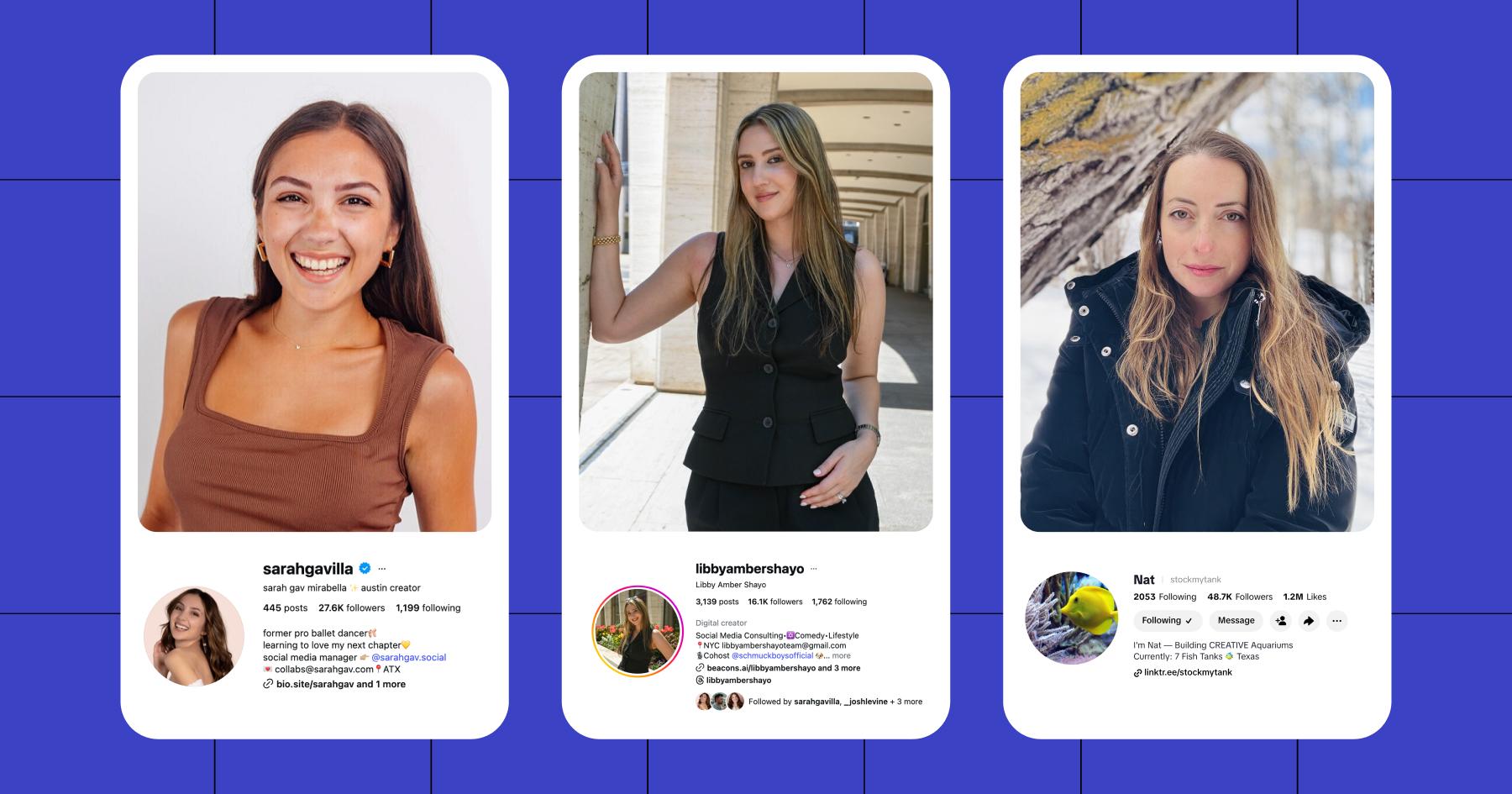
- Sarah Gavilla @sarahgavilla: Sarah is a content creator and Manychat’s social media manager. She has two Instagram accounts: a personal one where she posts ballet and lifestyle content, and another (@sarahgav.social) where she shares updates about her work in social media.
“Before this, I was a professional ballet dancer, so I talk a lot about dancing, and I dance a lot on camera. I also talk about my career now, and going through a big career change like that,” she says.
- Libby Amber Shayo @libbyambershayo: Libby is a full-time content creator and social media consultant. After getting married in 2024, she began offering consulting and content creation services to other brides. Recently, she got a new puppy named Bamba, so now she’s deep in dog mom mode.
She started on TikTok posting skits pretending to be her mom, but today, she posts “…whatever’s relevant to my life, but always with comedic Jewish flair.” - Nathalie Rovall @stockmytank: Nat is a TikTok creator in the fishkeeping and aquarium niche. If that sounds highly specific to you (like it did for me), note that fish are the third most popular pet in America.
“I got my first fish tank when I was in third grade, and I’ve kept all kinds of fish over the years. I’ve had reef tanks with clownfish. I’ve had freshwater aquariums, brackish aquariums, even,” she says.
Today, Nat uses TikTok to help others learn “…about good, proper care for our aquatic friends,” and document the challenges and realities of fishkeeping as a hobby.
Our discussion revealed a lot about the micro creator experience. Let’s talk about what these ladies all have in common.
They started creating for fun
Like many creators, Sarah, Libby, and Nat didn’t set out thinking content creation would become a career (maybe Libby did a little bit, since she has a background in acting).
Sarah started posting content when COVID interrupted her career as a professional ballet dancer. “Everything shut down and I literally had nothing to do with my life,” she says. So, she downloaded TikTok, started posting “silly videos,” and eventually realized there might be real opportunities there.
Libby’s story started similarly. In 2020, she graduated with a BFA in acting, but at the time, interviews and stage opportunities were practically nonexistent. So she started posting TikToks, and after one of her videos went viral, she decided this could really be something and began intentionally building her audience.
For Nathalie, it was a backyard pond project that kicked everything off. She found a giant pond structure on Facebook Marketplace and decided to document the process of turning it into a functioning aquarium setup.
At the time, aquarium creators were still a tiny niche, so her videos took off quickly. “I thought people might enjoy watching me try to create something out of this,” she says. “I actually got a ton of traction from that. I was like, wait, this account is growing a lot faster than I expected.”
They have a niche
There are real benefits to having a niche as a creator. One of the biggest ones is that it makes it way easier to find your people — the ones who are actually interested in your content and point of view.
Even lifestyle creators who post about their lives rather than a specific topic tend to have a subniche. For example, Sarah posts about ballet, and Libby makes skits about the Jewish community, even though both of them are best categorized as lifestyle creators.
“I always joke with my friends who are also Jewish content creators that we’re Jewish famous,” Libby says. Funny, but there’s something under the surface of that: an existing connection to a community that makes them more likely to relate to her content.
Nat might have the most specific niche of the three: aquariums and fishkeeping, a surprisingly massive online community that includes fish owners, hobbyists, experts, and everyday people intrigued by the lifestyle. Nat has been caring for fish for years, which is probably why she felt like she needed to position herself as an expert to get traction.
“But as time has gone on, I’ve realized my audience much prefers that you don’t come across that way, that you show them the journey, like, ‘Hey, just because I have nine aquariums, that doesn’t mean that I have everything figured out.'”
Nat documents the experience of fishkeeping in real time — problems, mistakes, algae outbreaks, and all. “There’s always stuff changing in the fish room,” she says. “Whether it’s me getting new fish or there’s suddenly a snail outbreak, I try to just show people the reality of what it’s like to have a fish tank.”
All of these creators make content with a clear perspective. And while their followers may initially show up for the ballet, the fish, or the Jewish comedy skits, they stay because they become invested in the person.
They experiment with different platforms and content
None of these creators built their audiences by sticking to a single platform or content type. In fact, a big part of growing as a micro creator is accepting that experimentation is part of the job. Not every video will land, and not every platform will stick, but it’s all a part of the process.
For instance, Sarah might have started on TikTok, but today, Instagram and YouTube are her strongest platforms. She realized early on that when certain videos gained traction on one platform, she could repost them on others and achieve similar results. One of her early YouTube Shorts was a reposted TikTok that pulled in eight million views in a week.
“It wasn’t really about the platform,” she says. “It was the pieces of content individually.”
Related: How Much Do YouTubers Make? We Asked to Find Out
Today, Sarah says there’s still a lot of testing involved with her content strategy. Some videos are designed to perform well (typically, her ballet content, like the video below), while others are simply experiments. “Sometimes the one that takes you five seconds and is totally off strategy is the one that blows up,” she says. The lesson there is don’t be afraid to take a risk and mix it up.
For Libby, the early days of content creation were less about having a strategy and more about being willing to try things publicly. “The strategy in the beginning is being cringe,” she says. “It’s trial and error. It’s just throwing things at the wall.”
In addition to TikTok and Instagram, Libby posts on Snapchat, YouTube, LinkedIn, Facebook, and Threads. She’s everywhere, and she’s creating all kinds of content (skits, puppy content, and social media advice, etc.). Still, she knows what works: “For me, a lot of my camp skits, especially if I post them after 5:00 PM, it’s a set situation. It’s going to perform well.”
Meanwhile, Nat has a more casual approach. “When I do try to make a strategy, I postpone making content,” she says. And while she’s tried posting on YouTube and Instagram, she says she hasn’t quite figured out those platforms yet. No biggie, though, because Nat is approaching 50k followers on TikTok with a good idea of what works for her page.
“I know if I talk about triops, which are like a seamonkey-adjacent type thing, I’ll get a ton of views. I’ve also gotten a lot of followers over the years from the pond project as well,” she says.
They’re close with their followers
The relationship between a micro creator and their audience feels personal. Sarah sees this as one of the biggest benefits of being in the micro creator tier. “You can make this into a career and do very well for yourself,” she says, “but there’s also a little bit of a tighter community.”
Unlike mega influencers with millions of followers, micro creators can recognize usernames in their notifications tab and reply to them regularly, helping them build genuine online communities.
This is certainly true for Libby, who has built long-term relationships with her followers over the years. They’ve watched her go from posting comedy skits to getting married, starting a business, and recently, adopting a puppy.
“I know who my OGs are,” Libby says. “They’ll always comment.”
Nat has also built years-long friendships with her followers and other creators in the aquarium community. “When I started, there were really only 10 total creators making aquarium content on TikTok. We had this really cool, almost family-style group, where we all knew each other, and we were all sharing fish tips.”
One of those creators is a guy Nat has known for six years. “Sometimes we met up for collabs in Austin, which was always really fun. We would shoot random short clips with good music, just enjoying aquariums. It was very casual, but we’re still friends to this day, which is really cool.”
They monetize through brand deals and good old-fashioned work
All three of these women have diversified their income by design. Two of them — Sarah and Nathalie — are employed full-time in addition to being creators, which isn’t all that uncommon (see How Macro Influencers Operate Outside the Algorithm).
As far as monetizing content goes, for Nat, brand partnerships have become far more reliable than platform payouts. That wasn’t always the case — for a while, TikTok was offering her payouts for posting one-minute videos. She’s also experimented with TikTok Shop and found some success. But ultimately, she relies on working directly with brands in the aquarium space for long-term stability. “Every couple of months, a big brand deal will come through, and that kind of floats the boat,” she says.
Bookmark this: From Scroll to Bankroll: Here’s Every Way to Monetize on TikTok
Libby, who went full-time as a creator just last year, has very intentionally established a mix of income streams. “I didn’t want to put all my eggs in one basket,” she says.
She does brand deals, but she also works as a consultant, helping creators and brands with their content strategy and event coverage. She also creates content for weddings, bar and bat mitzvahs, and creator events — all of which align with the audience she’s built online.
Sarah has a situation similar to Libby’s, but in reverse. After finding success on social media as a creator, she began getting clients who wanted her to help them do the same. She worked as a freelance social media manager and eventually launched an agency, Renue Social. Today, she has a full-time role here at Manychat, but she still has clients and does the occasional brand deal.
Creator Marketing is Here to Stay

The rise of micro and nano creators tells us that the future of creator marketing isn’t really about reach, it’s about connection. Community is the business model, and micro creators are proving it every day by building audiences that trust them, talk to them, and genuinely care about what they have to say.
You’re here because you want to learn more about the creator economy, which means you should definitely check out Algorithm Fatigue: A Look at Being A Creator in 2026. It was nominated for a Webby, so you know it’s good.
Then, do yourself a favor and sign up for Manychat. It’s free, and it’ll help you make the most out of your screen time (and touch grass, occasionally, too).
Frequently asked questions
A micro influencer is a creator with between 10,000 and 100,000 followers on a social media platform. While they may have smaller audiences than macro or mega influencers, micro creators often have much higher engagement rates and stronger relationships with their followers.
Brands increasingly prefer working with micro influencers because their audiences tend to be more engaged and trusting. Micro creators also cost less to partner with than larger influencers, making them a more cost-effective option for campaigns focused on conversions, community-building, or niche audiences.
Most micro influencers earn income through a mix of brand deals, affiliate marketing, platform monetization programs, UGC (user-generated content), consulting, and freelance or full-time work. Many creators diversify their income streams instead of relying on a single platform or revenue source.
Usually, yes. Having a niche helps creators attract a loyal audience and stand out online. That said, many of them opt to explore topics adjacent to their niche and/or add everyday life content to the mix to establish themselves as the reason people follow them rather than just the topics of their content.

Originally published: Jun 3, 2026, Updated: Jun 3, 2026
More stories worth reading
More content that's too good to miss