
If you’re a real estate agent or investor in 2026, there’s a good chance that you’ve got a social media account dedicated to your business. And if you don’t, it’s time to make one, because 52% of real estate agents and brokers said social media was their top tool for attracting quality leads in a survey conducted by the National Association of Realtors Research Group.
You might be thinking, “Well, who cares? I like to get my leads the old-fashioned way — standing on the street asking people if they want to buy a house!” That’s fine, but with 71% of home buyers choosing real estate agents with a strong social media presence, you’re really missing out if you’re not on social media today.
Where Real Estate Leads Actually Live Online
According to REsimpli, there are three relevant platforms for real estate agents: Facebook, Instagram, and LinkedIn.
Facebook: Best for creating ads
Facebook is the most widely used platform overall, with 90% of real estate agents active there, followed by 52% on Instagram and 48% on LinkedIn.
Meta Business Suite’s ad targeting capabilities are what make Facebook the default starting point for a lot of real estate agents: 92% of realtors use it specifically for lead generation. If you’re not running ads yet, check out our guide How to Create Facebook Ads That Sell.
Instagram: Best for conversational marketing
Instagram is where many newer, more conversational lead-gen tactics, like comment-triggered DMs, perform best. You can and should run ads you create in Meta Business Suite on Instagram. Instagram ads have a higher engagement rate compared to other platforms, with an average rate of 1.22% for real estate businesses.
LinkedIn: Best for old-fashioned professional networking
LinkedIn, meanwhile, is the platform for referral relationships, luxury listings, and commercial real estate — the audience on LinkedIn skews toward other professionals rather than first-time buyers.
Put simply, if you're building a lead gen strategy for your real estate business on social media:
- Facebook gets you reach,
- Instagram gets you engagement, and
- LinkedIn gets you relationships.
If you’re going after first-time buyers, go with Facebook and Instagram. If your ideal buyer is a business owner or real estate investor, you should be on LinkedIn.
Video is the thread that ties all three platforms together: 63% of real estate agents now use video content in their social media marketing strategy to advertise listings, whether that's a walkthrough, a market update, or a quick tip.
How to Generate Leads on Instagram with Manychat
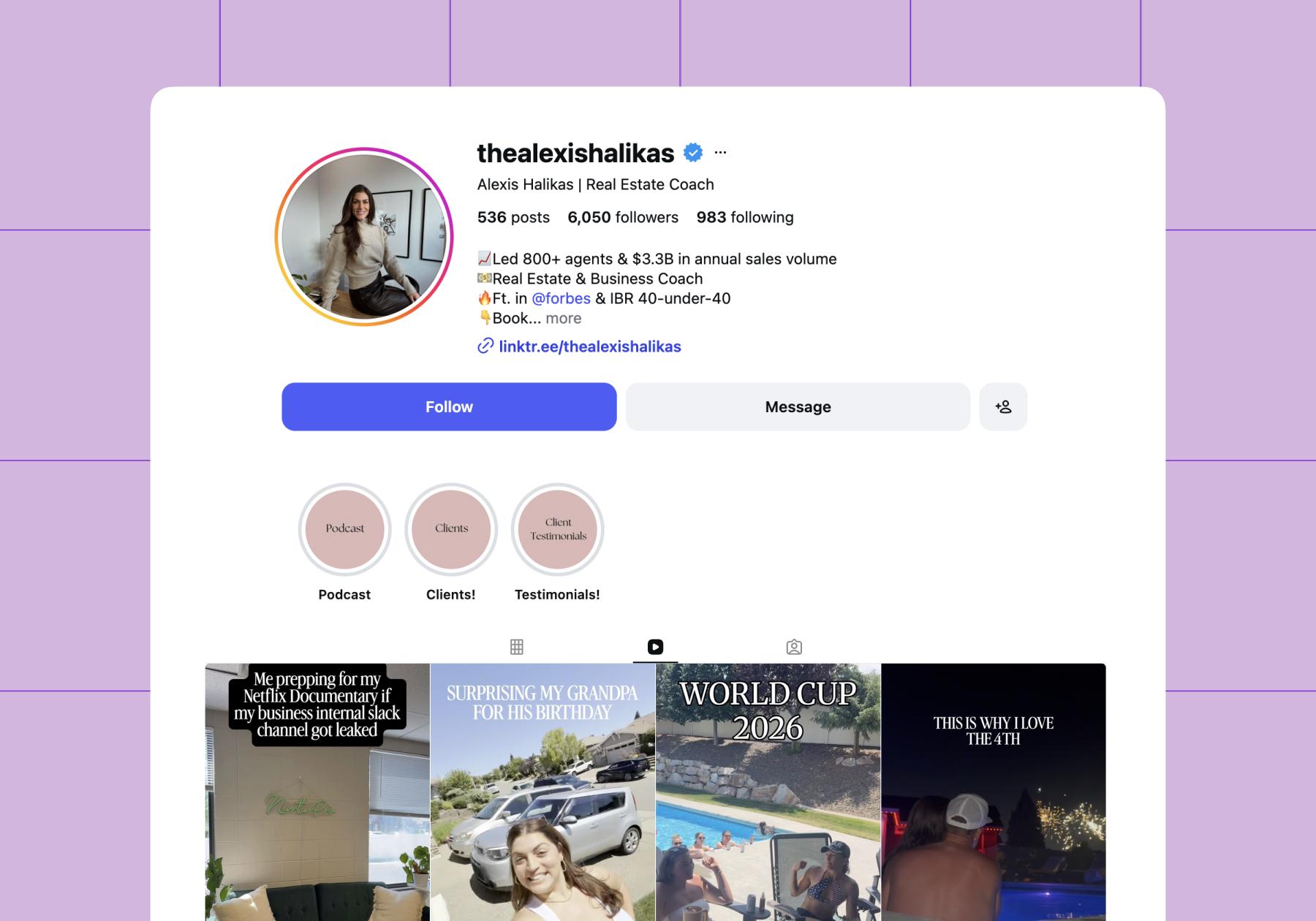
Knowing where your leads are is one thing. Turning the engagement you get on social into booked appointments? That’s a different ball game, and it's where most agents fall short.
Alexis Halikas has spent her career studying that gap. She spent over 15 years in production before helping scale a Keller Williams Market Center from 400 to 800+ agents and $3.3B in annual sales.
Today, Alexis coaches agents and team leaders on how to grow their business without spending too much too fast. "Social media automation is now a core part of how I teach agents and team leaders to generate leads without adding headcount," Alexis says.
For anyone wondering where to start, Alexis keeps it simple: "Pick one keyword, one piece of content, and one sequence. Get your first automated conversation to a booked call before you build anything else."
Sounds like great advice to me, especially because Alexis uses Manychat’s comment-to-DM Quick Automation for this.
When someone comments a specific word on her content (in the example above, “stable”), Manychat sends them a personalized DM that qualifies the lead, delivers a resource, and moves them toward a call booking, all without her touching her phone."One post can generate dozens of qualified conversations within hours of going live," she says.
The results are concrete for her business. "Since implementing automated DM sequences, I've seen a measurable increase in strategy call bookings directly attributable to organic Instagram content, not paid ads," she says. "The automation does the heavy lifting between the comment and the calendar."
But she's also watched plenty of agents build automations and get nothing out of them. The most common mistake, in her experience, is treating automation as a replacement for connection instead of an extension of it. "Agents will set up a DM funnel with no clear offer at the end, no qualifying step, and no plan for what happens after someone books, and then they're confused when it doesn't convert," she says.
"Automation doesn't fix a broken sales process. It just makes a good one scale faster."
Make it worth your time: Add questions to qualify leads
Let’s say you follow Alexis’s lead. You sign up for Manychat and start posting on social using comment-to-DM to send the link for your listing or website directly to people who find your content.
It works: You get eyes on your content, and some of them are interested enough to comment your keyword. But are they really interested in what you are trying to sell, whether it’s a historic craftsman bungalow or a coaching session to learn how to sell that bungalow (like in Alexis’s case)?
This is why qualifying leads is so important. You have limited time in your week to spend building relationships with potential buyers; don’t waste it on someone who’s just a lookie-loo.
“The point isn't to interrogate someone in a DM thread; it's to make sure the call you eventually have is with someone who's ready to have it and worth your or your team's time,” says Alexis.
“Before anyone lands on my calendar, the automation asks two or three qualifying questions.
The questions aren’t complicated, but they are just enough to understand where they are and whether they're actually a fit.”
Alexis gave the example of asking a real estate agent about their timeline for buying or selling a property and whether they’re preapproved.
An agent promoting a listing could ask the user whether they’ve been pre-approved for a mortgage, and if so, what their budget is. I built a Manychat Instagram automation in the Flow Builder based on this example, and it took me about 10 minutes.
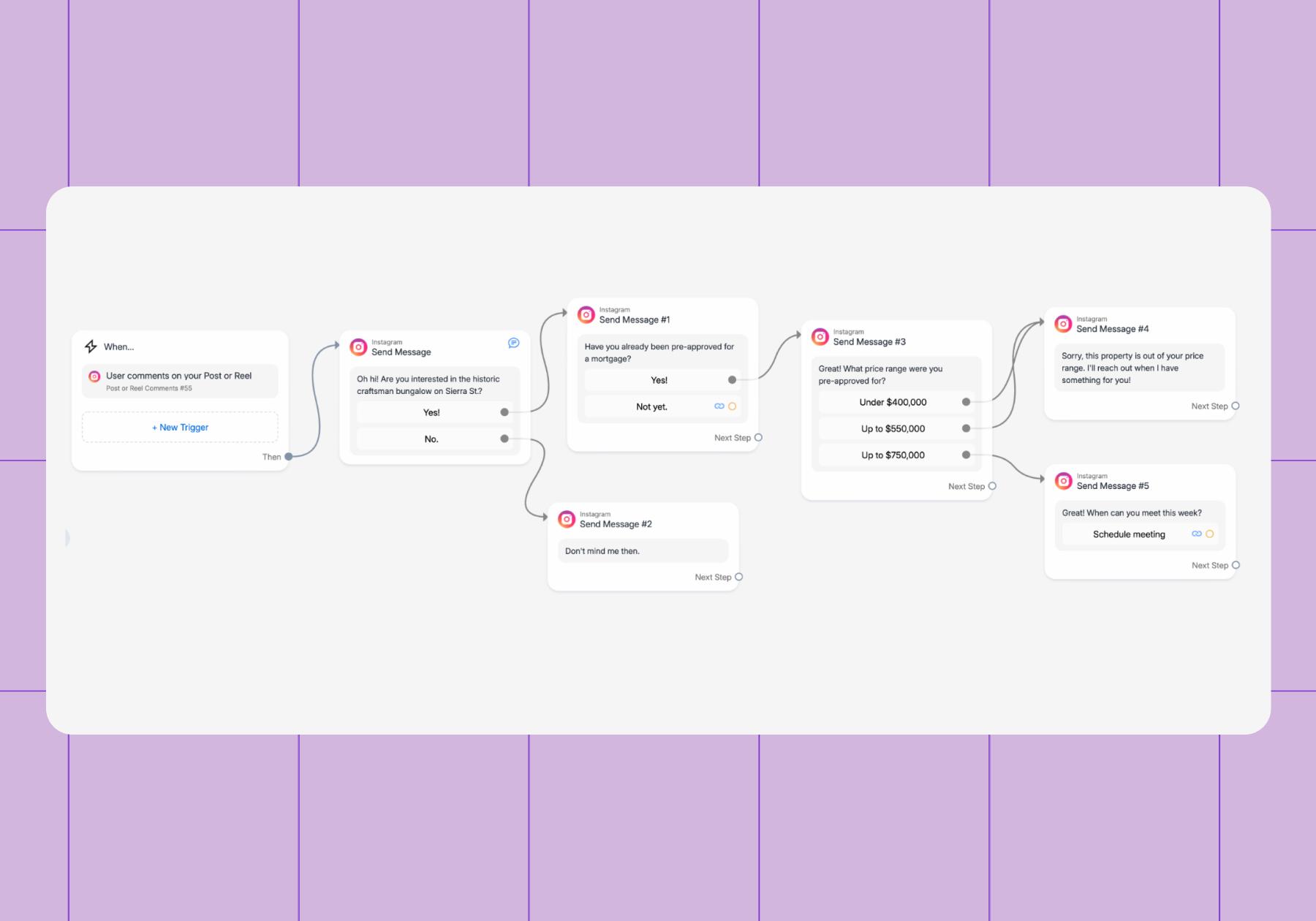
Here’s how to do this step-by-step:
- Open Automations
- Click + New Automation → Start from Scratch → Start from a blank canvas
- Click + New Trigger → User comments on your Post or Reel
- Choose the post you want the automation to fire off from and add a trigger keyword. Make sure you have a CTA on that post that tells scrollers to “Comment [your keyword].”
- Add a message block as the next step. To do this, choose Send user a message.
- Ask the user whether they’re interested in the listing and add two options (Yes and No). If they say yes, continue the conversation with another message block. If they say no, send a final message (à la “Sorry for the intrusion!”) and bow out of the conversation so as not to bother them.
- Keep adding message blocks with your qualifying questions of choice. Once you’re satisfied that someone is worthy of meeting in person or virtually, send them to your appointment-scheduling page.
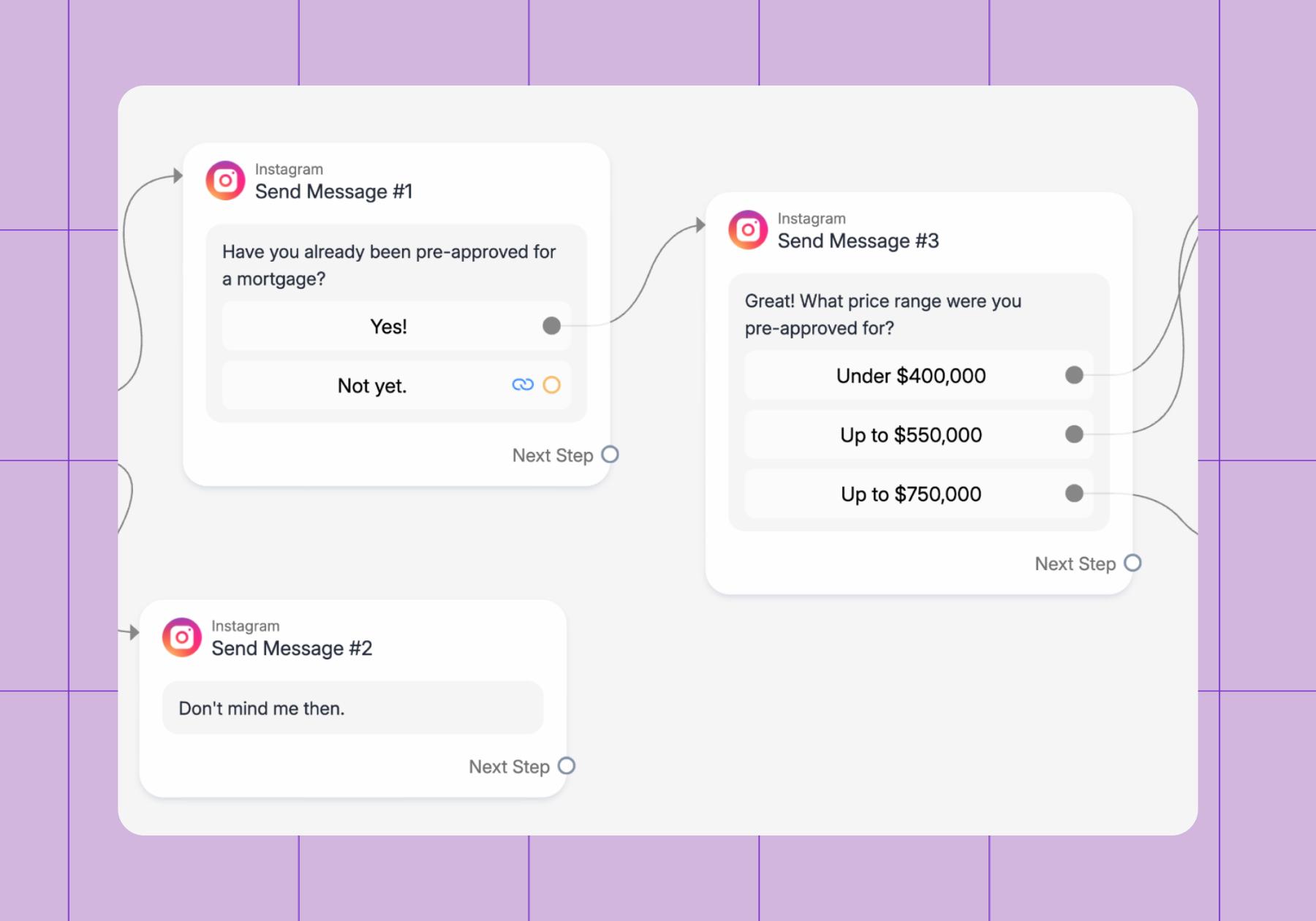
Lost in the sauce? How to build a Manychat automation
Good Content + Simple Automations = Success

It's tempting, once you see a system like this work, to build it out for everything at once: buyers, sellers, renters, referral partners, all funneling through one giant automation.
Alexis has watched that instinct backfire more than once. "They'll try to build one automation to capture buyers, sellers, and referral partners all at once, and it ends up serving none of them well," she says. "I always tell people to start narrow: one keyword, one audience, one outcome, to prove that it works, and then build out from there."
Good content and a few simple automations, like the one we walked through above, are enough to start gathering and qualifying leads from social.
Take this post from Boca Raton agent Kurt (@kurtsellsboca), who's been selling real estate in South Florida for decades. The video itself is simple: a beautiful shot of Lake Boca, paired with a caption breaking down what out-of-staters need to know before buying in the area, from hurricane season to property taxes to HOA fees. He closes with one clear CTA: "Comment 'GUIDE,' and I will send you my relocation guide." That single comment triggers a Manychat automation that handles the qualifying and delivering from there.
The post has pulled in more engagement and leads than a lot of his other content, and he didn't need an elaborate plan or funnel to get there. He needed one genuinely useful post and one keyword tied to a real resource. That's all you need, whether you're coaching real estate agents like Alexis or closing deals in Boca Raton like Kurt.
Frequently asked questions
A Messenger bot for real estate lead generation works by triggering an automated sequence off a specific action, most commonly a comment containing a keyword, a new follower, or a direct message. Instead of an agent manually replying to every commenter, the automation delivers a resource, asks a few qualifying questions, and routes the lead toward booking a call, all in real time.
Social automation for real estate refers to any tool or workflow that automatically responds to engagement on your social posts, comments, DMs, new followers, and moves that engagement toward a specific outcome, like a booked call, a downloaded guide, or a listing inquiry, without requiring manual follow-up from the agent.
Start with one post, one keyword, and one simple automation, like the comment-to-DM flow outlined above. Resist the urge to build something complex on day one. Prove that a single keyword tied to a single piece of content can turn into a booked call before adding more sequences, platforms, or audiences.
No. Alexis Halikas's results come from organic content and a specific, engaged audience, not follower count. A smaller, well-targeted post with a clear CTA and a specific keyword will consistently outperform a vague CTA sent to a larger audience.
Keep it to two or three short questions tied to buyer or seller readiness: timeline to buy or sell, financing or pre-approval status, and what's motivating the move. The goal is to ensure the calls you book are with people who are interested in and qualified to buy what you’re selling.

Originally published: Jul 13, 2026
More stories worth reading
More content that's too good to miss