
You’re replying to DMs at midnight, copying and pasting the same answer for the fourteenth time, and somehow still missing messages from people who were this close to buying.
Sound familiar? 🫠
If so, you need to take a hard look at your chat marketing strategy (or lack of one).
This guide will teach you how to turn your social media presence into a full-blown marketing channel — one that generates leads, closes sales, and keeps your audience engaged across Instagram, WhatsApp, Messenger, and TikTok. All without you having to type every reply to every person yourself personally (yay!).
Whether you’re brand new to chat marketing or looking to formalize something you’ve been winging thus far, you’ll close this tab with a roadmap you can actually execute.
TL;DR
- A chat marketing strategy is your plan for automating conversations across chat platforms like Instagram, WhatsApp, TikTok, Messenger, SMS, and email to generate leads, close sales, and engage your audience.
- The best chat marketing strategies take audience needs and preferred channels into account. They automate without losing personality and iterate based on what’s actually working (and what’s not).
- Automation tools (including Manychat) now offer AI-powered features like intent recognition and personalized replies to improve the user experience.
Chat Marketing, Explained

Chat marketing is the practice of using messaging apps and DMs (Instagram, WhatsApp, Facebook Messenger, and TikTok) as marketing channels. You might also hear it called conversational marketing, a broader term that includes social chat marketing, website live chat, and voice assistants.
Here’s how chat marketing compares to the traditional approach:
Chat marketing | Traditional marketing | |
|---|---|---|
Response time | Instant (automated replies 24/7) | Hours to days (email, form submissions) |
Personalization | Dynamic — adapts based on user responses and behavior | Static — same message to entire segments |
Conversion path | Two-way conversation inside the app they’re already using | Multi-step: ad → landing page → form → email → follow-up |
Scalability | One flow handles thousands of conversations simultaneously | Each lead requires manual touchpoints or batch sends |
Availability | Always on, every time zone | Limited to business hours or scheduled sends |
The gist: Chat marketing shows up in the channels people already use (social) and offers a faster, more personalized path to whatever they’re looking for.
Chat Marketing Eats the Traditional Marketing Funnel Alive (Yum!)

If you’re wondering whether chat marketing is worth building a whole strategy around — yeah, the numbers make a pretty strong case. Messaging apps have open rates hovering around 80%, compared to email’s 33%. And because conversations happen in real time (no waiting for someone to open an email they’ll scheduled for three days from now), they lead to higher conversions.
Here’s what makes chat marketing so essential for creators and businesses today:
- Higher conversion rates. When someone asks a question in your DMs and gets an instant, relevant answer (plus a link to buy), the friction between “interested” and “purchased” practically disappears. Brands using Instagram DM automation often see click-through rates of 12% to 18%, compared to just 2% to 3% for bio links.
- Better lead qualification. Instead of collecting a name and email and crossing your fingers that they want what you’ve got to offer, you can use chat automation to ask qualifying questions in the DMs naturally. By the time someone reaches your checkout page, they’ve already gotten a personalized recommendation.
- 24/7 availability without 24/7 effort. You can set up automations to handle the repetitive stuff (like sending links) so you can focus on the work that actually requires creative thinking.
- Multi-channel reach from one platform. Rather than using six different tools to manage six different channels, you can use one strong automation platform (ahem, Manychat) to support the customer journey across Instagram, WhatsApp, Messenger, and TikTok.
For creators and brands who live on social media, chat marketing is the primary way to turn followers into customers — especially in a time when consumers increasingly expect real-time responses from the businesses they interact with online.
A 7-Step Chat Marketing Strategy

Setting up one automation and crossing your fingers won’t get you anywhere. You need an action plan, and the seven steps outlined below are just that.
1. Get to know your audience first
Understanding your audience is the foundation of every good chat marketing strategy. This step matters more here than in most marketing channels because chat is inherently personal — you’re sliding into someone’s DMs, after all. Get the tone or timing wrong, and you’ll get blocked faster than you can say “unfollowed.”
Start with basic demographic information: age range, location, which platforms they use, and how they prefer to interact with your content (comments? DMs?). If you’re active on TikTok, Instagram, or Facebook, there are tools to help you collect this information, like Meta Business Suite, Instagram Insights, and TikTok Creator Analytics.
Next, determine what people DM you about and which comments keep popping up on your posts. Those patterns are gold. For example, a skincare creator might notice that the majority of their DMs are some version of “which product do you recommend for [x]?” That’s not an FAQ, even though it feels like one. Instead, it’s the beginning of an automated flow that segments users by skin concern and recommends products accordingly.
Once you know your audience, segment them. In Manychat, that means using features like tags and custom fields to collect and organize information about your contacts. Segmentation helps you send the right message to the right people, improving your conversion rate.
2. Align chat marketing automations with your goals
Chat marketing works best when it’s designed to support your goals. What those goals look like depends on who you are.
Creators might want to grow their email list, deliver lead magnets, or monetize their audience through digital products. An e-commerce brand might use chat to drive product discovery or collect post-purchase reviews.
Regardless, your automations should guide people toward a specific action, whether that’s buying a specific product, booking a call, or downloading a resource. Think about the problems your audience has and where chat can solve them faster than your current setup.
3. Set goals you can actually measure
The SMART goals approach may be 40+ years old, but it’s a classic for a reason. Your goals should be:
- Specific: Targeting a single, clear outcome
- Measurable: With concrete numbers to stay on track
- Achievable: Based on your current resources and capacity
- Relevant: Based on current market conditions
- Time-based: With a deadline that keeps you accountable
Set SMART goals (especially when you’re first starting), and list out the tasks you need to complete to achieve them.
For example, let’s say your goal is to get 500 new email subscribers via Instagram DM automation by the end of the quarter. You could start by creating a free resource (a lead magnet) your audience actually wants — something like a guide, template, or checklist. From there, you could build a comment-to-DM flow that delivers the resource and collects email addresses from people who comment a specific trigger keyword.
Once someone is on your email list, you can calculate lead scores based on their actions (opened the resource, clicked links, replied to messages) and send targeted follow-ups via sponsored messages or email to the people most likely to convert. Review your flow performance weekly and optimize based on where people drop off.
Now that you’ve laid out where you want to go, it’s time to figure out how you’ll get there.
4. Create automations that don’t sound robotic
It’s 2026. Your automations need to have personality (or people will think you’re a bot/spam).
The goal should be to replicate the experience of talking to a real person. Use words you’d actually say out loud. If your brand is playful, be playful. If you’re more buttoned-up, that’s fine — use plain language and skip the emojis. Either way, the language you use is what sets you apart from every other automated message in someone’s inbox.
Also, use creative CTAs. Phrases like “Yes, sign me up!” or “Hmm, IDK, tell me more” make the interaction feel less transactional. And know when to hand off to a real person. Automation is great, but jumping into live chat for high-value conversations, complex questions, or customers who are clearly frustrated makes all the difference.
5. Pick your channels wisely
Once you’ve defined your goals, decide which channels will actually get you there. If you did your audience research, you likely know which platforms your audience prefers. Even so, here’s a quick rundown of all the places you could show up with your chat marketing strategy:
- Instagram is an essential channel for creators and e-commerce brands. Instagram continues to invest in its DM channel with new DM features, including message translations and scheduled sends.
- WhatsApp dominates for international audiences and high-intent leads. If your customers are outside North America — or if your product requires more considered conversations (think real estate, financial services, higher-ticket items) — WhatsApp marketing is worth prioritizing.
- TikTok is the channel for viral moments — 46% of marketers call video their top content type. And when a video goes viral on TikTok, you need a way to handle the flood of DMs and comments without manually replying to hundreds of people.
- Facebook Messenger still works well for businesses with Facebook-heavy audiences, especially for running click-to-Messenger ads and cross-channel nurture sequences.
- SMS and email are your owned channels — the ones that don’t depend on any platform’s algorithm. Use them to re-engage subscribers who’ve gone quiet or to deliver time-sensitive offers.
Ideally, you have multiple channels working together in your strategy. For example, you could start a conversation on Instagram and close the sale via email (as long as your flow is designed to capture their email address).
6. Build your flows and launch
You’ve done the planning — now it’s time to actually build.
If you’re using Manychat, the easiest place to start isn’t from scratch — it’s with Quick Automations. These are pre-built setups for common things like welcome messages, FAQs, or email capture. They give you a working foundation in minutes, so you’re not staring at a blank screen wondering where to begin.
Create Your First Manychat Automation (step-by-step tutorial) 💬 Manychat Basics Ep. 2
Start there, then once you’ve got momentum, you can move into the Flow Builder to customize things further. That’s where you create more detailed, choose-your-own-adventure style paths based on what your audience clicks or replies. Basically, Manychat gives you the ability to go deep, but you don’t need to do so on day one. Launch something simple first, then improve it over time.
7. Test, learn, and optimize on repeat
If you spend a few weeks creating and implementing a chat marketing strategy for your business, you probably want to make sure it’s actually working…right?
You can’t improve what you don’t measure, and unfortunately, “I feel like it’s working!” probably won’t impress your boss (if it works for you, though, carry on).
Here are the KPIs that actually tell you whether your chat marketing strategy is doing its job:
- Open rates: The percentage of subscribers who open your messages. Messaging apps typically see open rates between 70% to 80% — if yours are significantly lower, your timing or targeting needs work.
- Click-through rates (CTR): This is how many people tap links or buttons in your messages. Low CTR usually means your CTA isn’t compelling enough or the offer doesn’t match the audience.
- Conversion rates: The percentage of subscribers who complete your desired action — purchase, sign-up, booking, or download. This is the number that ties directly to revenue.
- Response time: How quickly your automation (or team) replies. Consumers expect near-instant responses from businesses on messaging apps — anything over a few minutes, and you’re losing people.
- Opt-out rates: How many subscribers unsubscribe or block you? A spike here means you’re messaging too often, sending irrelevant content, or both.
- Revenue attributed to chat: How much money can you directly trace back to your chat marketing efforts?
Review these numbers at least every couple of months. A deep dive once or twice a year is worthwhile — that’s your chance to really take a look at how your automations are improving the user experience, and where you can improve next.
How AI is Changing Chat Marketing
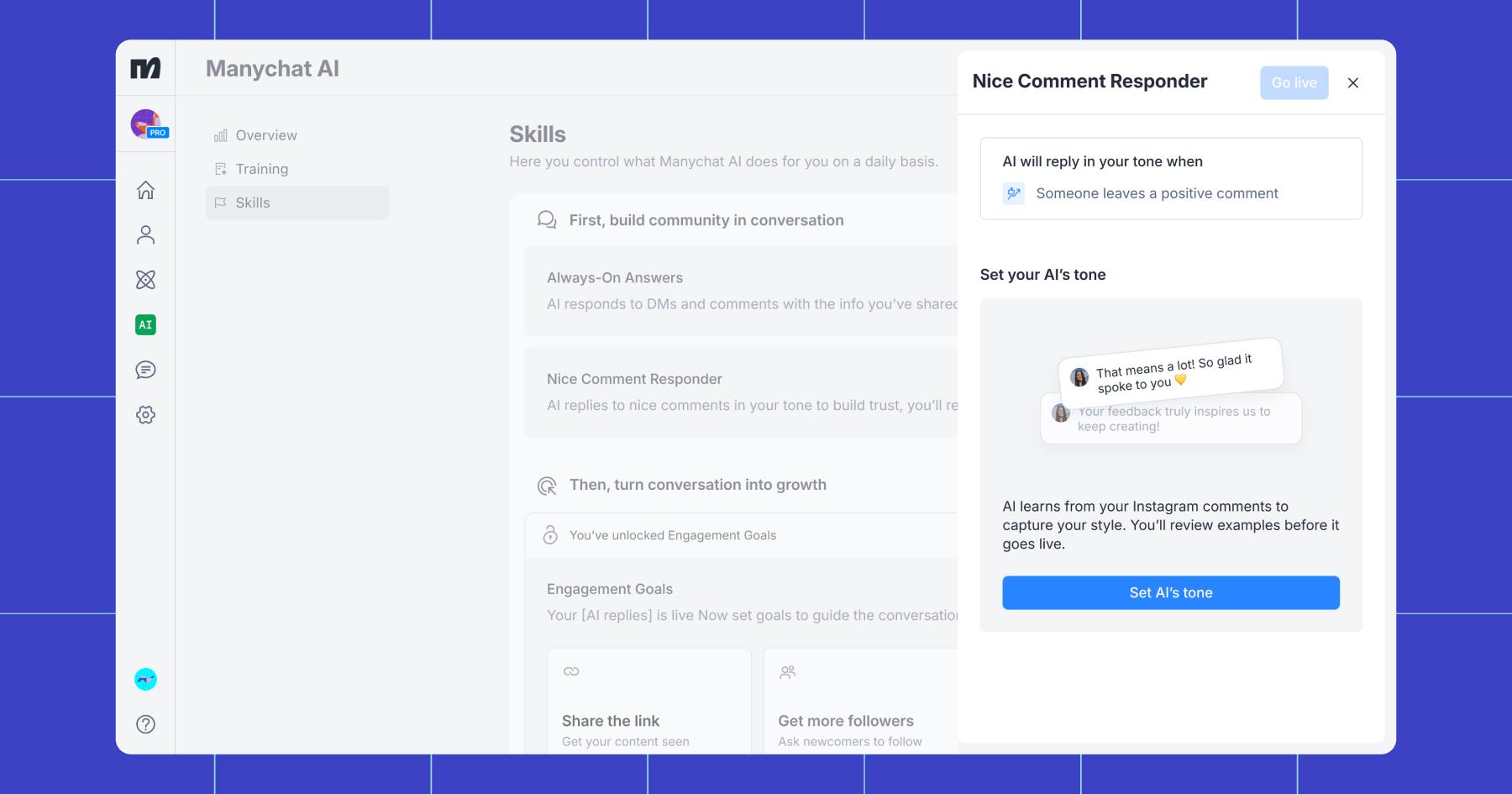
Remember when chatbots could only respond to exact keyword matches? Someone would type ‘pricing’ and get what they needed, but if they had typed ‘how much does it cost,’ they’d be hit with the classic ‘sorry, we didn’t get that’ message. Those days are (thankfully) over.
Today, AI can understand intent. Someone can ask, “Do you ship to Canada?” “Can I get this delivered to Toronto?” or “What’s your international shipping policy?” and get the same answer, because the AI understands what they’re trying to find out, regardless of how they ask about it.
In Manychat, that looks like:
- AI Replies handle messy, free-text messages that don’t fit neatly into predefined flows, so you don’t have to account for every variation manually.
- Intent Recognition identifies what a subscriber is trying to do and routes them to the right flow or response.
- AI Goals help guide conversations toward a defined outcome (like a purchase or signup) based on the logic you’ve built.
- Flow Builder Assistant speeds up creation by suggesting steps and drafting messages so that you can build faster.
Want to ride the latest wave of AI-powered chat marketing?
Frequently asked questions
A chat marketing strategy is a plan for using automated conversations across messaging apps — like Instagram DMs, WhatsApp, Messenger, and TikTok — to generate leads, close sales, and engage your audience. It covers everything from audience segmentation and channel selection to conversation design and performance measurement.
They’re closely related. Chat marketing focuses specifically on messaging apps and DMs, while conversational marketing is a broader term that also includes website live chat, voice assistants, and other real-time communication channels. If you’re using Instagram DMs or WhatsApp to sell, you’re doing chat marketing. If you’re also using a chatbot on your website, that falls under the umbrella of conversational marketing, too.
The best channel depends on where your audience already hangs out. Instagram DMs and TikTok tend to work best for creators and eCommerce brands. If your audience is international or high-intent, WhatsApp is your best bet. And don’t count out Messenger — it’s still strong for Facebook-heavy businesses. Most successful strategies use multiple channels together rather than betting everything on one.
Yes, chatbots are legal for marketing, but they’re subject to disclosure and transparency requirements that vary by region. Some states and countries require you to let users know they’re interacting with a bot, and messaging platforms like Meta and TikTok have their own policies for messaging ads. Always check the rules for your specific market and platform before launching.
Track open rates, click-through rates, conversion rates, response time, and opt-out rates — these KPIs tell you whether your automated conversations are actually driving results or just generating noise. Revenue attributed to chat is the ultimate metric, and platforms like Manychat provide analytics dashboards that connect the dots from first message to final purchase.


Originally published: Nov 18, 2019, Updated: May 8, 2026
More stories worth reading
More content that's too good to miss