
Getting leads from social media is great. But if you’re managing every conversation manually, figuring out who’s ready to buy today can get out of hand fast. Before you know it, you’re spending your time going back and forth with someone who’s nowhere near ready to shell out for whatever you’re selling.
That situation is exactly why lead qualification and lead scoring exist. These strategies help you learn more about the people behind the DMs, spot signs of purchase intent, and offer each prospect a more relevant next step.
In this guide, we’ll break down the difference between lead qualification and lead scoring, show you how both can work in Manychat, and walk through a practical Instagram example you can adapt for your own business.
TL;DR
- You can set up lead qualification and lead scoring automations in Manychat that work across Instagram, Messenger, TikTok, and Whatsapp.
- While you can capture leads with a Quick Automation like Comment-to-DM, you need to use the Flow Builder to qualify and score them.
- A step-by-step walkthrough of how to set up a simple lead scoring flow with screenshots.
What is Lead Qualification, and How Does it Work on Social Media?

Lead qualification is the process of figuring out whether someone is a potential customer. Instead of asking every person who interacts with your brand the same questions manually, you can use a Manychat automation to collect information such as:
- What product or service they're interested in
- What problem they're trying to solve
- Their location
- Their budget or other eligibility criteria
- Their email address or phone number
- Whether they want to book a consultation or take another step
Then, you can use those answers to determine what happens next. So, someone who's ready to speak with a sales rep might be routed to your team; someone interested in a particular product might receive a relevant recommendation; and someone who's still researching might receive an educational resource instead.
The whole point is to identify what a person needs and move them toward the most relevant next step.
Lead qualification vs. lead scoring
Lead scoring and lead qualification are related, but they’re not the same thing.
- Lead qualification evaluates whether someone meets criteria you've decided matter to your business.
- Lead scoring assigns numerical values to characteristics or behaviors.
Manychat can do both, but honestly, you’ll have an easier time using Manychat for lead qualification than lead scoring. More advanced users can create lead scoring-like workflows using Custom User Fields, tags, Conditions, Rules, and integrations with external CRMs (we’ll walk you through that below). But for most creators and small businesses, starting with qualification is simpler.
How Lead Qualification Works in Manychat

A basic lead qualification automation has four key parts.
1. Start with a high-intent interaction
Qualification works best after someone has already shown some interest. That could mean they’ve
- Commented on an Instagram post or Reel
- Sent you a DM
- Replied to an Instagram Story
- Responded to an ad
- Asked about a product or service
- Triggered one of your existing automations
With a lead qualification flow, you don’t want to send everyone to the same link, landing page, or form. Instead, use the conversation to learn more about what they need. The best way to do this is simple: ask questions.
2. Ask (a few) useful questions
It’s a Manychat best practice to keep your automated flows short. No one wants to interact with an automation for more than a few back-and-forth exchanges. So, only ask for information that will actually help you understand what a scroller wants.
- If you're a physical trainer or coach, that could mean asking what goal the person is working toward.
- If you're a local business, you should ask which service they’re interested in or where they're located.
- If you're a creator, you can inquire about what kind of content the person is most interested in.
Manychat can save a prospect’s answers to their contact record using Custom User Fields (CUFs). You can then use that information in Conditions to personalize what happens next — for example, sending different offers based on their goals or routing qualified prospects to your team.
3. Segment leads based on their answers
Once you know something useful about the prospect, you can use Conditions, Tags, and stored information to create different paths.
Let’s continue with the physical trainer/coach example:
- Interested in beginner course → send beginner-course information.
- Interested in advanced coaching → ask another qualifying question.
- Qualified for consultation → send the booking link or route the conversation to a person.
- Not ready yet → offer a helpful resource instead of immediately pushing a sale.
This represents the real value of qualification: the outcome of the conversation depends on what the prospect tells you. On that note…
4. Send the appropriate next step
Once you've learned what someone needs, make the next action relevant. That might mean:
- Sending the appropriate product or course
- Sharing a booking link
- Collecting an email address or phone number
- Sending a lead magnet
- Assigning the conversation to a live agent
- Passing the lead into your CRM or email platform
- Continuing the conversation with another automation
This turns qualification into something useful for both sides: your customer gets a more relevant experience, and you spend less time manually sorting conversations.
Example: Jenna Kutcher's Instagram quiz
Digital entrepreneur Jenna Kutcher created a quiz in Manychat designed to understand what her audience members were working on.
Jenna’s “Level Up Quiz” is a chat funnel that qualifies leads, shoots off personalized recommendations, and builds her email list, all in the DMs.
Here’s how it works:
- Jenna asks people to DM her the word “QUIZ.” Followers take a fun, fast quiz in DMs, answering a few questions.
- Based on their answers, they get a custom resource (freebies, course recommendations, next steps).
- Manychat collects data, like email addresses or where they are in their business journey.

The Level Up Quiz served two purposes:
- To help Jenna’s followers find resources relevant to their interests
- To give Jenna's team better insight into what her audience really wants
“We’re never inviting them off the app, never asking them to stop scrolling their newsfeed. They’re already there, and they’re getting served,” says Jenna.
After going live, the quiz collected 5,836 email addresses and achieved an 85% completion rate.
Read more: Jenna Kutcher’s Instagram DM Funnel: The Exact Strategy That Made her $900K (and Counting)
How Does Lead Scoring in Manychat Work?

Some businesses need more than lead qualification. And in those cases, you have to create an automation with more advanced logic using some of the Manychat features we’ve already mentioned.
Manychat Custom User Fields can store information associated with individual contacts, including numeric data. Custom fields can also be used inside Conditions to determine which path someone follows.
Rules provide another automation layer. They can respond to supported events, such as a tag being applied, a custom field value changing, a contact being created, or other account events.
That means an advanced setup could use combinations of fields and tags to represent a prospect's status or level of qualification.
Let’s say you're a creator selling a course about growing an Instagram audience.
Someone comments “GUIDE” on one of your Reels because they want your free Instagram Growth Guide. You could simply DM them the resource and end the conversation there.
Or, you could use that initial interest as the start of a conversation: deliver what they asked for, learn a little more about what they want to achieve, and start building a lead score that can eventually help you identify your strongest prospects.
Step 1: Start the automation when someone shows interest
One effective way to start a lead-scoring flow is with a freebie. Someone who asks for your guide, checklist, webinar, or other lead magnet has already shown some level of interest in what you teach or sell.
Continuing with the course creator example: Imagine you post an Instagram reel about your freebie and ask people to comment “GUIDE” to get the free resource.
In Manychat, that comment triggers your Instagram automation and sends the person a private reply.
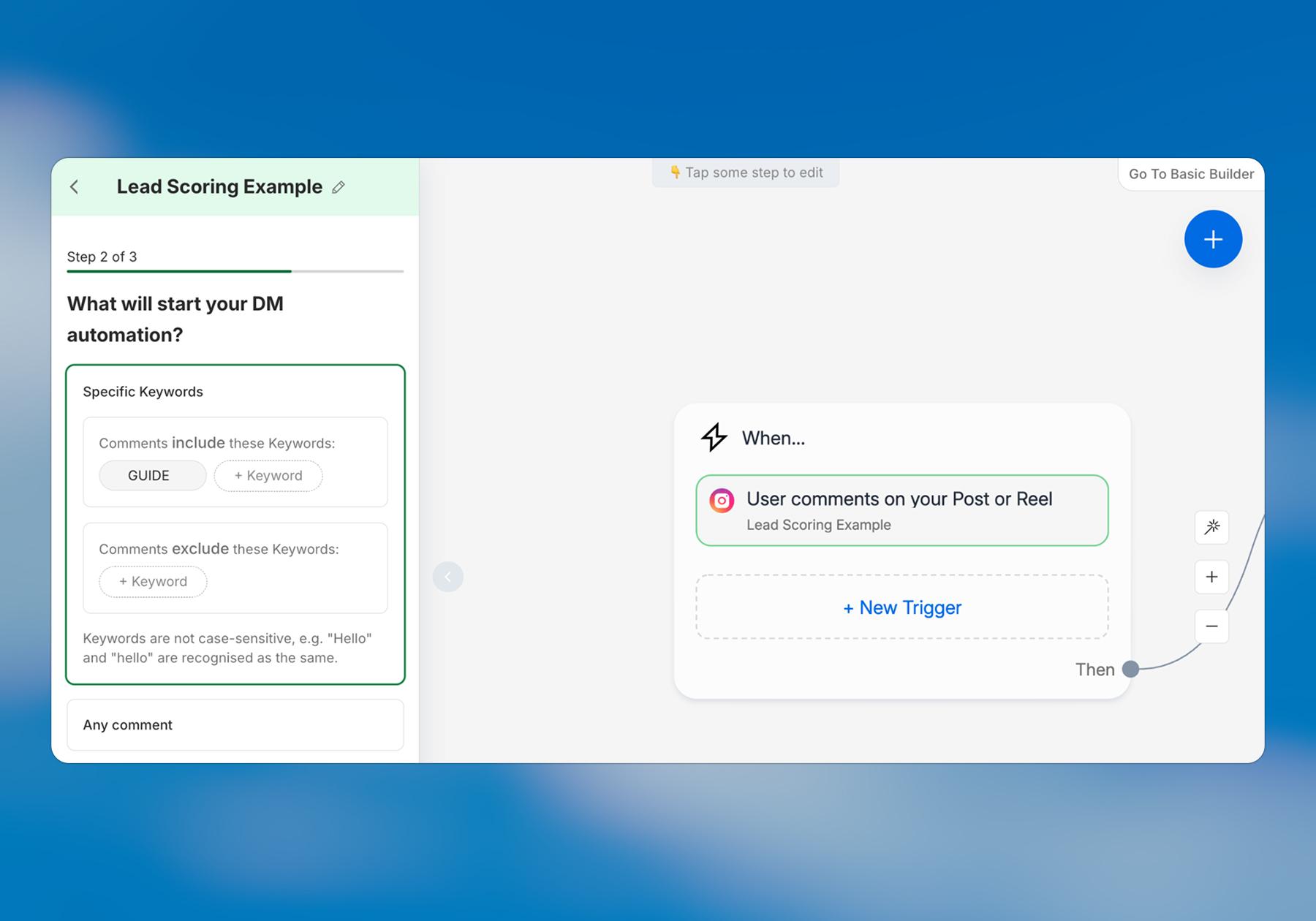
Important: The first private reply generated by the Instagram Comments trigger has restrictions: before the rest of your automation can continue, the contact needs to interact with the message. So, rather than asking your scoring question immediately, start with a simple prompt such as: “Tap the button to get the guide!”
Then add a button or Quick Reply that says something like “Send me the guide.” Once the person taps it, continue to another message that delivers the actual resource.
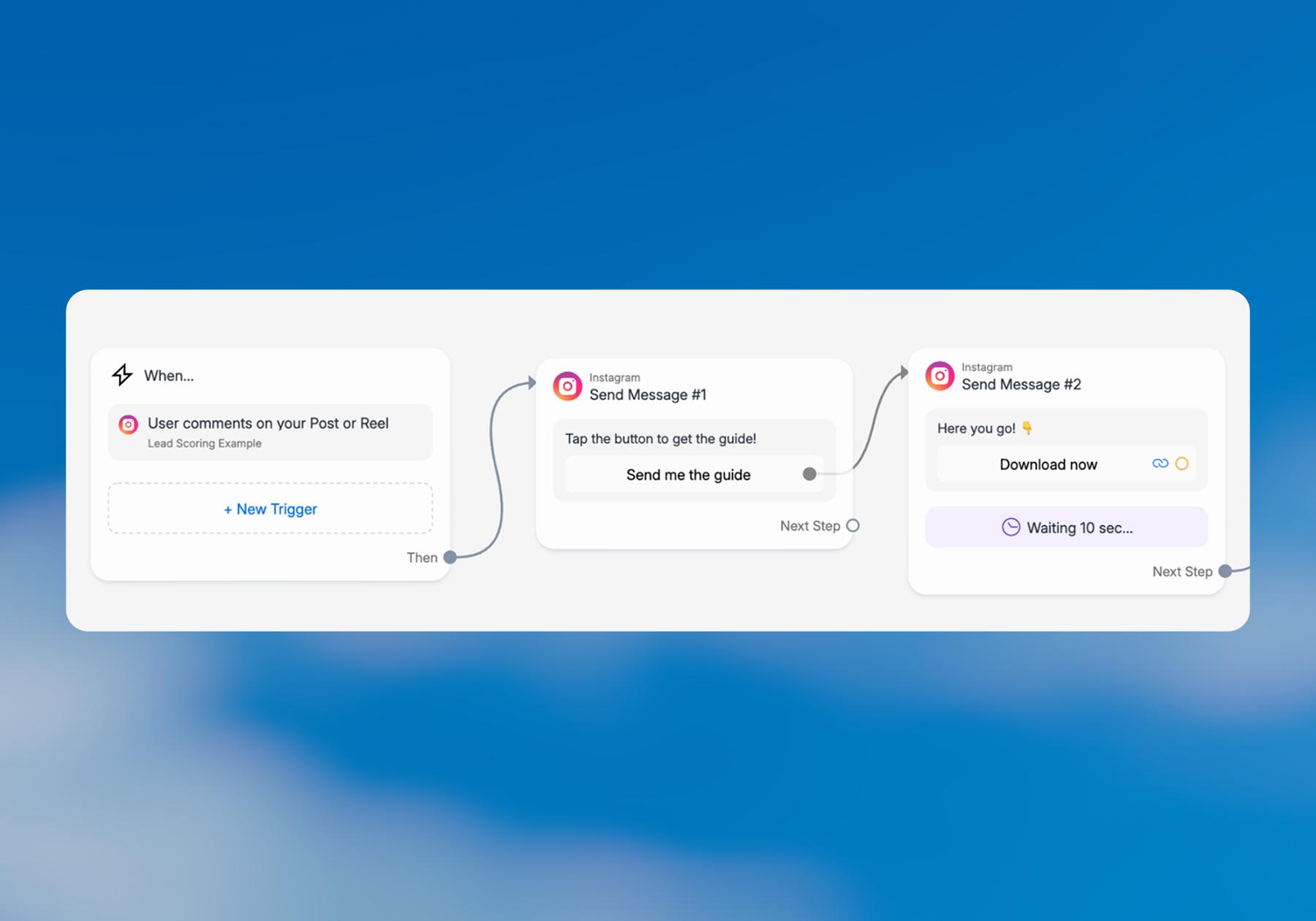
In our example, we've also added a short delay before continuing. This keeps the resource and the next question from arriving at the same time. The exact length is up to you; the delay is simply there to make the conversation feel more natural.
Now that you've delivered the freebie, you can start gathering signals to understand the lead better.
Step 2: Turn a response into a score
Our first question is: “Quick question: What is your motivation for growing your audience?”
We give people three ways to answer:
- Share what I love
- Grow my business
- Sell my products/services
These responses suggest different levels of commercial intent. But clicking a button doesn't automatically give someone a lead score. You need to tell Manychat what each response is worth.
First, create a Custom User Field to store the contact's score. From one of your response buttons, add an Action as the next step. Under Contact data, choose Set User Field.
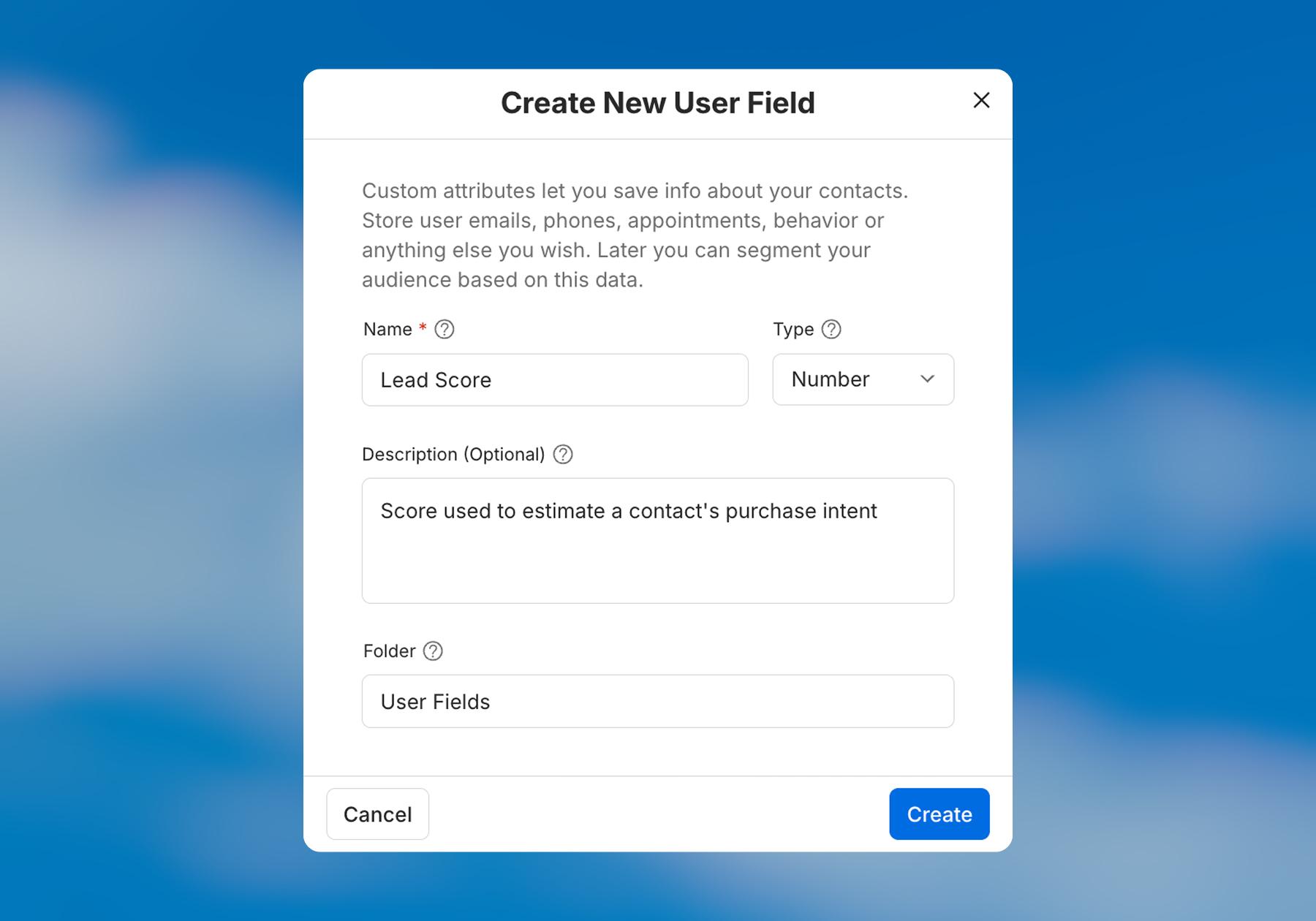
Create a new User Field called Lead Score and set its type to Number. Using a Number field is important because we'll add points to it over time.
Now decide how many points that response should add.
For this example, we're keeping the scoring intentionally simple:
Response | Points |
Share what I love | +1 |
Grow my business | +2 |
Sell my products/services | +3 |
For Share what I love, set the Action to increase the Lead Score by 1. Then repeat the process for the other two Quick Replies, increasing the same field by 2 or 3 points, respectively.
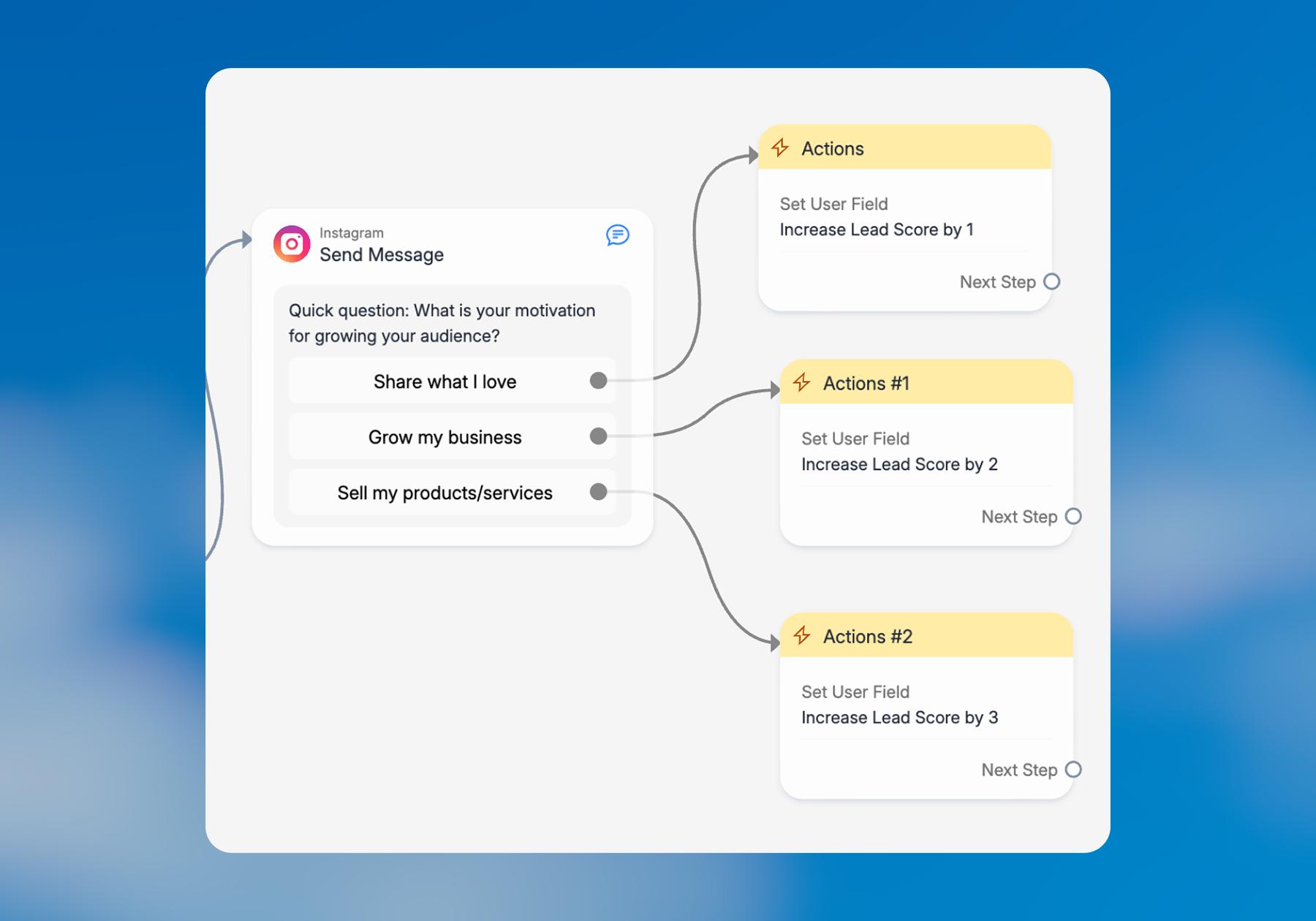
Your flow should now look something like the example above.
Note: We're telling Manychat to increase the Lead Score, not simply set it to 1, 2, or 3, because lead scoring is cumulative. If someone earns three points here and later takes another high-intent action worth five points, their Lead Score should become eight. If we simply set the field to five, we'd erase the three points they'd already earned.
You don't have to score only answers to questions. Once you've got the basic system working, you can add points for other signals that matter to your business — such as showing interest in a particular offer, requesting pricing information, or taking another action that suggests they're getting closer to buying.
Step 3: Decide what to do with the score
Collecting points is only useful if the score eventually changes what happens next.
Once you've built up a contact's Lead Score, you can use it to decide how to treat that lead. For example, you might decide:
- 1 to 3 points: Early interest; keep sharing useful content and resources.
- 4 to 6 points: Warmer lead; introduce your course or another relevant offer.
- 7+ points: High-intent lead; direct them toward a sales page, consultation, or another conversion-focused next step.
Those ranges are just examples. What counts as a "high" score will depend on your business, your offer, and the actions you're scoring.
In Manychat, you can use a Condition to check someone's Lead Score and send them down a different path based on the result. For example, once a contact meets your high-intent threshold, you could automatically show them a message about your course. Someone with a lower score could continue receiving educational content instead.
Should You Build a Lead Scoring System in Manychat?

You certainly can. But not everyone needs to do that. If you're a creator or a small business, a lead qualification flow is easier to build than an elaborate lead-scoring system.
With lead qualification, you can keep the flow really simple:
- Ask users a question or two.
- Collect their answers.
- Guide them to the next logical step.
Once your chat volume and/or sales process outgrow that system, then it’s time to level up and start scoring leads instead.
Frequently asked questions
No. Manychat doesn't currently have a dedicated, built-in lead scoring feature that automatically assigns or calculates lead scores for you.
However, you can build your own lead scoring system using Manychat's existing automation tools. As shown in the example above, you can create a numeric Custom User Field for a contact's lead score, then use Actions to increase that score when someone gives a particular response or shows a signal of intent. You can then use Conditions to determine what happens based on their score.
So, think of it as DIY lead scoring rather than a native lead scoring tool: you define which signals matter, how many points they're worth, and what should happen when a contact reaches a particular score.
Yes. You can ask qualifying questions in an automation, store responses, and use Conditions or Tags to determine what happens next.
Depending on your setup, qualified prospects could receive a relevant offer, booking link, another automation, or a handoff to your team.
Yes. You could collect a prospect's information in a DM and then pass qualified leads and their information to the system your sales team already uses. Manychat integrates with CRM and marketing tools, and Zapier can connect Manychat with thousands of additional apps.
Manychat supports lead generation and qualification workflows across its messaging ecosystem, but the available features and workflows vary by channel.
The best approach is to build a qualification process around the channel you're actually using, rather than assuming every trigger or automation works the same way everywhere.
Yes, likely. Manychat’s free plan is more of a trial tier. But it depends on the workflow and your account. Check out the Manychat pricing page for more information on each plan.


Originally published: Sep 12, 2019, Updated: Sep 23, 2026
More stories worth reading
More content that's too good to miss