
The Instagram DMs are like the Wild West — one minute it’s tumbleweeds and the next, a full-on stampede, blowing up faster than you can say “one sec!”
With 90% of Instagram accounts following a business, the DMs are where conversations happen, deals are sealed, and loyalty is built. But with more than 400 million messages sent daily to businesses on the platform, keeping up manually is a losing game.
Your ongoing conversations with potential customers get buried between random emoji responses to your story — and while Instagram now lets you pin up to three chats to the top of your inbox, tracking who you’ve replied to and who’s still waiting is still its own full-time job.
That’s where Instagram AI auto-replies come in. This guide walks you through setting up auto-replies the native way (through Meta Business Suite), shows you what’s possible with more advanced tools, and hands you six ready-to-steal templates so you can go live today.
TL;DR
- An Instagram autoresponder automatically replies to DMs so followers aren’t left on read, no matter what time it is.
- You can set one up for free through Meta Business Suite, but native options are limited to a single generic message.
- For keyword-triggered replies, personalized flows, and lead capture, you need a tool like Manychat.
- We’ve included six copy-paste autoresponder templates you can put to work today.
How an Instagram Autoresponder Works

An Instagram autoresponder is an automated message that goes out the moment someone DMs your account — no manual trigger needed. You set it up once, and every new message gets an immediate reply, whether you’re asleep, on a content shoot, or just trying to eat lunch in peace.
An autoresponder is like a chatbot, but it typically only handles the first response, not a full conversation. Both Instagram and third-party tools like Manychat let you set an autoresponder up, though the depth of what you can do varies wildly depending on the tool (more on that soon).
Your DMs are a mess without an autoresponder
Product inquiries and customer support are the top reasons followers interact with a business through Instagram DMs. But they’re not willing to wait around — 90% of customers think an immediate response is a make-or-break moment when they’ve got a customer service question. For many of them, “immediate” means 10 minutes or less.
When you’re building your brand on Instagram, more followers equals more DMs. It’s a time-consuming process to personally respond to each one, especially when other activities — like filming, planning, and editing — take up hours of your week.
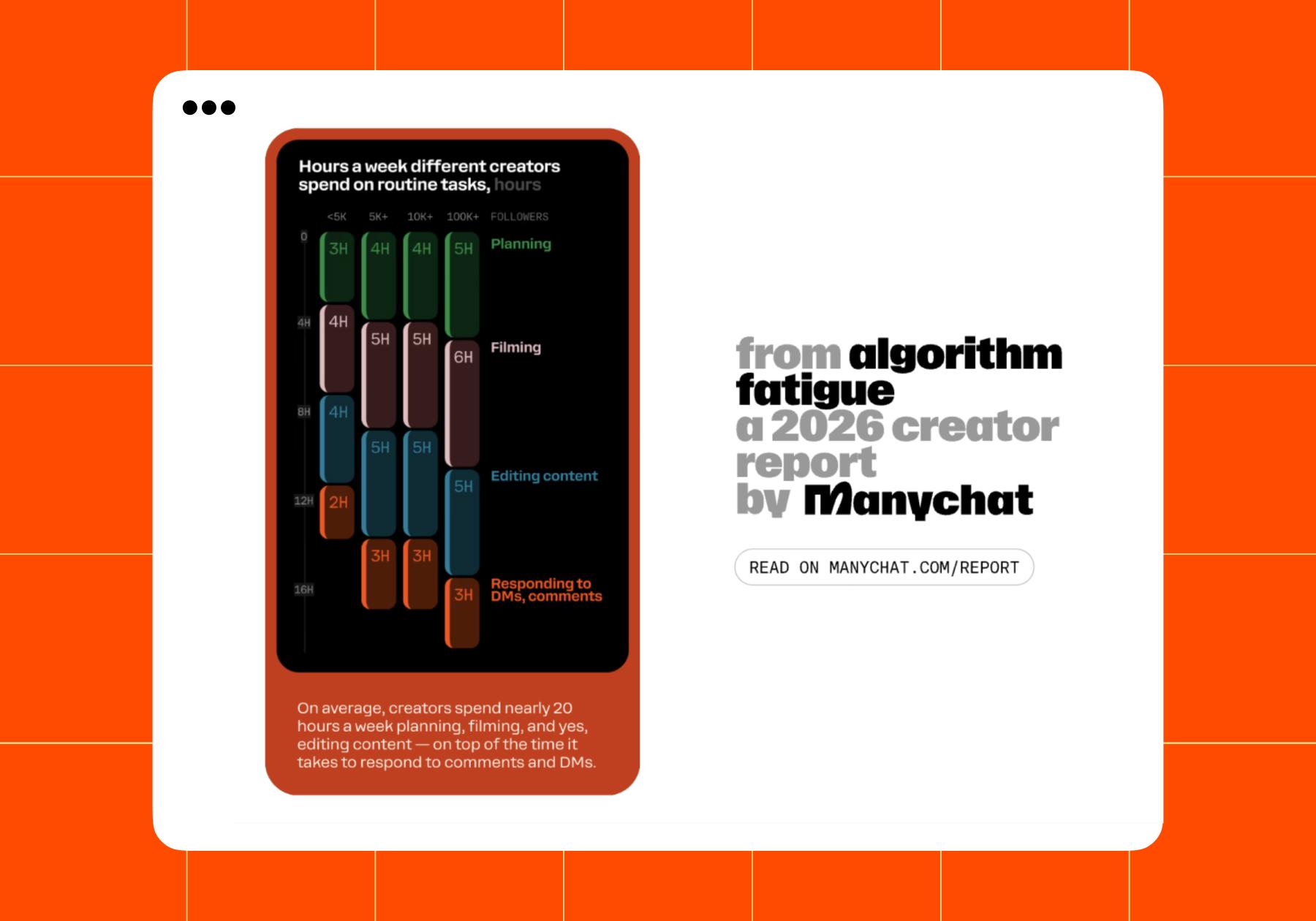
With auto-replies on Instagram, your business can:
- Point people toward your landing page. The DMs are the perfect place to promote your bestselling products or offers naturally. You can set up your Instagram autoresponder to point people there while they wait for a response from you personally.
- Answer FAQs. Limit the time you spend answering repetitive questions by covering them in your autoresponder. This could include shipping policies, product availability, or information about upcoming events.
- Provide followers with other contact methods. If your Instagram DMs are becoming too hard to control and you’d rather field questions through other communication channels, use your autoresponder to do so. You could say: “Thanks for your message! We don’t respond to DMs, so please email [x] to get in touch with our team.”
The Native Route: Auto-Replies via Meta Business Suite

Ready to start giving people who DM your business’s Instagram account an immediate, automatic response? Here’s how to configure auto-replies on Instagram using Meta’s built-in tools.
Switch to a professional account
Only Instagram users with a professional account (business or creator) can connect their profile with Meta Business Suite — the tool that powers autoresponders across both Instagram and Facebook.
If you haven’t already, switch to a professional Instagram account:
- Open your Instagram app and go to your profile.
- Tap the hamburger icon in the top-right corner.
- Open Settings and select Account type and tools (under “For professionals”).
- Tap Switch to professional account.
- Choose a Business or Creator profile. (Either works with autoresponders.)
Connect Instagram to Meta Business Suite
Next, go to Meta Business Suite and link your Instagram account:
- Go to your Instagram profile and tap the hamburger icon in the top-right corner.
- Go to Settings and select Account.
- Choose Sharing to other apps.
- Select Facebook and enter your login information.
- Head back to your Instagram settings and select Privacy.
- Tap Messages.
- Toggle the Allow access to messages button to On.
Turn on your autoresponder
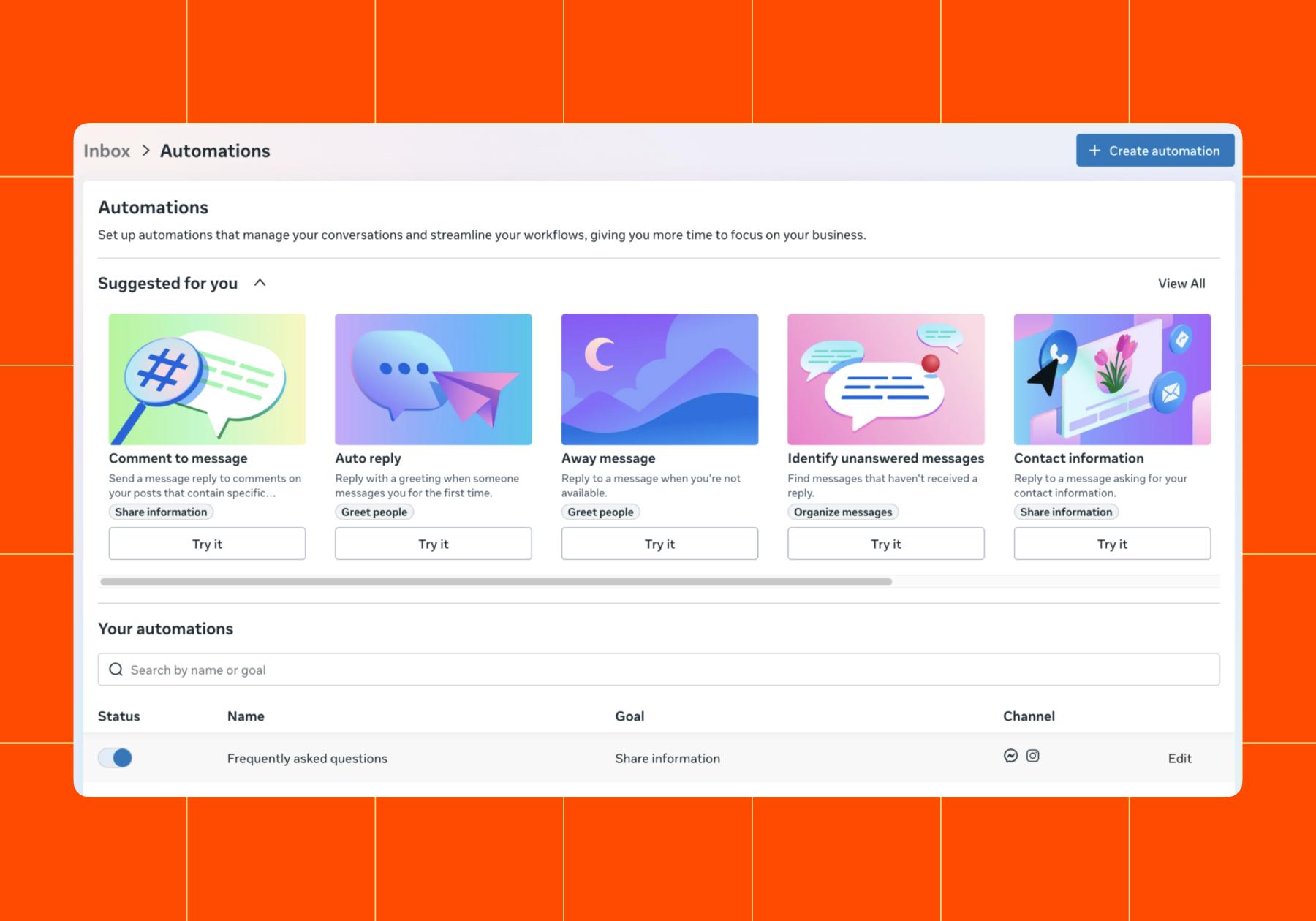
Now that your Instagram account is linked with Meta Business Suite, you can turn on autoresponders for anyone who sends a DM to your account. The current Meta Business Suite interface uses an “Automations” system with templates. Here’s how to set up an instant reply automation:
- Open Meta Business Suite and click Inbox in the left-hand column.
- Click the Automations icon.
- Click + Create automation and select the Auto reply template.
- Under Channel, check the box for Instagram.
- Write your automated response under Take this action.
- Toggle the switch to On.
- Click Save changes.
6 Instagram Autoresponder Templates You Can Steal
Auto-reply lets you send a single message to everyone. The standard option looks something like this:
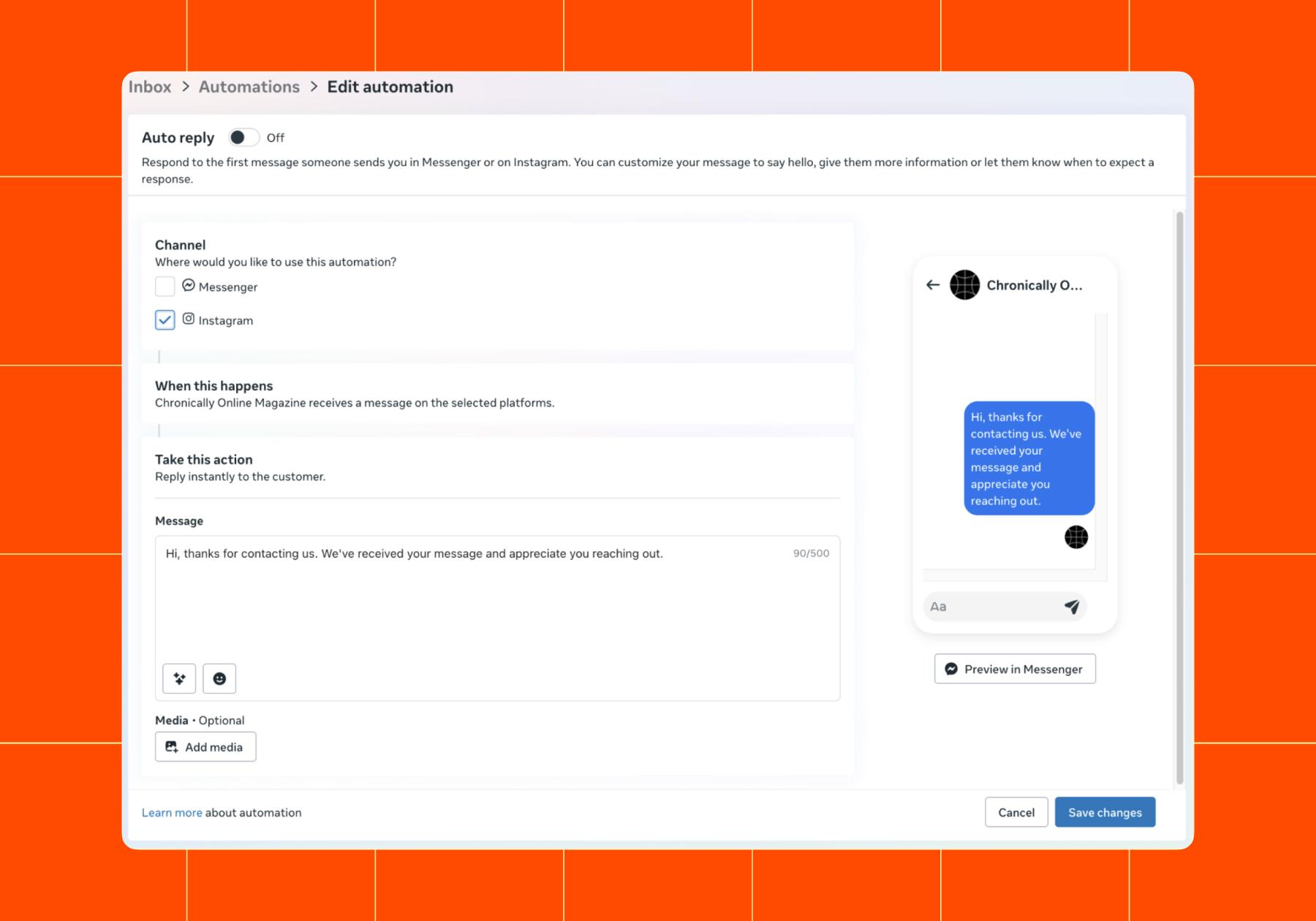
However, you can and should customize your opening message. And to help you do so, here are six Instagram autoresponder templates you can copy, paste, and customize.
- General welcome: “Hey! Thanks for reaching out. We usually reply within a couple of hours, but in the meantime — feel free to check out [link].”
Use this as your default instant reply to acknowledge every new DM. - After-hours/away message: “We’re currently offline (beauty sleep is real), but we’ll get back to you first thing tomorrow morning. If it’s urgent, shoot us an email at [email address].”
This is perfect for nights, weekends, or holidays when your team isn’t monitoring the inbox. - Product inquiry redirect: “Great question! You can browse our full catalog and check availability here: [link]. If you need help picking the right one, just reply, and we’ll jump in when we’re back online.”
A good option when most of your DMs are some variation of “Do you have this in stock?” - FAQ deflection: “Thanks for your message! We’ve answered the most commonly asked questions right here: [link to FAQ page]. If yours isn’t covered, sit tight, and we’ll reply shortly.”
Use this to save your team from having to answer the same five questions 50 times a day. - Lead capture prompt: “Hey, thanks for the DM! Want us to send you our free [guide/checklist/discount code]? Just reply with your email, and we’ll drop it in your inbox.”
This one’s a goldmine for building your email list. - Event or launch announcement: “You caught us at the perfect time — [event/product name] drops on [date]! Sign up for our newsletter to ensure you’re first to know.”
How to write automated messages like a human
Templates are a starting point, but the best automated messages feel like you wrote them. Here’s how to make yours land:
- Personalize where you can. Nothing gives people the ick like a “Hello, valued customer.” Meta Business Suite lets you insert the person’s first name as a variable in your automated response, so use that feature to add a personal touch.
- Acknowledge their message first. Before you redirect, inform, or ask for anything, let them know you’ve read their message. A simple “Got your message!” goes a long way.
- Set a clear response time expectation. Nothing’s worse than “We’ll get back to you soon.” Be specific: “Our team usually replies within two hours during business hours (9 a.m. to 6 p.m. ET).” This helps manage expectations and reduces “Hello??” follow-up DMs.
- Keep your brand voice intact. If your Instagram feed is playful and casual, your autoresponder shouldn’t suddenly sound like a legal disclaimer. Match the energy. For example, a skincare brand might write “Your skin called, and we’re picking up! Give us a few hours to get back to you.” instead of “Thank you for contacting us. A representative will respond shortly.”
- Include a clear next step. Every autoresponder should give the person something to do while they wait: browse a product page, check your FAQ, reply with a keyword, or visit your website. Dead-end messages (“Thanks, we’ll be in touch!”) are practically pointless.
Auto-replies vs. the real deal
Meta Business Suite’s autoresponder is free and functional, but it has limits. Here’s how it stacks up against what a dedicated automation tool like Manychat can do.
Feature | Meta Business Suite | Manychat |
|---|---|---|
Auto-reply variations | One message for all DMs | Unlimited, based on triggers |
Keyword triggers | Limited (desktop only, up to five keywords per automation) | Advanced keyword and phrase matching |
Personalization | Basic (first name variable) | Dynamic fields, conditional logic |
Lead capture | No | Email, phone, custom fields |
Comment automation | Basic comment-to-message templates | Full comment-to-DM flows |
Cross-channel support | Facebook, Instagram, WhatsApp | Instagram, Facebook, WhatsApp, TikTok, Telegram |
AI-powered replies | No | AI Replies with context awareness |
Analytics | Basic message metrics | Detailed flow and conversion tracking |
If you’re just getting started and your DM volume is low, Meta’s features work fine. But the moment you’re fielding more than a handful of messages a day (or you want your autoresponder to actually do something beyond saying thanks), you’ll feel the limitations fast.
Learn more about Manychat for Instagram
When to Automate (and When to Show Up)

Autoresponders are incredible, but they’re not a replacement for you. Knowing when to let automation handle things and when to jump in personally is what separates a great automation strategy from one that feels cold.
- Let the autoresponder handle it when you’re dealing with after-hours messages, high-volume periods (post-launch or giveaway chaos), repetitive FAQ-style questions, or initial greetings that just need a quick acknowledgment. These are the moments where speed matters more than nuance, and a well-written auto-reply does the job perfectly.
- Show up personally when someone has a complaint, a sensitive issue, or a complex question that doesn’t fit neatly into a template. Also, high-intent prospects — the ones asking detailed questions about your offerings or negotiating a partnership — deserve a real response.
The sweet spot is using your autoresponder as the first touchpoint that buys you time, then following up with a personal reply when the situation calls for it. Think of it as a tag team — automation handles the opening; you do the closing yourself.
Related: To Automate or Not? Here’s How to Respond to Comments on Instagram
Frequently asked questions
An Instagram autoresponder is an automated message that’s sent instantly to anyone who DMs your account. You set it up once, and it fires every time a new conversation starts, keeping your followers from staring at a blank chat while they wait for you to notice.
Quick replies are saved message shortcuts you manually insert into a conversation — you still have to be there, open the chat, and tap the shortcut yourself. Auto-replies fire automatically the moment someone sends you a DM, without any action on your end.
With Instagram’s native options, no. But with a third-party tool like Manychat, you can use keyword triggers to send different responses based on what someone actually asks. So, someone DMing “pricing” gets your rate info, while someone DMing “hours” gets your schedule.
Instagram’s native settings include a basic AI auto-reply feature for creator accounts, but it’s limited in scope. For more robust AI-powered DM responses — ones that recognize intent, handle multiple languages, and adapt to how people actually phrase things — you’ll want a tool like Manychat.
No, as long as you’re using an approved tool. Meta Business Suite’s options are safe, as is Manychat (we’re an official Meta Business Partner). Both options work within Instagram’s API, so you’re not doing anything the platform doesn’t explicitly allow.


Originally published: Apr 18, 2022, Updated: Jun 23, 2026
More stories worth reading
More content that's too good to miss