Instagram Keywords 101: How to Use Automation to Drive Engagement, Leads, and Sales

Want to turn lurkers into leads? Comments into conversions? Random DMs into personalized product recommendations?
One of the best ways to do that is with keyword-triggered automations.
These words and phrases look simple on the surface — “help,” “join,” “discount,” — but when paired with the right flows, they become powerful tools for capturing leads, answering FAQs, recommending products, and driving sales around the clock.
More importantly, though, they work. Manychat users who leverage Instagram Keywords see a 99% faster response time and up to a 40% boost in engagement, all without lifting a finger after setting up.
Sounds great, right? So, let’s get into it.
First Things First: What Are Keywords?

Keywords are specific words or phrases that kick off an automated conversation inside Manychat. Think of them as triggers: When someone sends a message with a pre-defined keyword (like “support,” “hours,” or “promo”), Manychat instantly starts the conversation flow you’ve connected to that keyword.
Here’s how it works.
Let’s say you run a skincare brand and promote a new product launch on Instagram. In your Story, you share a video of the new moisturizer and add the caption: “DM us the word ‘GLOW’ for an exclusive discount 🌟.”
A follower sends you the word “glow” in a DM, and Manychat immediately responds with a unique discount code and prompts the user to shop the product. Congratulations, you’ve just turned a Story viewer into a potential customer with minimal effort.
In short? Keywords are the entry points to your automated experience on Instagram (or Messenger, WhatsApp, etc.). They help you meet your audience where they are — scrolling, watching, and ready to engage.
5 Examples of Instagram Keywords in Action

Keywords and the automated flows they trigger offer a direct line to better engagement, faster support, and more conversions. Let’s discuss several ways you can put them to use.
1. Level up your customer support (and save time while you’re at it)
If your followers regularly message you about things like your return policy, store hours, or what’s in stock, you can set those phrases up as Keywords and provide quick answers or guide users to a live chat agent. This gives customers instant support and frees up your time — no more answering the same questions repeatedly.
💬Example: A customer types “help” into your DMs, and your automation responds with quick links to track orders, return items, or chat with a support agent.
2. Offer freebies (and capture contact information in return)
Another common use for Keywords is to automate the delivery of lead magnets like ebooks, checklists, or webinar invites. Not only do you give users instant value, but you can also collect their contact info in the process (if you’re doing it right).
💬Example: You craft a Story CTA that says, “DM us ‘ebook’ for your free Instagram growth guide.” When a user DMs you “ebook,” Manychat delivers the PDF and asks for their email address. Score!
3. Put promotions on autopilot
Running a flash sale or launching a new product? Keywords are perfect for sending promo codes or unlocking exclusive access without requiring manual follow-up.
💬Example: You post a Reel teasing your upcoming seasonal candle launch, with cozy fall vibes, behind-the-scenes footage, and a CTA in the caption: “Our Fall Fireside candle is almost here! DM us ‘FALL’ for early access and a secret discount.” Then, viewers message you “fall” and trigger a flow that gives them first access to the product, a promo code, and a link to shop before it goes live.
4. Get the right products in front of the right people
Keywords can act like your personal sales assistant, guiding people to the right offer without back-and-forth DMs or a clunky link-in-bio menu. Instead of sending people to a general landing page and hoping they find what they need, you can use Keywords to start a conversation that feels specific and helpful instantly.
💬Example: Let’s say you’re an online business coach. You post a Reel breaking down the differences between your three most popular offerings: a self-paced mini course, a one-on-one strategy session, and a premium group coaching program.
In the caption, you write: “Not sure where to start? DM me the word ‘guide’ and I’ll help you find your perfect fit.” Then, a user DMs you the word “guide” and triggers a Manychat flow that asks a few quick questions to help them choose between the three offerings.
This creates a smoother buying experience and positions you as a creator who understands your audience’s needs and delivers value before they ever spend a dime.
5. Bonus: Use Default Reply to answer messages around the clock
Not every DM needs a full-blown flow, but every DM does deserve a response. Enter: Default Reply.
In Manychat, the Default reply acts as a catch-all. Instead of leaving someone hanging, you can acknowledge their message, set expectations, and guide them to the next best step.
It’s the perfect way to set expectations around response times, offer helpful links or fallback options, or nudge users to type a Keyword like “help” or “agent” to connect with a real person. It’s also just a great way to keep the conversation going, even after hours.
💬Example: Someone sends you a DM that doesn’t match any of your active Keywords, like “Hey, do you ship to Canada?” In place of a triggered flow, your Default Reply kicks in with a friendly auto-response: “Thanks for reaching out! A team member will get back to you soon. In the meantime, check out our FAQ here 👉 [link].”
How to Set Up Instagram Keywords in Manychat

Now that you understand the potential of Keywords, let’s talk about how to set them up. Getting started with Keywords in Manychat is simple, and once you’ve established some flows, they’ll run in the background 24/7, automating conversations and capturing leads for you.
Before you dive in, make sure you’ve got:
- A professional Instagram account (i.e., a business or creator account)
- A Manychat account (Free, Pro, or Elite, but you’ll be limited on the Free plan)
Once you’re ready to go, you can create Keywords in two places in Manychat:
- From Automation > Keywords in your dashboard
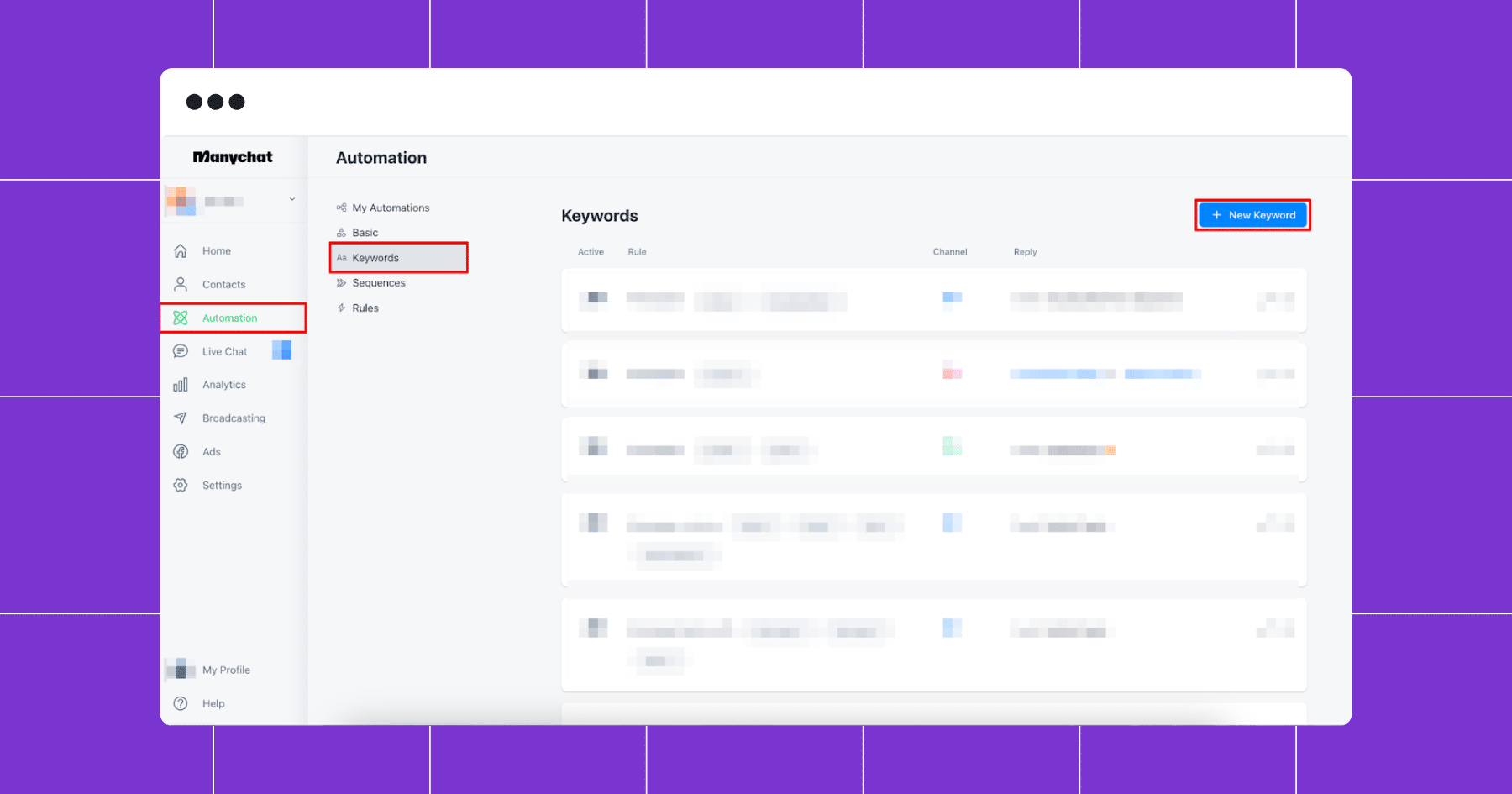
- Directly inside a flow using Flow Builder
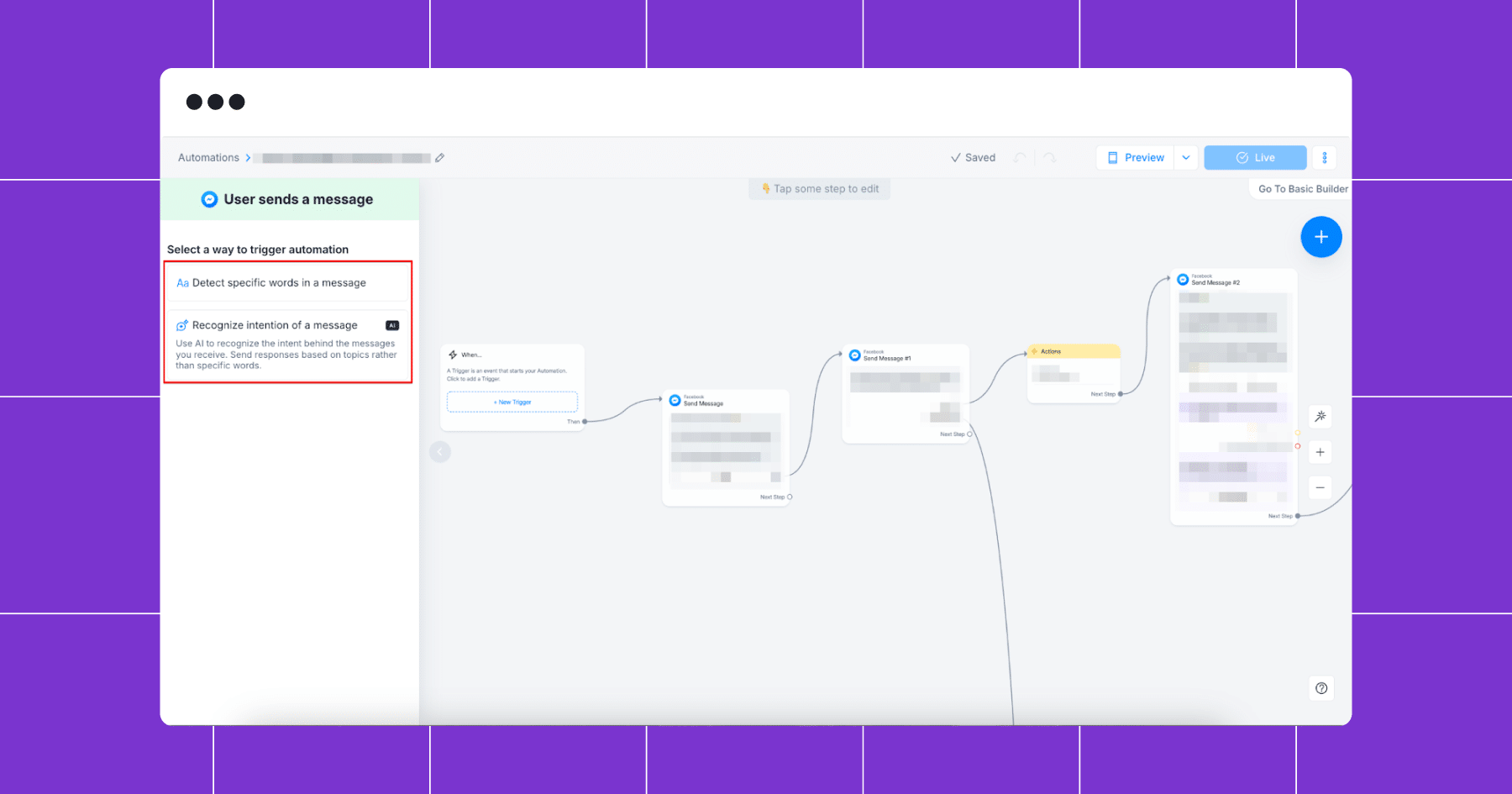
Both options let you add custom words or phrases, choose how they should behave (for example, whether they need to be an exact match or can appear anywhere in a sentence), and link them to an automation flow.
💡Tip: For detailed instructions on creating Keywords, choosing rules, managing limitations, and troubleshooting, check out our full walkthrough in the Help Center.
Best practices for effective Keyword campaigns
Anyone can set up a Keyword, but how about one that converts? That takes a little bit of strategic thinking. Here are our best tips:
- Keep ‘em short and easy to remember. Stick to one- or two-word phrases that are simple to type (and harder to mess up). The easier it is to remember your Keyword, the more likely people are to use it, especially if they see it in a fast-moving format like Stories or Reels.
- Choose words and phrases that are relevant to your offer. An obvious, but important rule: Your Keyword should clearly connect to whatever you’re promoting. So, if you’re offering a discount, use something like “discount” or “deal.” And as a general rule, avoid short, vague words like “hi” or “no,” as they can trigger automations in unintended ways.
- Account for common misspellings. Typos happen, especially on mobile. Add a few alternate versions of your Keyword to ensure misspelled entries still trigger your flow. For example, if your keyword is “summer,” it’s a good idea to include slight variations like “sumer” or “suummer.”
- Promote Keywords where people are most engaged. Stories, Reels, Lives, your Instagram bio, and click-to-Messenger ads are perfect places to drop a Keyword CTA. Just pair it with a clear call to action (like “DM us ‘START’ to join”) so there’s no confusion about what to do next.
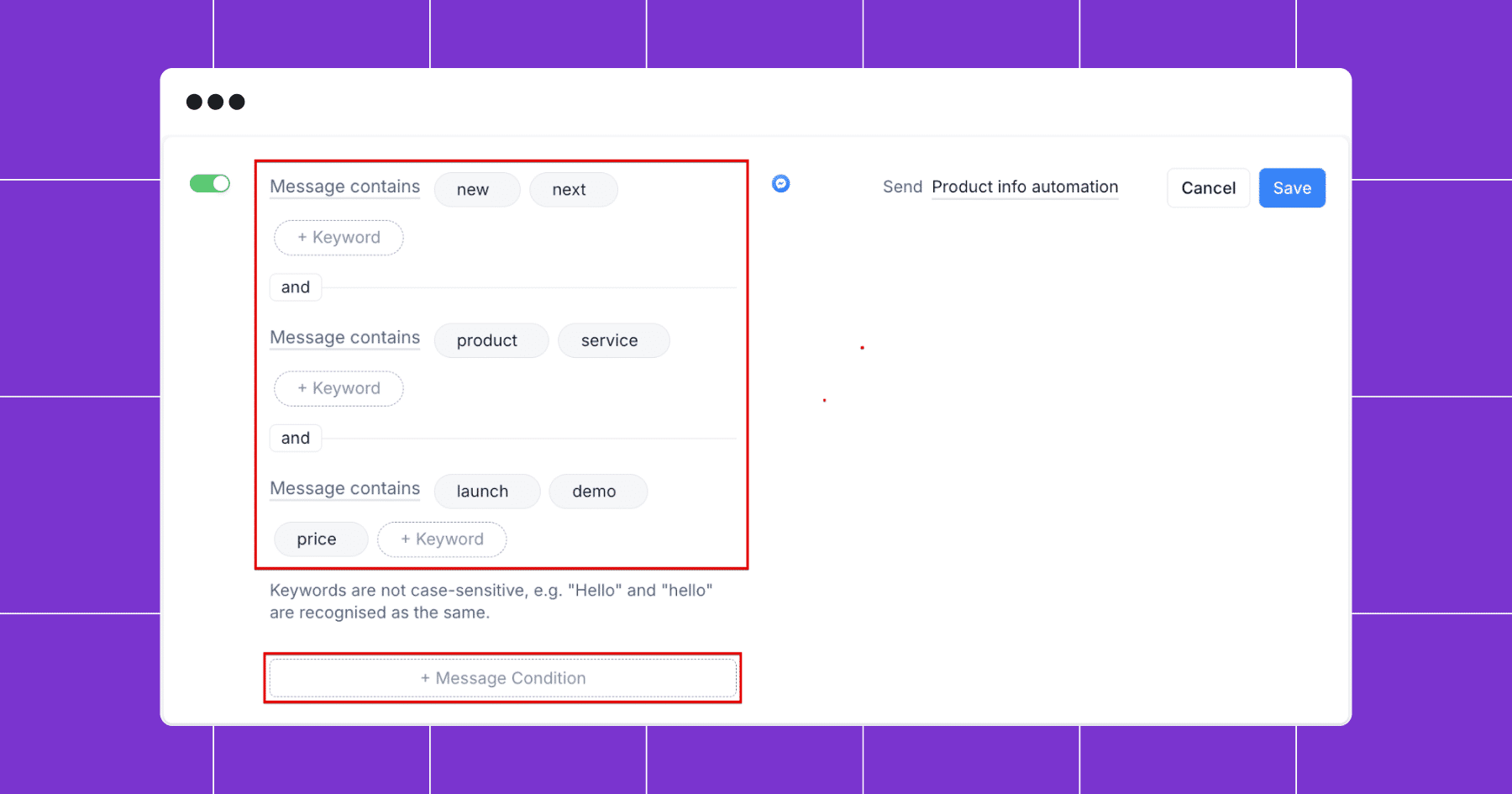
- Use the right Keyword rules. Not all Keyword triggers are created equal. If you want the automation to trigger only when someone types the exact word, use Message is ‘X’. If you want it to fire when the word appears anywhere in their message, go with Message contains ‘X.’
Bonus: Advanced Tips for Using Keywords

Keywords can do way more than just deliver content or discount codes. If you’re ready to take your automation game to the next level, here are a few tactics to try:
Route to Live Chat
We all love bots…right? 😅 Even so, sometimes people just want to talk to, well, a human. Luckily, there’s an easy way to give them what they want: Set up a Keyword like “human” or “talk to a person” that triggers the Notify Admin action, so your team gets a ping to jump into Live Chat and respond.
Run interactive quizzes using keyword flows
Want to turn your DMs into something more fun than a sales pitch? Use Keywords like “quiz,” “find my fit,” or “recommend” to launch into a flow that feels more like a conversation than a transaction. It’s a smart way to guide people to the right product or offer while keeping them entertained.
Caleb Johnstone, SEO Director at Paperstack, tried this tactic with a small outdoor gear brand. His team created a Messenger experience called Choose Your Next Adventure. Using a few lighthearted questions, the quiz matched users with gear based on their upcoming plans, like camping, hiking, or weekend trips.
“It was more of an entertaining quiz rather than a selling gadget, and that kept them around. People interacted with it, clicked to check out their suggested gear, and even came back later with questions.”
This automation allowed the brand to build trust and engagement, all while capturing valuable data.
“That’s my favorite thing about Manychat — it allows automating, but not in a way that feels automated,” Johnstone says.
If you want to turn a Keyword like “quiz” into something high-impact, consider pairing it with conditional logic and tags. You can segment users based on their responses and follow up with personalized recommendations, email flows, or retargeting campaigns that make sense.
Test variations to see what works (and what doesn’t)
Sometimes, a tiny wording change can make a significant impact. That said, it’s worth A/B testing different variations of a Keyword across your campaigns to see which drives the most engagement or conversions.
For example, if you’re promoting a live webinar, you can try testing different Keywords like “webinar,” “live,” “signup,” “spot,” or “save my seat” to see which one gets the best engagement. Each option taps into a slightly different motivation (urgency, exclusivity, or clarity), which can influence how people respond.
Once your campaign is live, use Manychat’s analytics tools to track:
- Flow entry rates (how many people triggered the Keyword).
- Conversion goals (like link clicks, button taps, or email captures).
- Drop-off points (where people disengage from the flow).
💡Tip: If you’re running the same campaign across multiple channels (like Stories and Reels), assign different Keywords to each entry point. That way, you can pinpoint which source brought in the most leads — and double down on what’s working.
Over time, you’ll build data around what types of language your audience responds to best, which can improve not just your automations but also your broader content and campaign strategy.
Say the Magic Word(s)

To reiterate: Keywords are one of the most powerful ways to bring automation to life across Instagram. With just a word or two, you can spark conversations, deliver instant value, and guide followers exactly where they need to go.
TL;DR: Let Keyword-triggered automations do the heavy lifting so you don’t have to.
Want to go even deeper? Check out this video to level up your automation game: How to Send Automatic Messages on Instagram Comments using Manychat!
✋ Frequently Asked Questions (FAQs)
1. How do I know if a Keyword is working?
Check your flow stats: Are people clicking links? Giving you their email? Buying? If not, it’s time to tweak the message, offer, or timing. A great Keyword flow feels like a helpful guide, not a dead-end reply. If you suspect a keyword is not working, check out our guide to troubleshooting on the Help Center.
2. Do I need a different Keyword for every campaign?
Not always, but it does help with clarity and tracking. Instead of using “freebie” for everything, try using campaign-specific Keywords like “ebook,” “quiz,” or “earlybird.” That way, you can see exactly which entry point brought the lead in, and double down on what’s working.
3. Can I make automations feel more like me and less like a robot?
Yes, and you should. The trick is in your tone and pacing. Use emojis, short sentences, voice notes, or fun buttons. Add “human-friendly” touches like, “Hey 👋 real human here if you need me!” to your Default Reply.
4. Why do people sometimes drop off mid-flow?
Usually, the flow is too long, too salesy, or too generic. Instead, ask one simple question early on (like “Looking for X or Y?”), then guide based on their choice. The more your flow feels like a convo (not a pitch), the more likely people will stick around.
5. Should I set up Keywords before or after I launch a campaign?
Before. Always. If someone sees your Story and messages “discount” but the Keyword isn’t live yet, that’s a missed lead.
6. I’m just getting started — how many Keywords should I use?
Start with three to five high-impact flows:
- One for support (“help”).
- One for a freebie/lead magnet (“free”).
- One for your main offer or product (“shop” or “discount”).
- One fun/interactive one like “quiz”.
- A catch-all Default Reply to handle everything else.
You can expand later based on what your audience responds to.


Originally published: Sep 23, 2025, Updated: Dec 17, 2025
More stories worth reading
More content that's too good to miss