Impossible to Scroll Away: 30 Creators, One Uncomfortable Truth
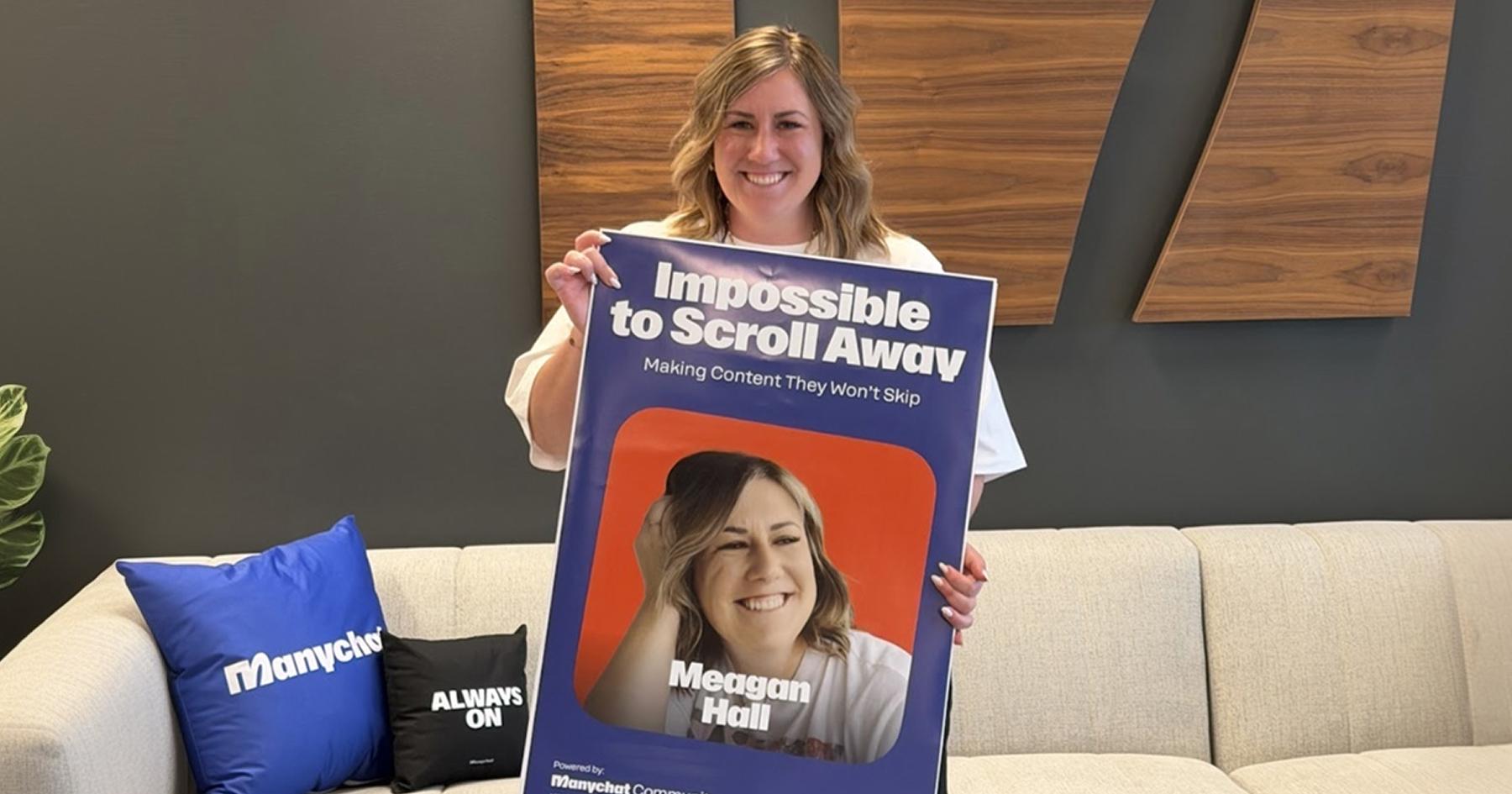
Austin, Texas. 4 p.m. Manychat office.
“Impossible to Scroll Away,” a Manychat Community IRL pilot, was an experiment designed to answer one very specific, very painful question: why are you posting content that people like… but don’t act on?
And for three hours, nobody pretended that likes were the goal. Because they’re not.
The Room: Not Total Beginners
Attendees weren’t absolute newbies.
These were creators who have a grip on what they’re doing and who their audience is:
- Running Instagram and usually also TikTok
- Repurposing into YouTube Shorts
- Flirting with long-form YouTube but not committing
- Posting consistently enough to be tired of posting
Exactly the type of creator who’s dangerous, because they’re close.
Close to growth. Close to monetization. Close to figuring it out.
And stuck.
Some had been at it for six months. Others for three years. Different timelines, same energy: “I feel like I should be further along than this.”
The Lie Everyone Walked in Believing
At 4:05 p.m., Meagan Hall steps on stage. If you don’t know Meagan, she’s built a multi-million dollar business off organic content, scaled a massive audience, and made her name teaching creators how to actually make money from what they post, not just grow for the sake of growing.
She immediately removed everyone’s favorite excuse. “Most of you don’t have a growth problem. You have a sales problem.”
You could feel people mentally resisting it.
Because “growth problem” is comforting. It means:
- Post more
- Try harder
- Wait longer
- Stay consistent
It keeps the blame external. Algorithm. Timing. Reach.
A sales problem? That lands differently. Something you’re doing isn’t converting. Something about your content is missing the moment when a person decides to act.
And that’s harder to ignore.
“This is so helpful!” (and other useless compliments)
Hands went up when she asked: “Who’s posted something they were proud of… and it got no views?”
“Who’s gotten ‘this is so helpful!’ in their comments… and zero sales?”
Almost everyone.
You can build an audience that loves you and still make no money.
Education gets applause. Activating gets action. And most creators are addicted to applause.
It feels good. It looks good. It performs just enough to keep you going.
But it doesn’t convert.
You might be saying things like:
- “3 tips for better content”
- “How to stay consistent”
- “Meal prep ideas for busy people”
Which sounds fine. Until you realize no one thinks of themselves as “busy people.” They think: “I’m spending every night catching up on my work and still…”
That’s the difference.
Talking about your topic educates. Talking to a human activates. And that gap is where money dies.
“Put your past self, and that pain, into words a 12-year-old can understand,” Meagan said.
No jargon. No “optimize,” “leverage,” or “transform.” Keep the focus on: what did it actually feel like?
The Hooks Workshop
Then came the hands-on part. Small groups. Notebooks out. People rewriting their own hooks.
- Instead of: “Tips for beginner designers”
- It became: “If you’ve done 10 ‘free projects for exposure’ and still don’t have paying clients, here’s what’s actually going wrong.”
- Instead of: “How to stay consistent with content”
- It became: “If you keep disappearing from your account every 2 weeks because you’re overwhelmed and out of ideas, this will fix it.”
- Instead of: “Tips for new moms trying to stay organized”
- It became: “If you just had a baby and your house feels like it’s falling apart, try this”
Once you see the difference, you can’t unsee it. You start realizing half the content on your feed is saying nothing to no one. It’s content for “people.” Not content for someone.
Be specific enough that the right person feels called out in the first two seconds.
Of course, specificity is always riskier. It means some people won’t relate. Some people will scroll. Some people will opt out.
But the right person will act.
Every piece of content needs a job. Not vibes. Not aesthetics. Not “value.” A job.
Click. Comment. Buy. Follow. Reply. Repeat.
The Identity Crisis
Between exercises, the real conversations started happening.
“I feel stuck in my niche.”
“I want to pivot, but I don’t want to lose people.”
“I don’t even know what my content pillars are.”
Creators don’t just struggle with growth. They struggle with identity.
You build an audience for one thing. You evolve into something else. Now your content feels like a betrayal… either to them or to yourself.
And the fear is simple: “If I change, will anyone stay?” or “What if I’m only successful at the version of me I’ve already outgrown?”
So instead, people start doing weird half-measures:
- They “soft pivot”
- They test new content but bury it between safe posts
- They try to please both audiences and end up connecting with neither
You can’t build a business on content if you don’t know what you stand for. And you can’t evolve your content if you’re still trying to protect an outdated version of yourself.
The room didn’t solve this in one session. That’s not how identity works.
But it’s progress.
The Filming Block
At 6 p.m., theory turned into reality. And suddenly, everyone had to do the thing they’d been overthinking: Hit record.
One shot. Five minutes. Move on.
People had scripts. Half-scripts. Notes app bullets. Some had nothing but a vague idea and adrenaline.
There was some hesitation. But then something interesting happened; they did it anyway.
Constraints force clarity.
You don’t have time to spiral or to second-guess every word. You just… say it.
And most of the time? That version is better.
What People Actually Left With
Not just frameworks. Not just notes. Something more valuable: awareness.
That:
- Their content wasn’t bad, it just wasn’t specific
- Their audience wasn’t wrong; they just weren’t being activated
- Their growth wasn’t stalled; they just weren’t converting
Hooks are just the surface. Messaging is the engine. Sales happen when someone feels seen, not impressed
And more importantly, they realized how much they’d been hiding behind “good content.”
Because “good” is safe.
“Good” gets likes.
“Good” gets “this is helpful.”
“Good” keeps you in the game without forcing you to actually sell something.
But “good” doesn’t make people move. Specific does. Honest does. A little uncomfortable does.
Sales happen when someone watches your content and thinks: “Wait… this is exactly what I’ve been dealing with.”
That moment right there is what everything is building toward.
The Aftermath
Can you take creators out of their usual environment, give them the right framework, force them to confront what’s not working, and get them to actually create something better on the spot?
Yes.
If this series scales, and it will, and not just because of the tacos (though they helped), it’s because the model works:
- Small group
- High honesty
- Real execution
- Immediate output
Most creator education lives in theory. Watch this. Learn that. Save this post. Come back later.
This was the opposite.
Want more?
Nobody is out here making money by cracking the algorithm. They’re making money because when the right person finds their content, it feels like it was written specifically for them.
Like someone reached through the screen and said exactly the thing they’ve been thinking, but couldn’t articulate.
Are you going to keep posting content that looks good, or start making content that actually moves people?
That’s the part no one can answer for you.
But after this event? At least 30 creators are a lot closer to getting it right.
Want to keep up with our events? Join the Manychat Community!


Originally published: Apr 30, 2026, Updated: Apr 30, 2026
More stories worth reading
More content that's too good to miss