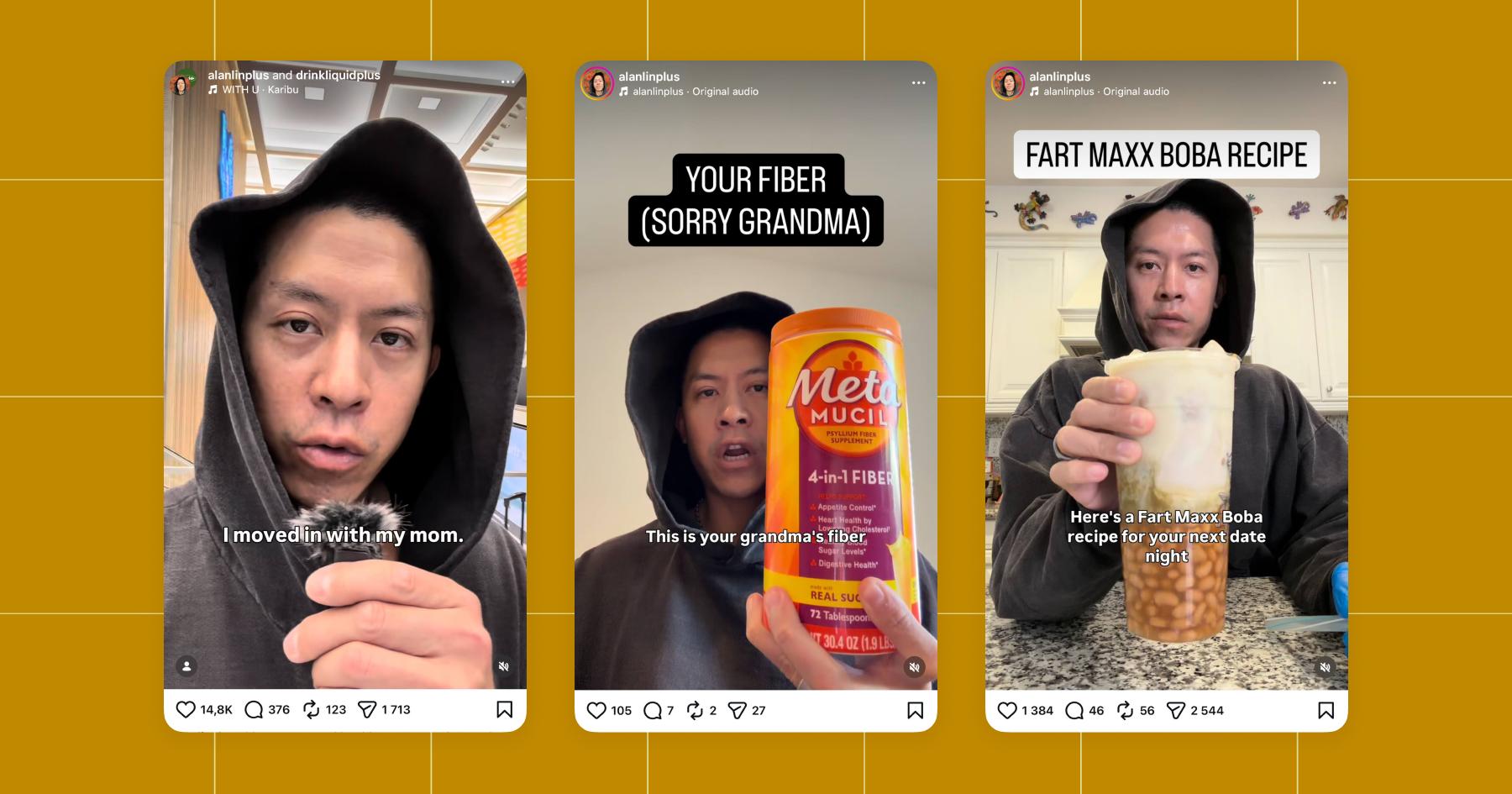
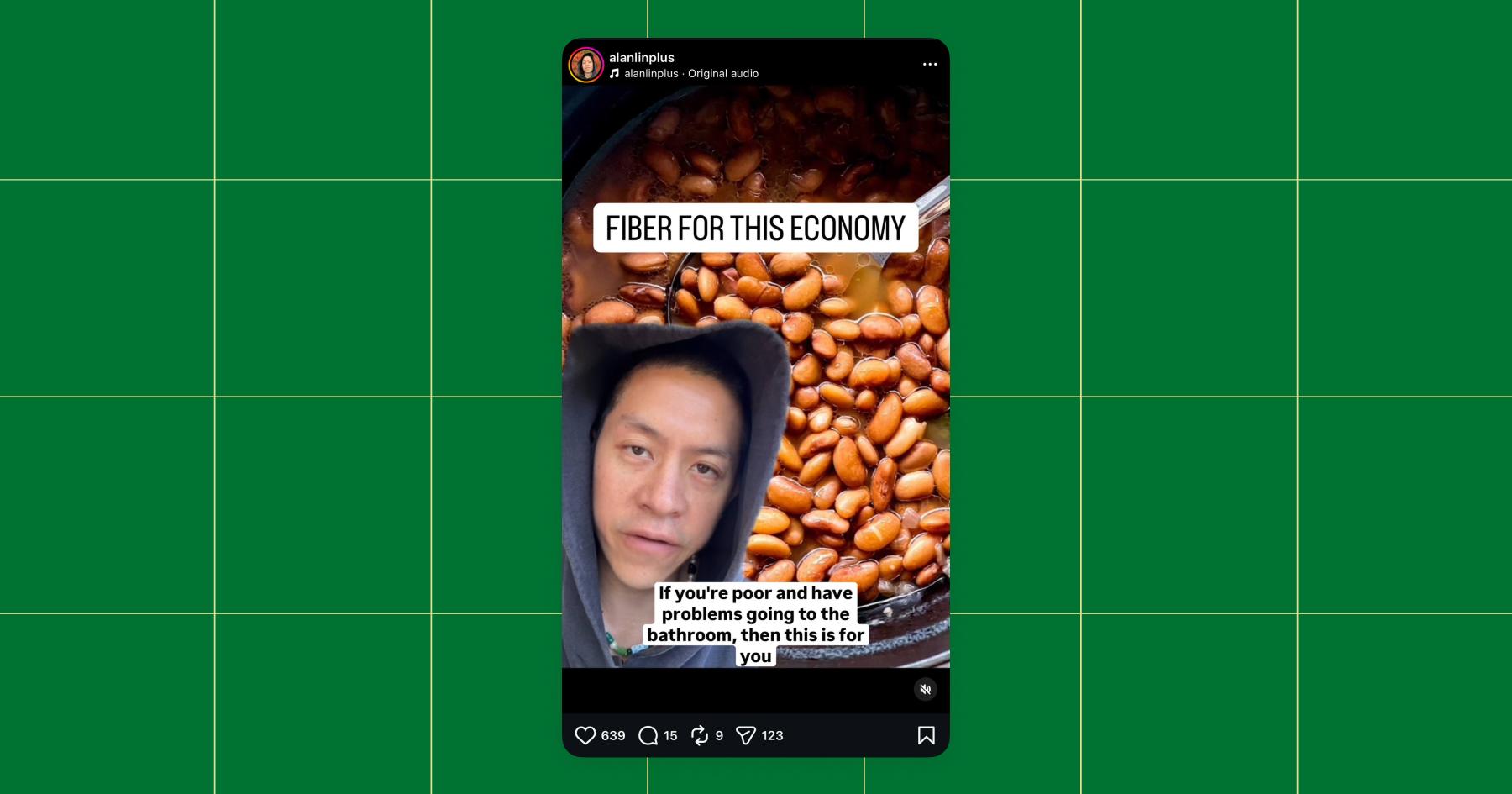
I just watched a guy whose content is about Fart Maxxing on Instagram. His entire platform is built around gut health and demonstrating, in real time, how to smoke out a room based on a gnarly diet.
That’s it. That’s the content. 147k people (and counting) follow him for clean-colon theatrics. What a time to be alive.
But farting on video isn’t an anomaly. It’s the logical descendant of planking, owling, hamstering, the Harlem Shake — every trend that proved social media doesn’t reward meaning so much as novelty with velocity. Which raises a bigger question: will the platforms that win the next era really be the ones that optimize for reach, or for reciprocity?
Not “how many people saw this,” but “how many people actually talked back?”
Don’t Go Chasing Virality
Everyone is chasing reach and chasing numbers. Going after the sweet dopamine hit of going viral and finally breaking through the noise, even though most large accounts see regular engagement from <1% of their followers. And yet we complain about social media while compulsively refreshing it, a contradiction that’s easy to mock and harder to dismiss.
A comment that sparks a reply feels fundamentally different than a comment that vanishes into Satan’s algorithmic void. That hunger for engagement isn’t narcissism; it’s biological. People thirst for community. (That sentence felt weird, and I stand by it, you freaks.)
Back to the subject: We’re social animals by design. Anthropologist Robin Dunbar famously estimated that humans can meaningfully maintain about 150 relationships at a time, far fewer than any follower count suggests. The open question is whether social media is a shared public space or just a voyeuristic window into other people’s lives. (Silence, once again, you weirdos.)
Humans have always sought validation as a form of social proof of belonging. Social media didn’t invent that instinct — but industrialized it. It turned connection into a Henry Ford assembly line of scrollable thoughts that ask us to buy, follow, consume, and feel something, all at once. (Insert They Live gif here.)
The context is blurry by design. But that fuzzy tension might be the point. The dissatisfaction isn’t evidence that people want less connection; it’s evidence that they want a better connection than what they’re being served. As MIT professor Sherry Turkle has observed, “We expect more from technology and less from each other.”
What’s unsettling isn’t the existence of the algorithm, it’s the absence of emotional consent. At some point, the feed stopped feeling like a place we gather and started feeling like a blinking Las Vegas slot machine we’re locked into. It’s just content-content-content, and that’s probably doing something to the psyche that we’re not fully aware of, even though it’s likely a hot topic around the psychology conventions of the world.
It’s algorithm fatigue.
Conversations don’t disappear because people don’t want them; they disappear because they’re inefficient. They don’t scale. They don’t convert. And people can feel the difference between being seen and being processed.
Conversation as the Feature

This is what people are actually building toward. Not followers. Not reach. A space where showing up means something beyond being processed by the feed — conversation as the feature, not the bug.
Which helps explain what’s happening next. People aren’t bailing on social media; they’re shrinking it and moving from the town square to the group chat. From broadcast to DMs. From thousands of followers to 47 people who actually give a shit. This isn’t antisocial behavior; it’s self-preservation. A quiet rebellion that says, Dude, I’m sold enough. Tribe beats audience. Community beats clout. Rock beats scissors. The beat goes on.
For creators, scale has become the problem. The feed once promised you could maintain meaningful relationships with thousands of people. You can’t. The people who feel least lonely online aren’t the ones with the biggest audiences; they’re the ones who’ve built micro-communities:
- Discord servers
- Substack comment sections
- Close Friends stories
As sociologist Zeynep Tufekci has noted, “The problem isn’t that social media connects us too much, but that it connects us without giving us meaningful agency.”
Tipping the Scales of the Future
A DM now carries weight because it demands a human response, or a conscious decision not to respond. It’s inefficient. It doesn’t scale. It can’t be gamified the same way. That’s precisely why it works.
So what does social media look like five years from now? What’s the next evolution of Fart Maxxing? Probably something smaller. Less smelly. Less optimized for virality and more optimized for being felt. That may not be great for growth charts, but it might finally be suitable for people.
God only knows what trend is coming next. My guess is it’ll be weird as hell.
Originally published: Feb 24, 2026, Updated: Feb 24, 2026
More stories worth reading
More content that's too good to miss