West Hollywood, one day, no excuses.
Instagram Summit by Manychat (IGSxM) IRL took Instagram off your phone and into a room where people said the quiet parts out loud: attention is rented, conversations are owned; go deep, not wide; have a failure budget; stop stepping over dollars to pick up nickels.
If you wanted tactics heard on a Friday you can use on Monday, you were in the right hotel. We left with systems for DMs, frameworks for repeatable content, and a to-do list that doesn’t require selling your soul (or your audience’s trust).
If you were there, you left taller. If you weren’t, here’s everything you missed (and the perfect upcoming opportunity to heal your FOMO).
🚨That’s right — there’s still time to register for our virtual event, happening Oct. 22-23.
Morning: Caffeine, Badges, and a Hundred “Wait, I Follow You!” Moments
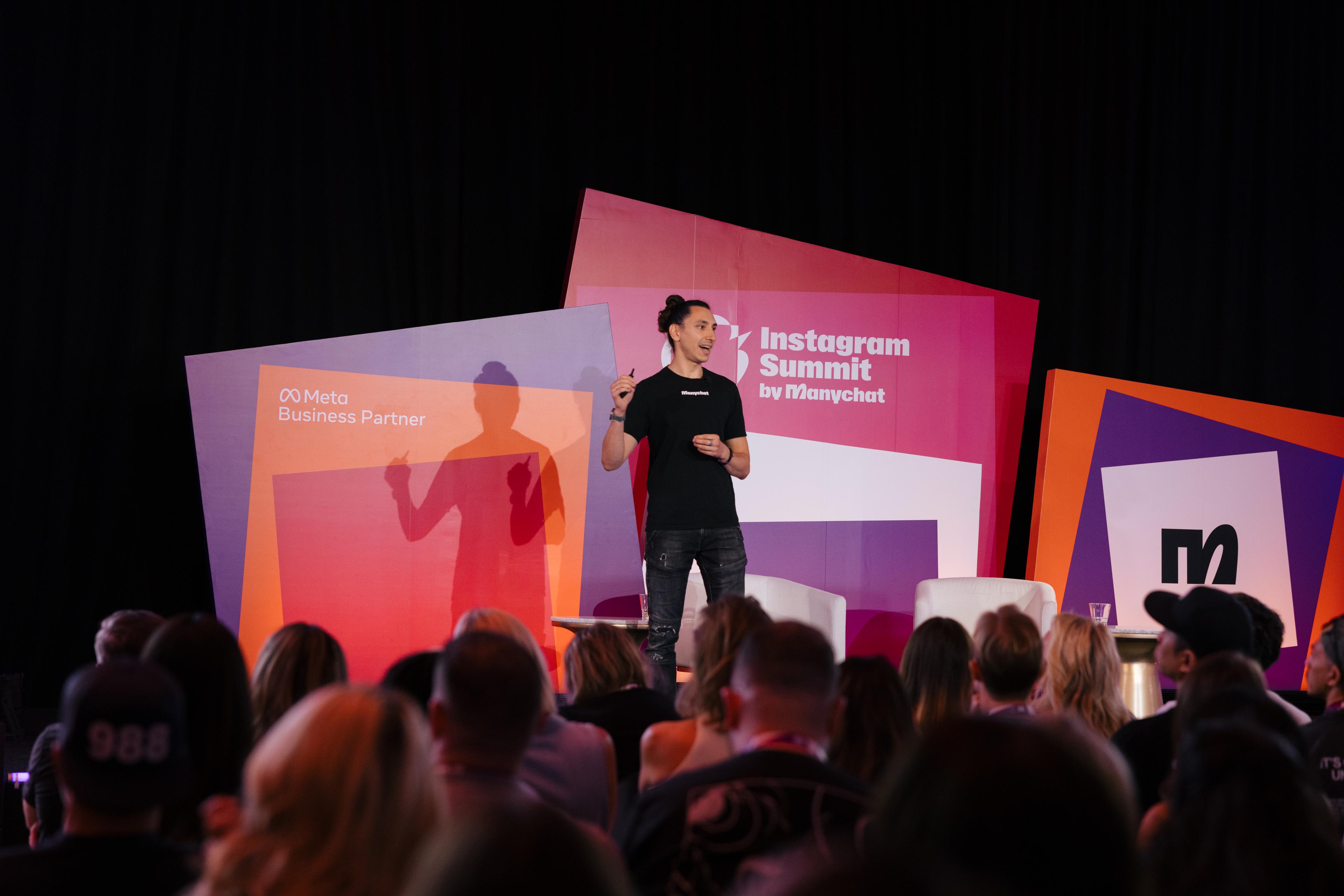
Breakfast hit first — shoutout to the people who balanced a yogurt parfait, a phone, and a mini-tripod like it was an Olympic event. Check-in ran all day (plus free Hulken bags and DIBS lipstick for the early birds), and the sponsor area turned into creator therapy with Meta, Teachable, and Manychat teams answering the questions attendees actually had, not the ones in your standard press release.
Michelai Graham fired the starting pistol with welcome remarks, and then we went straight into the chaos with Gabby Windey, TV personality, podcaster, and professional “say the quiet part out loud” machine.
Gabby Windey: Winning fans everywhere they scroll
Gabby’s thesis: Be extremely you. Unblurry, unfiltered, occasionally in questionable lighting.
- “No matter what you’re doing, showing up as yourself is always going to be part of your story.”
- “My followers like me at the end of the day. I’m not everyone’s cup of tea — and that’s a good thing.”
- Boundary setting like a pro: nine hours of sleep, phones in a lockbox at night, no phones at dinner. (Yes, she and her wife actually do it.)
- Honest business talk: “When to pause vs push depends on the money. Money talks.”
- And the reminder we all needed: “It takes a long time for things to take off.”
The vibes? Warm, feral, practical. The takeaway? Your best performing filter is being a person.
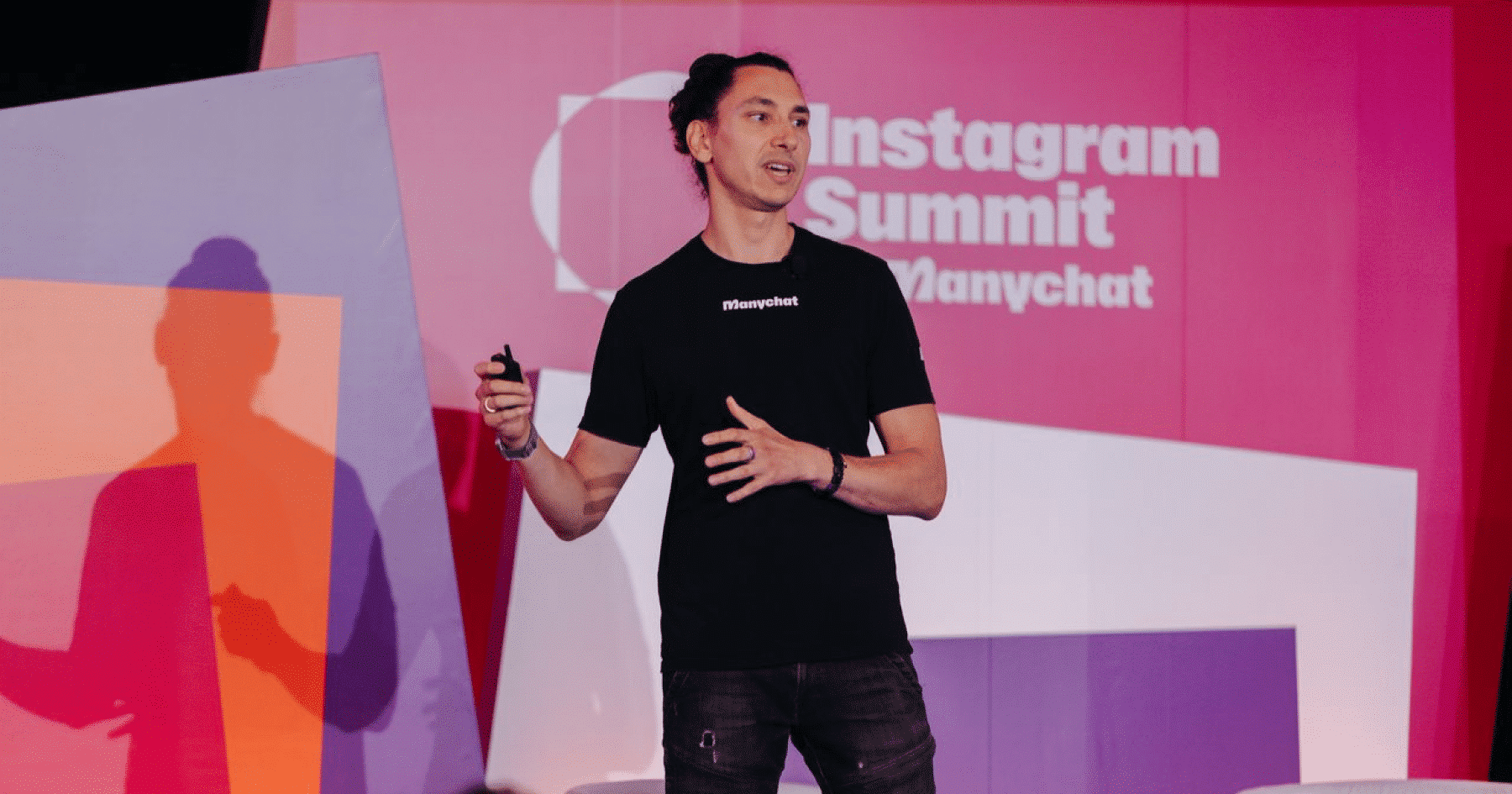
Mike Yan’s keynote
Mike Yan (Manychat’s CEO) went deep on how conversations, not just content, drive results on Instagram. He walked through new ways to move people from passive watcher to engaged follower to paying fan without working 24/7.
Midday: Bread was gotten, and corners were conversed
“Getting that bread” was 50 minutes of creators swapping exactly how they’re packaging offers, balancing sponsorships vs. owned products, and how to keep cash flow from wrecking your creativity.
Conversation Corners spilled into the hallways:
- Gannon Meyer on automation wizardry
- Marina Mogilko on multilingual empire building
- Shira Lazar on creators-for-mental-health real talk
- Jamie Brindle on freelance systems
- Rebecca Borrego on collabs with a spine
Then lunch hit — and so did the content capture. Tripods everywhere. (Respect the craft. And the floor space.)
Afternoon: The playbooks, the Rules, the Chaos
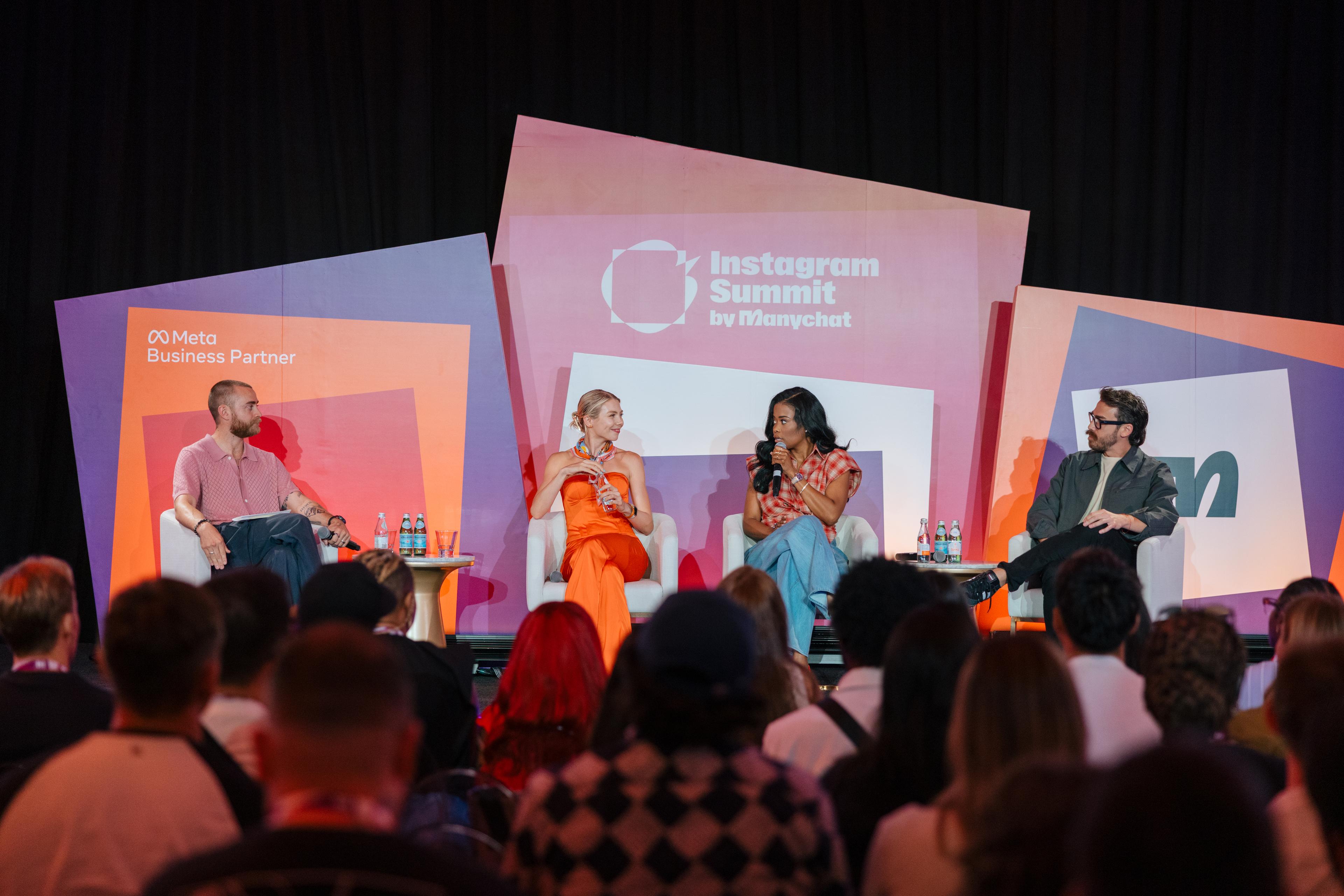
Nobody felt the post-lunch slump with this agenda; things kicked off with a powerhouse panel and simply did not let up.
Beyond the single stream: building multiple revenue engines
Brock Johnson moderated Hannah Wilson, Can (John) Ahtam, and Karen (KC) Civil through the money maze.
- Can Ahtam (Viral Nation): “You and your content are an IP.” Don’t chase 100 brands. Choose 10, then go deep with upsells. Use affiliate data (CTR, conversion) to determine which verticals and price points fit your audience. And stick to your code: don’t hawk competing diaper brands and expect anyone to trust you again.
- Karen Civil (Always Civil): “I’m never gonna step over a dollar to pick up a nickel.” Translation: protect the macro play. You can’t be in every room; build a team that covers the ones you miss. Be yourself, at scale, and make sure the money lets you hire the help.
- Hannah Wilson: “When you’re posting into the ocean, you have to learn how to swim.” She’s 75% brand deals today, but shifting to 60% business with Manychat doing heavy lifting. Don’t take every check; build signature style, real relationships, and read your non-competes like your rent depends on it (because it does).
📒 Pocket playbook:
- Go deep, not wide.
- Treat brand partners like partners, not chores.
- Spend like a business to become one.
- Use data (even affiliate crumbs) to plot the next move.
Colin & Samir: Five rules for building a creator brand that lasts
The creator economy’s favorite professors gave a masterclass in attention economics.
- “We’re competing for attention in the most competitive landscape ever.”
- “The return on a viewer’s time must be value.”
- The checklist they run every time:
- Who is this for?
- Why would they watch/listen?
- Is it unique to me?
- Is it repeatable?
- Is it a two-way street?
Colin’s cheat code: “Creators going deep with a specific group are growing the fastest.” Samir’s framing: aim for permission, not interruption — familiar but unexpected wins.
💡 Try this tomorrow: Title your next three videos with one familiar promise + one unexpected twist. Then write one sentence about the repeatable system to which this idea belongs. If it doesn’t belong anywhere, it won’t last.
Make it vertical (and make it watchable)
Over in the Fairfax room, directors and actors traded tactics for turning everyday clips into binge-worthy series. The big pattern: process beats gear. If you can’t explain your vertical in one sentence, it’s probably a vlog, not a show.
AI-powered creation: Tools, ethics, the “are we screwed?” question
Another powerhouse panel with Natasha Willis, Roberto Nickson, Artem Petrov, King Willonius, and Maya Carter = chef’s kiss chaos plus receipts.
- Roberto Nickson: Calls himself a “hybrid” creator. AI now handles 5–10% of his workflow and chops production time from eight hours to two. He’s using AI for in-context visuals that connect better than stock. “Can you survive without AI?” Maybe. “Compete?” Harder. “Manychat doubled value for creators on Instagram overnight.”
- Artem Petrov (CopySight AI): The uncomfortable truth: in many cases, AI-made outputs aren’t owned by you under current law. You need to know which model you’re prompting and how to direct it like a specialist. His spicy take: only ~30% of pros are required going forward — if you don’t adapt your workflow.
- King Willonius: TIME 100 in AI, professional cultural chaos agent. “My main goal is to troll; I’m just here for the giggles.” His stack: LLM (ChatGPT or Claude) + image gen (Midjourney) + video (Veo or Cling) + music tools (Suno, Udio). Also: “Some people want fine dining. I want McNuggets.” Fast, hot, ship it.
- Maya Carter (Meta): “Creators make a way out of no way.” Use AI to translate your intro video for new audiences. Keep you as the final editor. It’s collaboration, not cosplay.
😇 Ethics speed-round: Own your voice, disclose when needed, and don’t outsource taste.
Zach King: Magic is a system
You know Zach for “digital sleight of hand.” You might not know that he runs creativity like a factory for wonder.
- “Brainstorming is broken. Have a shared language.”
- Separate ideation from green-lighting. In the idea room, say yes to everything — greenhouse ideas first, green-light later.
- His four-step loop: Ideation → Mockups → Production → Post.
- Do mockups in one hour on your phone.
- Add 30–60 minutes on set for the last 10%; that’s where the magic hides.
- Keep a failure budget. If you’re not producing duds, you’re not producing enough.
- Find your signature by going back to your roots. Childhood obsessions count as R&D.
“My challenge for you today is to stay young and stay an artist.”
Sold.
Night: Rooftop Diplomacy Under Sunset Lighting

Harriet’s Rooftop did what rooftops do best: it turned strangers into collaborators. Deals were scoped between sips; someone booked a November launch after a six-minute chat; at least three micro-documentaries got filmed near the hedge.
You missed out if you left before the DJ started those deep nineties cuts.
The Cheat Sheet: Save This for Later

It’s basically an open book test.
1) Pick your lane, then build lanes next to it.
Start with one revenue engine you can repeat in your sleep. Add one more every quarter. Keep them complementary, not cannibalizing.
2) Treat data like a compass, not a ruler.
Use affiliate links, DMs, and Manychat flows to see what your audience actually buys or clicks. Then pitch that, not your hunch.
3) Build a signature.
A repeatable idea language makes collaboration, delegation, and sponsorships simpler. Zach’s mockup rule — one hour, on your phone — will save your year.
4) Use AI as a speed boost, not a mask.
Aim for 5–15% workflow acceleration: ideation boards, rough visuals, alt-language intros, first-pass drafts. You do the taste test.
5) Protect the long game.
Read your non-competes. Say no more often. Remember KC’s law: don’t step over a dollar to pick up a nickel.
6) DM is not a side quest.
Conversations are the product. Even before the embargo lifts, you can use rule-based flows, smarter replies, and a clean inbox to stop leaving money unread.
Missed LA? We’re Not Done Yet

IGSxM goes 100% virtual Oct 22–23. Two days, dozens of sessions, and a front-row seat from that chair you swear isn’t ruining your posture. Replays included. Come for the systems, stay for the “oh wow, I can do that this week” energy.
See you on the Timeline (and in the DMs)
If the IRL day proved anything, it’s this: attention is rented, conversations are owned. We’ll see you at the virtual summit with the rest of the playbook. And we’ll be in your Inbox label called “hot leads,” cheering when you turn comments into customers.
Now make something gloriously you.
(And put your phone in a lockbox at dinner. Gabby’s watching.)

Originally published: Sep 25, 2025, Updated: Oct 3, 2025
More stories worth reading
More content that's too good to miss