Hear ye, hear ye! We have important news from the creator economy.
On October 15, 2026, the U.S. Small Business Administration (SBA) announced new federal guidance formally recognizing content creators as small businesses.
This is a BIG win for creators. Does it mean the haters will suddenly stop commenting “Get a real job!” on their posts? Probably not.
But it does mean that the U.S. government is officially acknowledging creator businesses within its small-business framework.
What Did the SBA Actually Announce?

In its announcement, the SBA clarified that qualifying content creators fall under an existing federal industry classification called NAICS 5121 — Motion Picture and Video Industries.
NAICS stands for North American Industry Classification System; it's how the U.S. government categorizes different types of businesses. And until now, it hasn’t been clear where creator work fits into that system.
The new guidance covers businesses primarily producing and distributing original audio/visual content, including YouTubers, streamers, podcasters, gamers, video producers, social media entrepreneurs, and creative agencies.
As Avi Gandhi, Chair of Government Advocacy for the Creators Guild of America, explained:
“This change has been a long time coming. Prior to today, creators had no ‘home’ in the NAICS classifications.”
To be clear, creators could already operate businesses and access small-business resources before now. What's new is clearer guidance as far as where they fit into the industry classification system.
What Does This Mean for Content Creators?

Beyond the bragging rights, the SBA's announcement comes with a few practical benefits for creator businesses.
1. Clearer access to small-business financing
Creators who qualify can explore SBA-backed loans to help grow their businesses, whether that means buying production equipment, hiring an editor, or expanding their operations. (More on this in a bit.)
The new guidance makes it easier for creators to understand where their businesses fit within SBA programs, though they'll still need to meet the usual eligibility and lending requirements.
2. More clarity around government contracts
The federal government sets aside certain contracts specifically for small businesses. But to compete for those opportunities, businesses need to know how they're classified and whether they meet the requirements.
The SBA's new guidance clarifies where creator businesses fit into the federal classification system, giving qualifying creators a clearer path to determining which small-business contracting opportunities they're eligible to pursue.
3. Recognition of creators as entrepreneurs
This announcement is also a win for the organizations and creators who've spent years advocating for greater recognition of the creator economy.
“Content creators are small businesses, and always have been,” said Daniel Abas, Founder and President of the Creators Guild of America, an organization that advocates for digital creators.
The Creators Guild of America has been advocating for greater professional recognition and legal protections for creators. Its members advocated for this guidance from the SBA.
As Shira Lazar, founder of Creators 4 Mental Health and a member of the Guild's Advisory Council, put it: “For years, creators have clamored for recognition from Washington. [October 15th’s] announcement demonstrates that our government has started to listen and is ready to take action.”
What Should Creators Do Next?

You don't need to take any action to be recognized as a small business if you're already operating one. However, now's a great time to explore the resources and opportunities available to you. Here's where to start:
Check your business classification
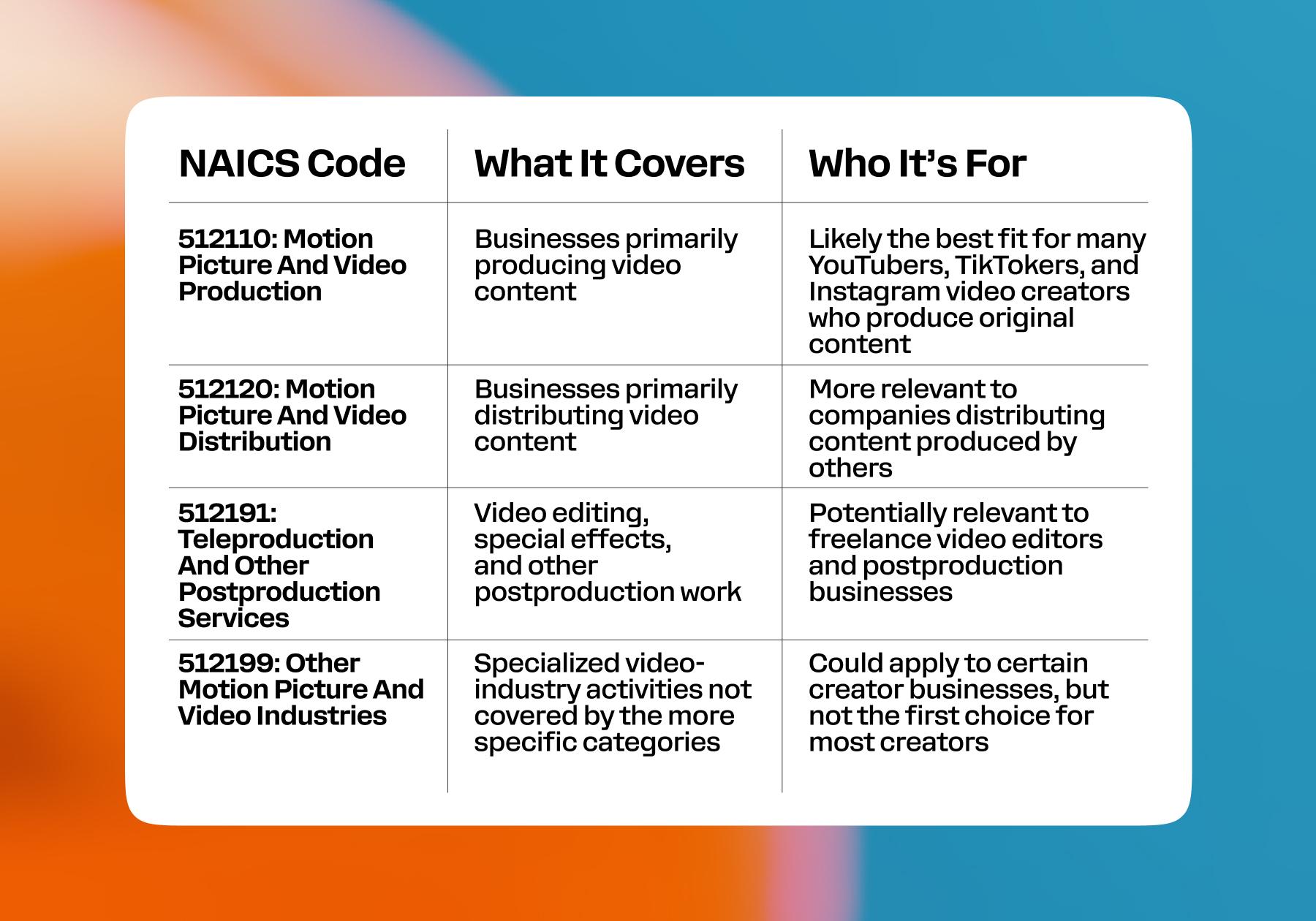
Review the NAICS 5121 code description and find the six-digit industry code within it that best describes your primary business activity as a creator.
Here are four NAICS codes that may be relevant to different types of creator businesses:
Explore SBA financing
The SBA doesn't currently offer creator-specific loans, but you can apply for existing small-business loan programs, depending on what you need the money for.
It’s best to visit SBA.gov to learn about available loan programs and eligibility requirements. But potentially relevant loan programs for content creators include:
- SBA microloans, which offer up to $50,000 for eligible working capital, equipment, furniture, and supplies. These smaller loans can be useful for creators looking to upgrade their filming setup, purchase a new computer or camera, or cover other everyday business expenses.
- SBA 7(a) loans, which offer up to $5 million for eligible business expenses. The SBA specifically permits equipment, supplies, real estate, and working capital under its 7(a) program. This means you could potentially use a 7(a) loan to purchase cameras, microphones, and editing equipment, cover studio or office rent, or pay an editor or producer as you grow your team.
- SBA 504 loans, which are long-term financing for major fixed assets, such as purchasing business property or qualifying long-life equipment. This one's more relevant to larger production businesses than individual creators, but hey, shoot for the moon.
Keep in mind that these are loans, not grants. You'll need to meet the lender's eligibility requirements and repay the money you borrow.
Look into federal contracting
The National Park Service has a surprisingly strong meme game. NASA has more than 100 million Instagram followers. It’s a bit strange to think about, but the federal government has quite the social media presence, and somebody has to create all that content.
As such, government agencies often hire businesses for help producing videos, filming events, creating public awareness campaigns, and running their social media accounts. Some federal contracts are even reserved specifically for qualifying small businesses, giving smaller operations a chance to compete for government work.
If you’re interested in federal contracting, you can search for available contracts at SAM.gov.
FYI: To bid on federal contracts directly, you'll generally need to register your business in the government's System for Award Management (SAM) and meet the requirements of the individual contract. Check out the SBA's guide to federal contracting to get started.
Congrats to the Creator Economy
Let's be real, creators have been building businesses online for years. This announcement doesn't make those businesses any more legitimate than they already were. It just means the government is finally catching up.
There's still work to be done, but this is a meaningful step toward giving creator businesses the same opportunities as other small businesses.
And if anyone still tells you to get a real job? Well, now you've got a government announcement to send them. 🖐🎤


Originally published: Oct 19, 2026
More stories worth reading
More content that's too good to miss