
The sun is hot. Water is wet. Everyone loves Instagram. These are all facts.
From stories to reels and everything in between, Instagram is one of the powerhouses of social media, and a huge part of why people open the app every day is what happens in the DMs.
The majority of Instagram users send direct messages every single day, which means if you’re a creator or brand and you’re not paying attention to your inbox, you’re leaving relationships (and revenue) on the table. Consider this your guide to reclaiming them.
TL;DR
- Instagram Direct is the private messaging feature inside Instagram where users can send text, photos, videos, voice notes, and more to one another.
- Creators and businesses use DMs to handle customer questions, deliver lead magnets, and build relationships that comments can’t replicate.
- Privacy controls like message requests, restrict, and vanish mode let you decide who gets access to your inbox.
- Automating your DMs means you never leave a follower on read, even if it’s 3 a.m. and you’re fast asleep.
Inside the Inbox: What Instagram Direct Actually Does

Instagram direct messages (DMs, as we all call them) are your way to have private conversations on Instagram. Whether it’s a one-on-one chat or a group discussion, DMs offer a space for discussions that the comment section can’t quite provide. They’re where creators build real relationships with their audience, where customers ask about products before buying, and where brand deals get negotiated.
Here’s what makes direct messages on Instagram different from everything else on the platform:
- Privacy: Unlike comments on posts that everyone can see, DMs are just between you and the recipient(s).
- Flexibility: You can send text messages, photos, videos, voice notes, and even disappearing media that vanish after viewing.
- Group chats: Instagram allows you to create group conversations with up to 250 participants.
DM sends are now one of Instagram’s top ranking signals, which means you shouldn’t underestimate the power of a strong DM strategy.
Everything You Can Do in a DM

Instagram Direct is way more than a text box. The feature has grown significantly over the years, though most people use only a fraction of what’s available.
Here’s the full rundown:
- Text messages
- Photos and videos from your camera roll or taken in the moment
- Voice notes sort of like what Snapchat offers, but they don’t expire
- GIFs and stickers
- Reactions (double-tap or long-press a message to react with an emoji)
- Polls
- Shared posts, reels, and stories: you can forward content directly to someone’s inbox
- Disappearing photos and videos: viewable once (or twice), then gone
- Vanish mode: a chat mode where everything disappears
- Notes: short text statuses that sit above your inbox
- Group chats (up to 250 people can participate in a single conversation)
That’s a lot of tools in one inbox. Let’s break down which ones deserve a closer look.
Group chats: more useful than you might think
Starting a group DM is simple: tap the compose icon in your inbox, select “Group chat,” and add the people you want. You can add up to 250 participants, name the group whatever you want, and admins can manage who joins or gets removed. For creators, group DMs are a great way to build an exclusive community with your most engaged followers.
Vanish mode: Instagram’s take on Snapchat
With vanish mode, you can send Snapchat-style disappearing messages. Swipe up in any one-on-one conversation to activate it, and everything sent in that mode disappears once the chat is closed. Swipe up again to turn it off. One thing to know: If someone takes a screenshot while vanish mode is active, Instagram sends a notification. So…no sneaky business.
Notes: the tiny status nobody talks about
Notes are those little text bubbles that appear above conversations in your DMs. You can post a short message (up to 60 characters) or share a song clip, and it stays visible for 24 hours. For creators, notes are an underrated way to tease new content, ask a quick question, or just remind your audience you exist without cluttering the feed.
How to Send Your First DM

In case you’ve been off the grid for the last 10+ years: sending a DM to another Instagram user is straightforward, and we’ll talk you through how to do it below.
FYI: If you’ve connected your Instagram and Facebook accounts, you can message people across both platforms from the same inbox.
Sending an Instagram direct message on mobile
Open the Instagram app and tap the paper airplane icon in the bottom center of your home feed — this is how you get to your DM inbox. From there, tap the compose icon in the top right, search for the person you want to message, and start typing.
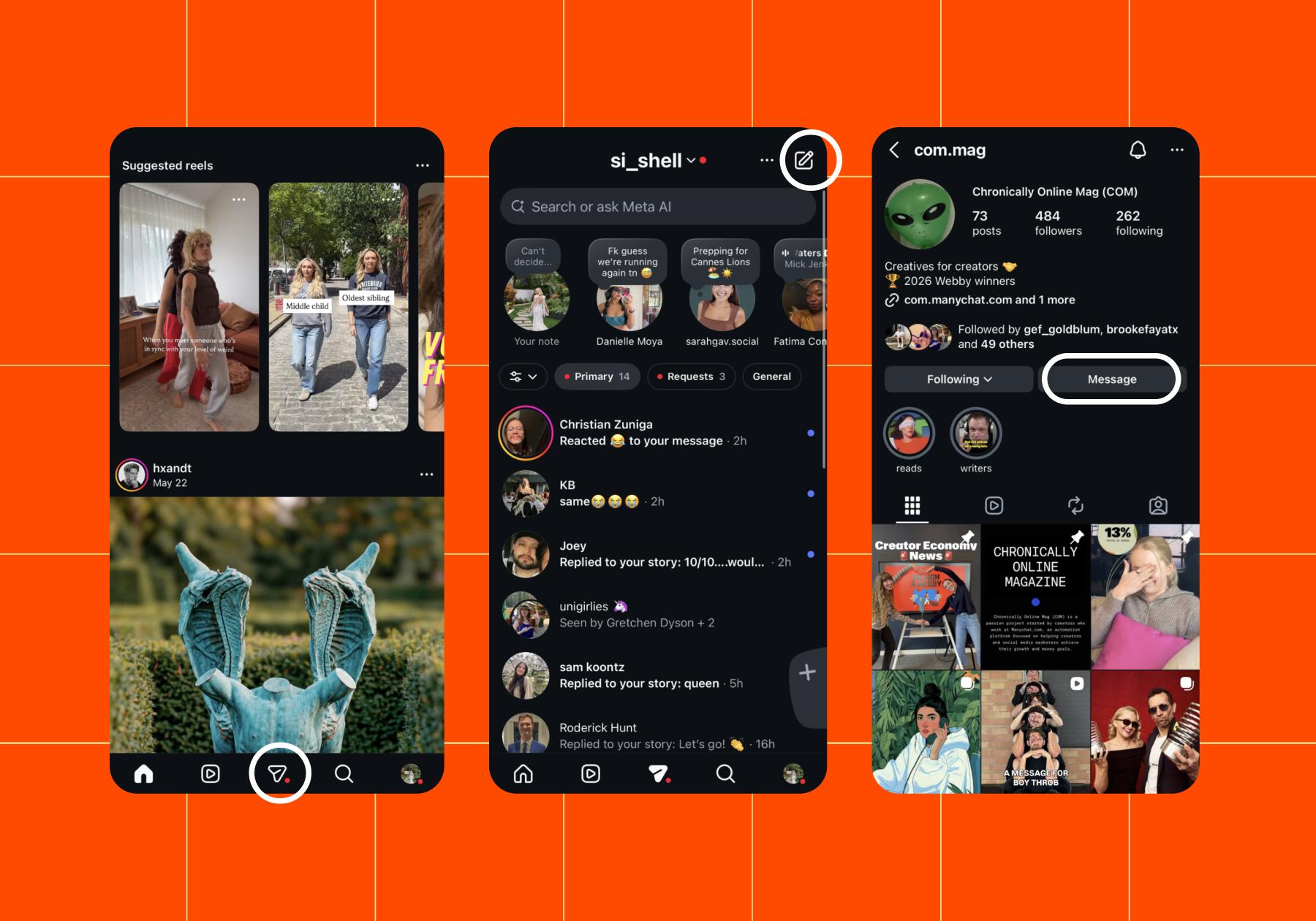
Alternatively, you can also DM someone directly from their profile by tapping the “Message” button. And if someone posts a story you want to respond to, just swipe up (or tap the message bar at the bottom of the story), and your reply will go straight to their DMs.
Sending an Instagram direct message on desktop
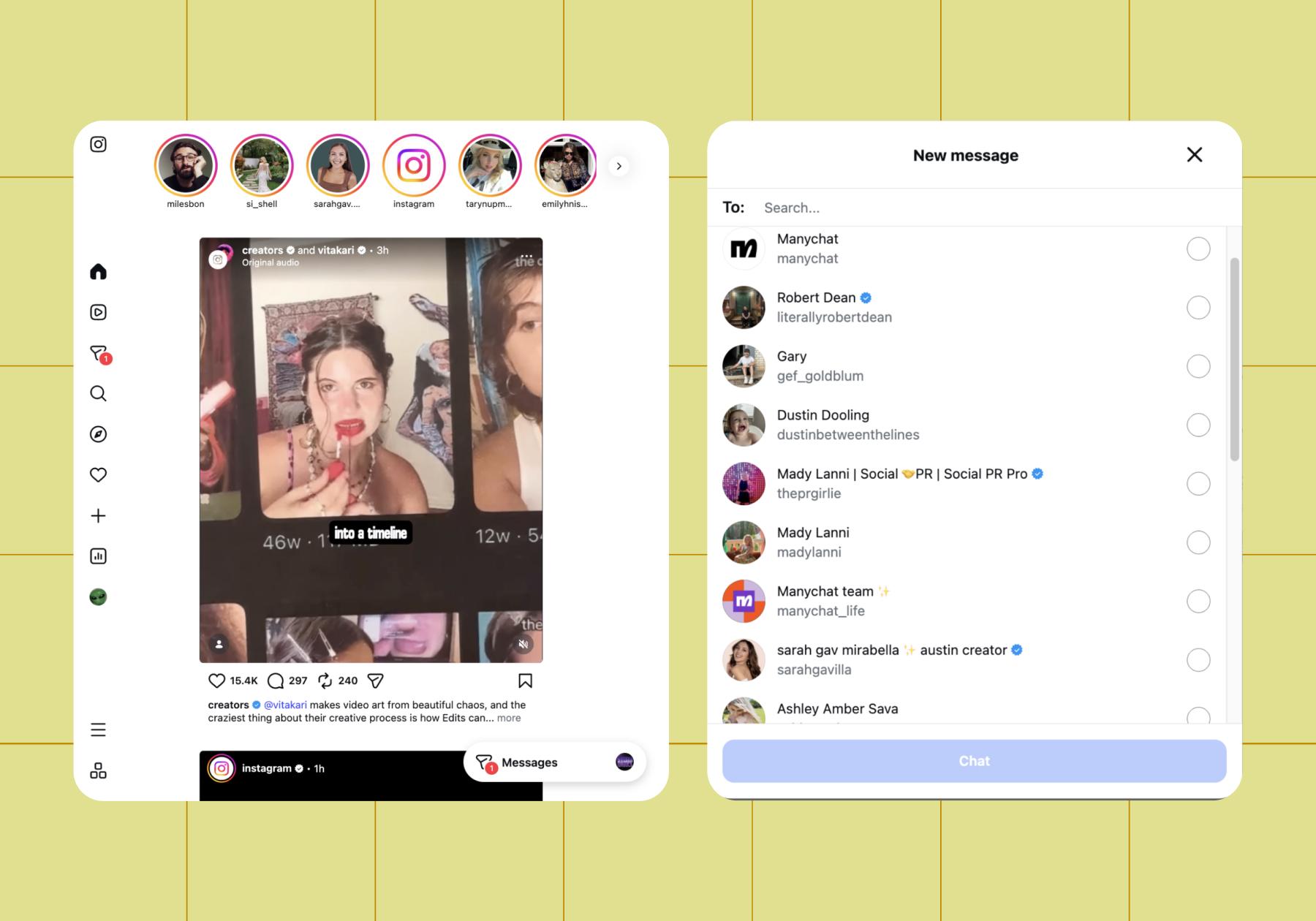
If you want to send a message from your computer, head to instagram.com and log in. Click the messaging icon in the left sidebar to open your inbox. From there, click the compose icon, choose your recipient, and type your message. Desktop DMs now support most of the features you’d expect — photos, voice notes, reactions, and more. It’s a solid option if you’re managing your inbox during work hours and don’t want to be glued to your phone.
Who Gets to Slide In? Privacy Controls

One of the most overlooked parts of Instagram Direct is the privacy settings. If you’re a creator or business owner running an account that gets dozens (or hundreds) of messages a day, knowing how to control who reaches your inbox is essential.
Message requests vs. your main inbox
Instagram uses a two-tier system. Messages from people you follow (or have chatted with before) go straight to your main inbox. Messages from everyone else land in Requests: a separate folder where you can accept, delete, or ignore them without the sender knowing you’ve seen anything.
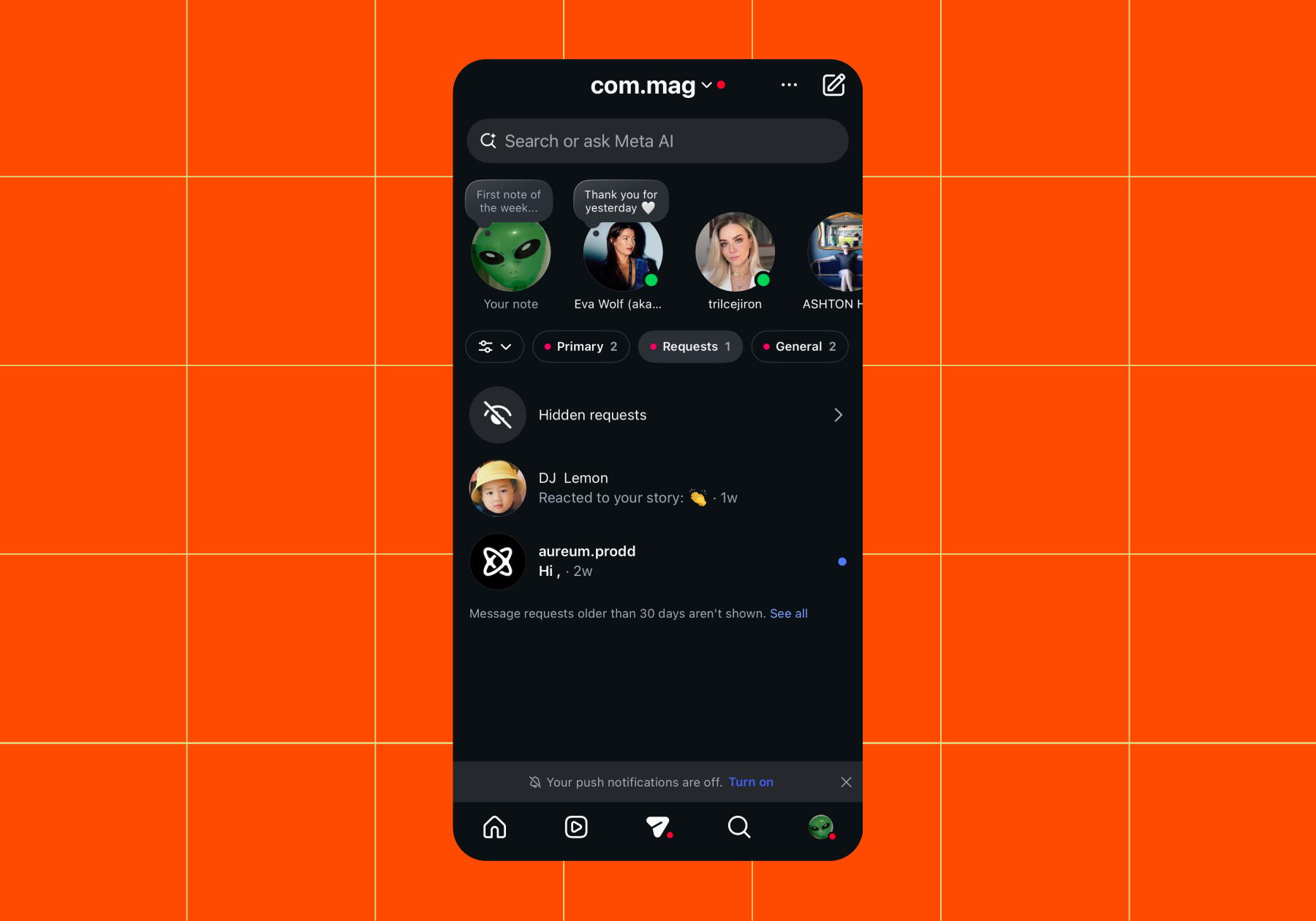
Here’s the thing: A lot of creators never check their message requests, which means they could be missing brand deals, customer inquiries, and collaboration offers.
There’s even a “hidden requests” subfolder for messages Instagram’s filters flagged as potentially spammy. Make it a habit to check both regularly; you might be surprised what’s sitting in there.
Restrict, block, and report: your spam toolkit
If someone’s being annoying (or worse, harassing you), you’ve got options.
- Restricting an account is a subtle move. Restricted accounts’ messages will get routed to message requests, and they won’t know you’ve done it.
- Blocking is the nuclear option. Blocked accounts can’t message you, find your profile, or see your content.
- Reporting sends the conversation to Instagram for review. This is the best option for accounts that are potentially violating community guidelines.
For business accounts that attract a lot of spam, restricting is usually the best first step before going full block.
DM Etiquette Best Practices

Knowing how to send a DM is one thing. Doing so without getting muted, blocked, or ignored is another.
Here are the ground rules for creators and businesses who want their inbox game to actually work:
- Respond fast: People expect quick replies in DMs, so try to respond within an hour of receiving the message. If you can’t be online all the time, set up auto-replies (more on that in a sec).
- Use saved replies for FAQs: If you’re answering the same Instagram FAQs every day — shipping times, pricing, collab inquiries — set up keyword-based automations that respond in seconds.
- Personalize, even when it’s automated. Write your automations so they sound like you. A message that feels copy-pasted will get treated like spam, even if the info is helpful.
- Pin important conversations. Got an ongoing brand deal negotiation or a VIP customer thread? You can pin up to three messages per chat so they don’t get buried under shares and story replies.
- Don’t cold-DM with sales pitches: Nothing gets you muted faster than sliding into someone’s inbox with “Hey! Check out our product!” unprompted. Earn the conversation first: respond to their content, engage with them publicly in the comments, then take it to DMs when there’s a reason to.
Here’s Where DMs Get Annoying

We love DMs. (Obviously.) But let’s be real, when you’re getting 200 messages a day, your inbox starts to feel like a second job, especially because Instagram Direct has some limitations that creators and businesses hit pretty quickly.
- No native scheduling: You can’t queue DM responses or set messages to send later (except for the basic message scheduling feature in individual chats).
- No conversation tagging: There’s no built-in way to label conversations by lead status, customer type, or priority, so everything lives in a single undifferentiated stream.
- No conversation analytics: Instagram gives you insights on posts, reels, and stories, but your DM conversations? No data on response times, conversation volume, or conversion rates.
- Inbox overload at scale: Once you’re past a few hundred followers, manually replying to every DM becomes unsustainable. Important messages get buried, and response times tank.
- One account at a time: Managing multiple Instagram accounts means constantly switching back and forth — there’s no unified inbox natively.
Comparing the native Instagram inbox to Manychat makes it obvious that it wasn’t built for business at scale.
Capability | Instagram Direct (native) | Manychat |
|---|---|---|
Auto-replies to common questions | No ❌ | Yes ✅ |
Keyword-triggered DM responses | No ❌ | Yes ✅ |
Lead tagging and segmentation | No ❌ | Yes ✅ |
24/7 response capability | No ❌ | Yes ✅ |
Conversation analytics | No ❌ | Yes ✅ |
Multi-account management | Limited ⚠️ | Yes ✅ |
If you’re starting to hit a point where the native Instagram inbox isn’t working for you anymore, there’s an obvious next step you can take: Sign up for Manychat.
Here’s how it works: You set up triggers (a keyword in a comment, a story mention, a specific DM), and Manychat will send a relevant, personalized response instantly based on the specific trigger that’s sent to your account.
For example, someone comments “LINK” on your latest reel? There’s a DM in their inbox with the URL before they’ve even scrolled to the next post. A customer asks about sizing in the middle of the night? They get a helpful reply immediately, not hours later when you finally wake up.
Learn more with this short video:
Or, get straight to business: Sign up for Manychat.
Frequently asked questions
Instagram Direct is the built-in private messaging feature on Instagram that lets you send texts, photos, videos, voice notes, and more to individuals or groups. It’s separate from comments and public interactions; everything in your DM inbox stays between you and your recipients.
Tap the paper airplane icon at the bottom of your Instagram home feed to open your DM inbox. On desktop, click the messaging icon in the left sidebar at instagram.com.
Yes, but only if read receipts are enabled. You’ll see “Seen” below your message once the recipient opens it. However, users can turn read receipts off in their privacy settings, so the absence of a “Seen” indicator doesn’t necessarily mean they haven’t read it.


Originally published: Jul 8, 2024, Updated: Jun 23, 2026
More stories worth reading
More content that's too good to miss