Running ads on Facebook can be a smart investment or a straight-up money pit. The difference lies in knowing how to set them up the right way.
Facebook still has a billion more users than Instagram or TikTok, and Meta’s ad system gives you unmatched targeting power to reach those users. But whether you’re a business owner, creator, or marketer, the challenge is turning that reach into results without burning through your budget.
This guide helps you do exactly that. We’ll walk you through everything you need to know to create and manage Facebook ads that actually sell — not just drive clicks.
Let’s dive in.
1. Log in to Meta Ads Manager

First things first: Skip the shiny blue “Boost Post” button. (Tempting, we know.) Boosted posts are great for a quick engagement grab, but they don’t have the audience targeting and goal options that ads do. For that, you need to use Ads Manager, Meta’s native tool that lets you choose campaign objectives, test creative, and manage an ad budget.
Make sure you have a Facebook Page or hold an admin, editor, or advertiser role on someone else’s Page — this is required to advertise with Ads Manager.
Inside Ads Manager, you’ll see a dashboard with all the essentials: campaigns, ad sets, and ads. Don’t worry if it feels a little overwhelming at first. You only need to use key features to capture leads and sales.
Optional: Connect Manychat to Facebook
If you plan to use Manychat (smart move), you’ll need to connect Manychat to your Facebook business page — personal profiles and groups won’t work.
The setup takes just a minute: Log into Manychat, head to Settings → Messenger, and select the page you want to connect. Once linked, you’ll unlock automations, interactive chats, and 24/7 support inside Messenger.
2. Choose Your Campaign Objective

Every great ad starts with a clear goal. In Meta Ads Manager, that goal is called your campaign objective.
As of 2025, Meta has simplified campaign objectives to six options.
- Awareness: Get your brand in front of as many people as possible. Perfect if you’re new and just want to be seen.
- Traffic: Send people to your website, app, or Messenger conversation.
- Engagement: Encourage actions like likes, comments, video views, or messages.
- Leads: Collect contact info through sign-ups, forms, or (better yet) DMs.
- App promotion: Drive installs or in-app actions if you have a mobile app.
- Sales: Get people to buy, whether that’s on your site or through integrated shops.
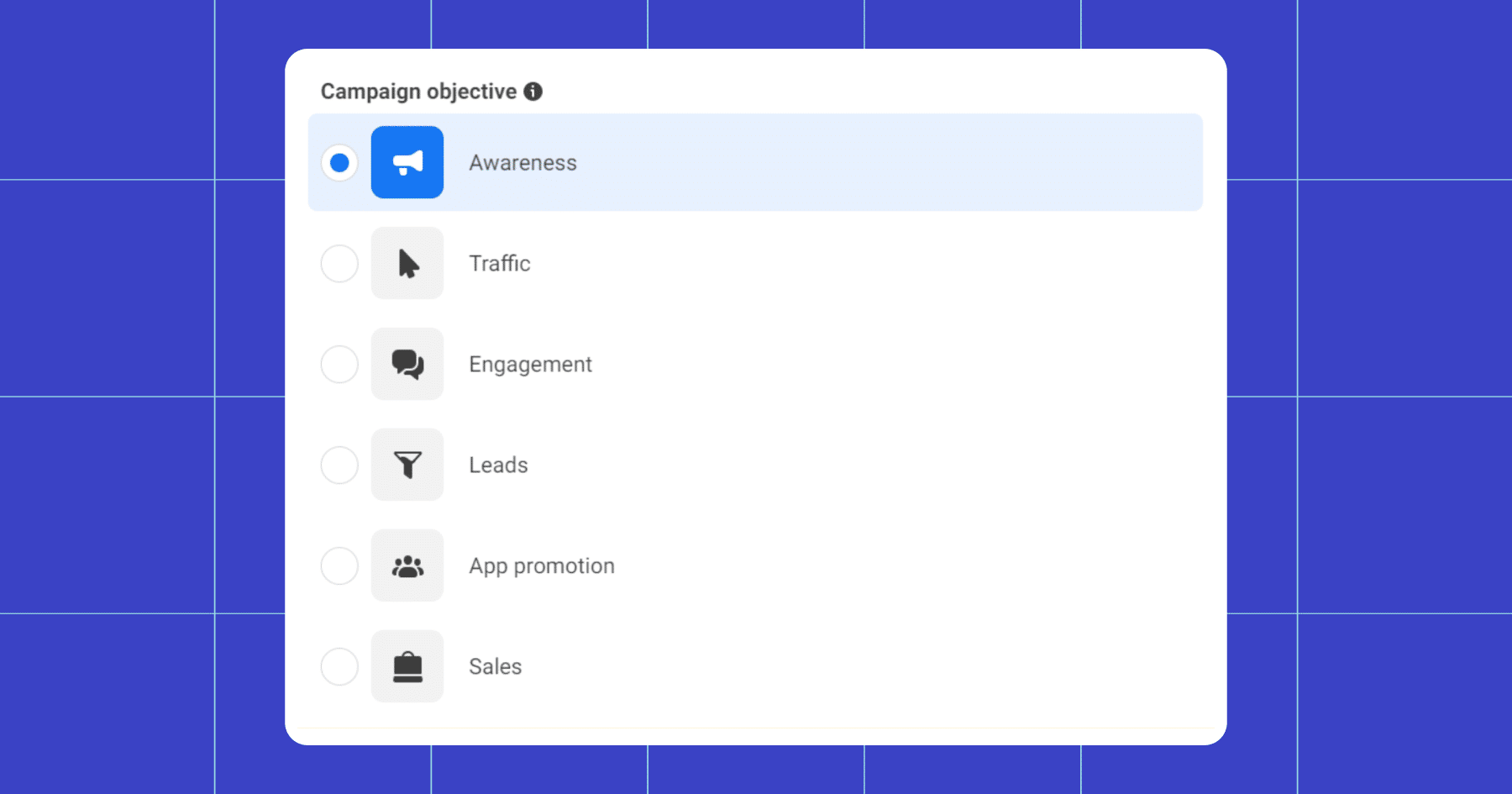
If you’re not sure which one to pick, ask yourself: What is my end goal? Do I want awareness, leads, or sales?
Think funnel, not one-off. Start with Awareness to get on people’s radar, then retarget engagers with a Leads or Sales campaign.
3. Choose Your Ad’s Destination

Where are you trying to send people with your ad? In Ads Manager, your main options are:
- Website: Drive traffic straight to your site.
- App: Send people to download or engage with your mobile app.
- Messenger: Open an instant conversation on Facebook Messenger.
- Instagram DMs: Start a private chat directly in Instagram.
- WhatsApp: Connect with people on the world’s most popular messaging app.
Here’s our take: Landing pages are fine, but conversations convert better. That’s what makes Click-to-Messenger Ads such a game-changer. With Messenger as the destination, your ad clicks spark a conversation, not a bounce.
Instead of waiting for a page to load (or hoping someone fills out a form), you’re instantly having a personal, interactive conversation in their inbox.
Don’t leave leads on the table — automate with Manychat
Manychat takes Click-to-Messenger ads to the next level. Instead of manually replying to every new lead, you can set up simple automations that:
- Welcome people instantly with a friendly, personal message.
- Collect contact info (like email or phone) for retargeting or follow-ups.
- Guide them to the next step, whether claiming a freebie, browsing a product catalog, or booking a time with you.
Sign up for Manychat. You’ve got nothing to lose (it’s free), and lots to gain.
4. Determine Your Target Audience

Even the best ad creative will flop if you show it to the wrong people. In Ads Manager, you’ve got three powerful tools for finding the right audience:
- Core Targeting: Start broad with basics like location, age, gender, and interests. Meta’s algorithm will refine delivery over time.
- Custom Audiences: Retarget people who’ve already shown interest: past site visitors, email subscribers, app users, or anyone engaged with your social profiles.
- Lookalike Audiences: Use your best customers as a “source” to find new people with similar traits and behaviors.
Broad audiences usually beat hyper-specific ones. That’s what Meta recommends and what Borja Obeso, founder of Rebelgrowth and Marketing Director at TN Marketing, has seen after managing seven-figure ad budgets on Meta.
As he puts it: “Broad > over-targeting. Broad and Advantage+ outperformed tight interest stacks and even lookalikes.”
Why does broad win? Once your offer is dialed in and Meta’s algorithm has conversion history, broad gives it room to hunt for buyers at scale. Bigger reach means:
- Lower CPM (the cost to show your ad 1,000 times)
- Less audience overlap
- Faster exit from the “learning phase”
- Optimization on real conversion signals — not guesswork
Borja tested this with clean splits: same offer, same landing page, same creative. Here’s what he found:
- Broad targeting: $85.90 per registration
- Lookalike: $210.16 per registration
- Retargeting (for context): $41.18 per registration
Here’s what to take from this: Let the creative and offer do the targeting. If your audience is mass or mid-market, let Meta’s AI (Advantage+) do the heavy lifting.
When to still go specific:
- Niche B2B or very small geos
- Brand-new pixels with no conversion history
- Campaigns that require pre-qualifying leads tightly (compliance, high-ticket sales)
Borja’s rule of thumb: “If an ad set can’t hit ~50 conversions per week, narrow until you get enough data. Then open it up to broad.”
🚨 Audience targeting reality check
Since iOS privacy updates that occurred in 2021, relying only on third-party signals (like cookies or interest stacks) is a dead end; that’s why first-party data is gold.
With Manychat, you can collect that data directly — emails, phone numbers, and Messenger opt-ins — through automated chats. Then, sync it into Meta Ads Manager to build stronger Custom Audiences and Lookalikes for retargeting.
Pair this with Meta’s Conversions API (CAPI), which sends your conversion data back to Meta, and you’ll benefit from smarter AI optimization and audiences who actually want to buy.
5. Craft Scroll-Stopping Creative

Newsflash: Your creative is the ad. It’s the first impression, the hook, and the reason someone clicks (or scrolls right past).
Meta offers a variety of ad formats — each with different strengths. Here’s a breakdown of ad types and how to make them work:
| Format | Description | Best practices | Best for |
|---|---|---|---|
| Image Ads | Single photo with optional text overlay | Use high-res images, show people using your product, keep text minimal, and crop tightly around the subject | Simple promos, brand awareness campaigns |
| Video Ads | Video content (from short Reels to longer demos) | Keep videos short (six to 15 seconds for Reels), design for sound-off (use captions), and provide key info in the first few seconds | Product demos, storytelling, and capturing attention fast |
| Carousel Ads | Multiple scrollable images/videos | Use each card to highlight a feature or product, make sure images tell a story in sequence, and include strong CTAs | E-commerce product showcases, highlighting multiple offers |
| Collection Ads | Product catalog that opens into an Instant Experience storefront | Use a strong cover image or video, ensure catalog items are visually consistent, and keep product info clear | Retail/e-commerce, impulse shopping |
| Stories Ads | Full-screen vertical (9:16) ads | Use bright visuals, motion, and urgency; make text large and legible; keep it casual and native to Stories | Quick-hit promotions, limited-time offers, mobile-first reach |
| Lead Ads | In-app forms for collecting user info | Keep forms short, pre-fill fields when possible, offer a clear incentive (discount, freebie, etc.) | Growing email lists, booking inquiries |
| Dynamic Ads | Automated ads that show products people viewed or added to their cart | Ensure your product catalog is clean, up to date, and well-organized; use strong lifestyle images | Retargeting, abandoned cart recovery |
| Messenger Ads | Ads that open a Messenger conversation | Use conversational CTAs (“Chat with us”) Pro move: Use Manychat to qualify and collect leads automatically | Service businesses, lead gen, conversational funnels |
What actually works in 2025?
Beyond the format you choose, certain creative patterns are consistently driving results in 2025:
🎥 Short-form video and Reels outperform static images
Data shows that short-form videos drive higher engagement and click-throughs than static images and long-form videos. The sweet spot is between six and 15 seconds, with your hook and key message front-loaded in the first three seconds.
👤 Authentic, user-generated content beats polished stock
Polished, “ad-looking” creative often gets ignored, while relatable, human content builds trust. Meta calls this “native storytelling,” and research backs it: 79% of consumers say UGC influences their buying decisions.
🎨 Creative refresh cycles prevent fatigue and rising CPMs
Even the best ads wear out. As frequency climbs, performance dips, and costs rise. Refreshing creative every two to three weeks (swapping visuals, testing new hooks, or rotating formats) keeps audiences engaged and CPM lower.
Okay…but what actually works for real marketers?
Trends and best practices are great, but what really matters is how they play out in the wild. That’s why we asked business owners and marketers who run Facebook ads every day what’s actually working for them.
📹 Madison Hollimon: Founder, Mad Marketing House
Madison has managed over $1M in Facebook ad spend for luxury brands, small businesses, and personal brands, driving $50M+ in revenue for clients by focusing on personalization and testing.
“What works particularly well is using personalized ad creatives paired with segmented audiences, which significantly increases engagement and click-through rates. On the flip side, generic visuals underperformed.”
The takeaway: Don’t set and forget. Small, iterative changes in copy and visuals can lead to performance gains.
⚡ Adam Bushell: Owner, AB Electrical & Communications
Adam runs a small electrical company in Sydney and leaned into short, simple videos shot on-site.
“The ads that had people working in them — even if it was filmed on a phone — worked better than anything that looked like it was staged. They saw me and my team in action, and this directly translates to bookings.”
The takeaway: Authenticity wins. Forget stock photos. Show your business in real life, even if it’s shot on an iPhone.
🚰 Emily Demirdonder: Director of Marketing, Proximity Plumbing
Emily runs digital advertising for a local plumbing business and focuses on relatable, service-first ads.
“I learned over time that urgency-driven lines like ‘Need a plumber tonight?’ result in far more calls than generic service ads. Simple and clear offers with a little local credibility will always outperform generic ads that look well-polished.”
Her team spent ~$1,200 in three weeks, driving 42 direct service calls worth ~$350 each (a 12x ROAS).
The takeaway: Lead with clarity and credibility. A strong, urgent offer beats a polished but basic ad every time.
6. Budget, Bid, Test, Repeat

Once you’ve nailed your creative, it’s time to decide how much to spend and how to get the most out of every dollar. Ads Manager gives you plenty of control here, but you don’t need to overcomplicate it.
Daily vs. lifetime budgets
Every Facebook ad enters an auction. Dozens of advertisers compete for the same “seat” in someone’s Feed. Your budget is how much you bring to spend in total, and your bid is how much you’re willing to put down to win each seat.
Meta decides who wins based on bid and ad quality (relevance, engagement, etc.). The better your creative, the less you’ll need to bid to win.
- Daily: Meta spends up to your set amount daily; this is the best option for steady delivery and predictable pacing.
- Lifetime: Meta spreads your spend across a set time window; this option is better for fixed events, launches, or promos.
For new campaigns, start with daily budgets so you can adjust quickly. Use lifetime budgets when you have a defined end date.
A/B testing your creative
Never assume you know which ad will win. A/B testing lets you compare different versions of an ad to see which performs best. You can experiment with:
- Headlines (curiosity-driven vs. benefit-driven)
- Calls to action (e.g., “Shop Now” vs. “Learn More”)
- Visuals (UGC video vs. product shot)
Even minor tweaks can impact performance, so don’t be afraid to experiment.
Scale what works
Once you’ve found a winner, resist the urge to crank your budget overnight. Meta’s algorithm performs best with gradual changes. Increase budget by 20% to 30% every few days, or duplicate winning ad sets at a higher spend. And don’t forget to keep testing fresh variations so you don’t exhaust your audience.
7. Track and Optimize Performance

Once your ads are live, monitor key metrics like CTR (click-through rate), CPM (cost per 1,000 impressions), conversions, and ROAS (return on ad spend) closely.
- If your CTR is low → test new hooks or visuals.
- If your CPM is high → broaden your audience.
- If conversions lag → refine your offer or landing page.
- If ROAS is weak → double down on what’s already working and cut what isn’t.
FYI: Ads Manager shows you clicks and conversions, but can’t show you what happens inside conversations. Manychat can fill in the gaps, letting you track open rates, opt-ins, replies, and follow-up engagement. That way, you see the full funnel — from ad click to customer.
Own Your Facebook Ad Game

You’ve got the action plan, and here’s a quick recap: set clear objectives, target the right audience, craft creative that stands out, and optimize as you go.
Follow these best practices, and you’ll turn clicks into customers.
Go build your first campaign with confidence. And when you’re ready to scale conversations and automate more of the work, Manychat Pro is here to help.
✋ Frequently Asked Questions (FAQs)
1. How do I make sure I actually own my audience from ads?
Most creators send traffic to a landing page or shop they don’t control (hello, high bounce rates). With Manychat, you can capture emails, phone numbers, and opt-ins directly in Messenger or Instagram DMs. That means you keep the audience, not just Meta.
2. What happens if people click my ad but don’t buy right away?
This is where retargeting comes in. With Meta Ads Manager, you can build Custom Audiences of people who engaged with your ad, visited your website, or interacted with your Facebook or Instagram profile. Then, you can run follow-up campaigns that:
- Remind them about the product or offer they clicked on
- Share social proof like testimonials or reviews
- Create urgency with a time-sensitive discount
The key is to think of ads as a sequence, not a one-shot. Most sales happen after a few touchpoints — retargeting helps you stay visible until they’re ready to buy.
3. How do I know if my ad clicks are actually turning into customers?
Meta Ads Manager shows you if ads drive purchases or leads, but only if you’ve set up tracking with the Meta Pixel or Conversions API (CAPI). These tools connect your website or CRM to Meta so you can see how many sales, sign-ups, or bookings came from a specific ad.
What Ads Manager won’t show you are the individual people behind those actions. If you want names, emails, or phone numbers, you’ll need to collect that data directly (for example, through a lead ad or Messenger opt-in in Manychat).
4. Do I need a big budget for ads to work?
Not necessarily. With Click-to-Messenger ads, you often get higher conversion rates than with a landing page funnel. That means your ad spend goes further, even if you only test with $10 to $20 a day.