Manychat Pricing Is Changing. Here’s What That Means for You.
Manychat pricing is changing. And it’s changing for a good reason.
We’re introducing new plans and a new pricing model designed to better match how creators and social-first businesses actually grow today, not how software used to think growth worked.
Because the creator economy is no longer scrappy side-hustle territory, it is a $250 billion business ecosystem, with the potential to reach $480 billion by 2027.
And the way creators and social-first businesses grow inside that ecosystem has changed, too.
People aren’t building businesses on one channel anymore. They are juggling conversations, leads, sales, support, and content across a growing stack of platforms.
The volume is bigger. The stakes are higher. The workflows are messier. And creators don’t all grow the same way, which means one single plan can’t meet every need at every stage.
Manychat has spent the last decade right in the middle of this shift, helping creators and social-first businesses turn engagement into conversations at scale. We helped pioneer the kinds of workflows that are now table stakes for modern social selling, like comment-to-DM and Follow-to-DM. But one thing has become painfully obvious: creators are not one-size-fits-all, and their growth is not linear.
Maybe you’re still answering the same DM 400 times. Maybe you’re selling digital products or passing leads to a team. Or maybe you are running full-on multichannel chaos, with AI, Inbox, and automations keeping it all from falling apart.
The common denominator is that your audience is your business, and the value is in the active relationships and conversations you build with the people you’re actually reaching.
That’s why we’re introducing a pricing model that better aligns cost with real engagement and growth, not outdated pricing assumptions.
What’s Changing at a Glance
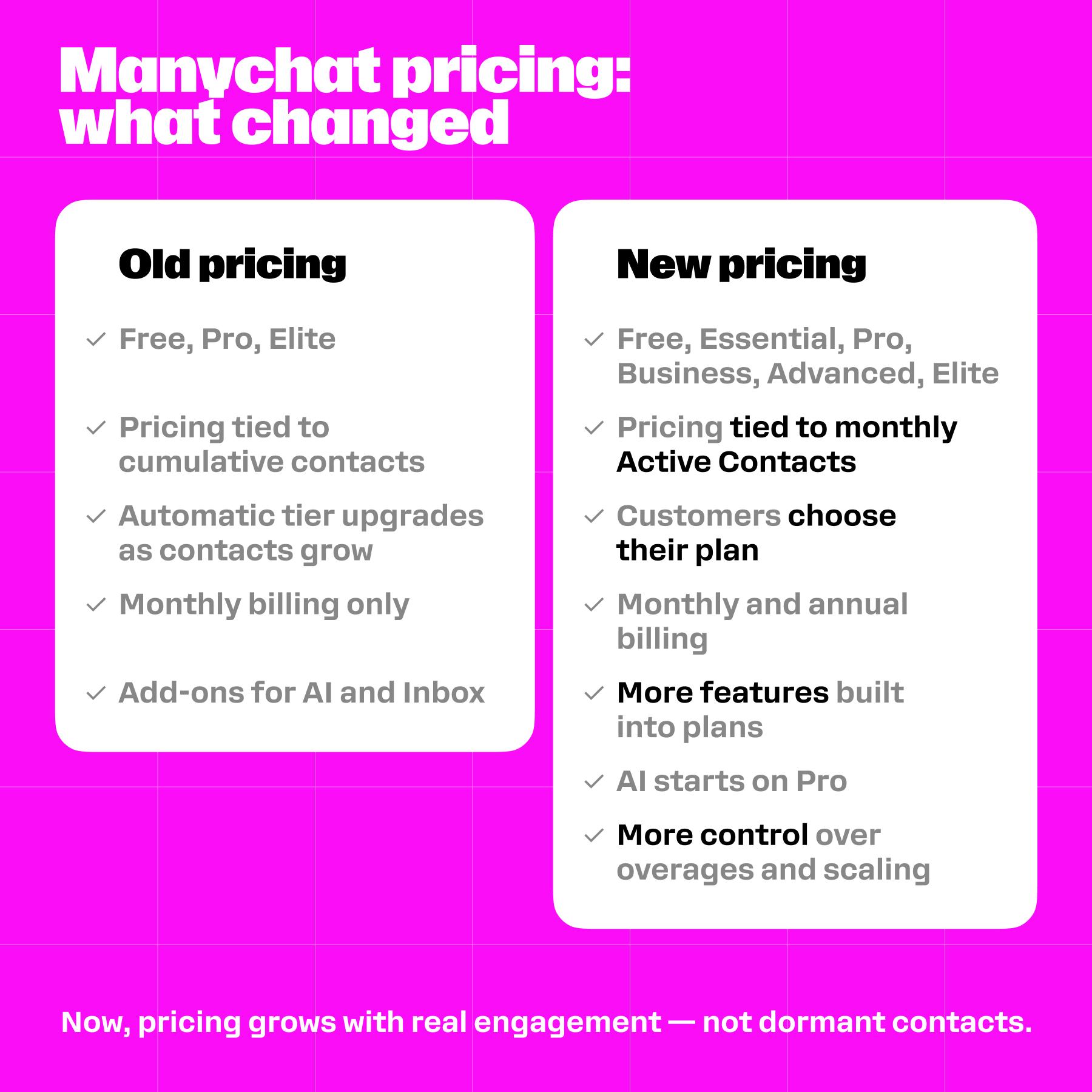
We’re moving away from a rigid, one-size-fits-all model to one that gives you greater flexibility to choose the plan that best fits your stage of growth.
What’s new: Free + 4 paid plans
Here’s what’s new, at a glance.
- Free
- Essential
- Pro
- Business
- Advanced
The biggest changes
One paid plan becomes four paid plans. A wider range of options, so you can choose the level of features and capacity that fits your business today — and scale as you grow.
Cumulative contacts become Active Contacts. Pricing is now tied to the people you actually engage with each month, not your total stored contact list.
More features are built into plans. Instead of stacking extra add-ons on top, features like AI and Inbox are intentionally distributed across plans based on the needs of different growth stages.
Monthly and annual billing. You can now choose monthly or annual plans, with savings on annual.
The Main Takeaway
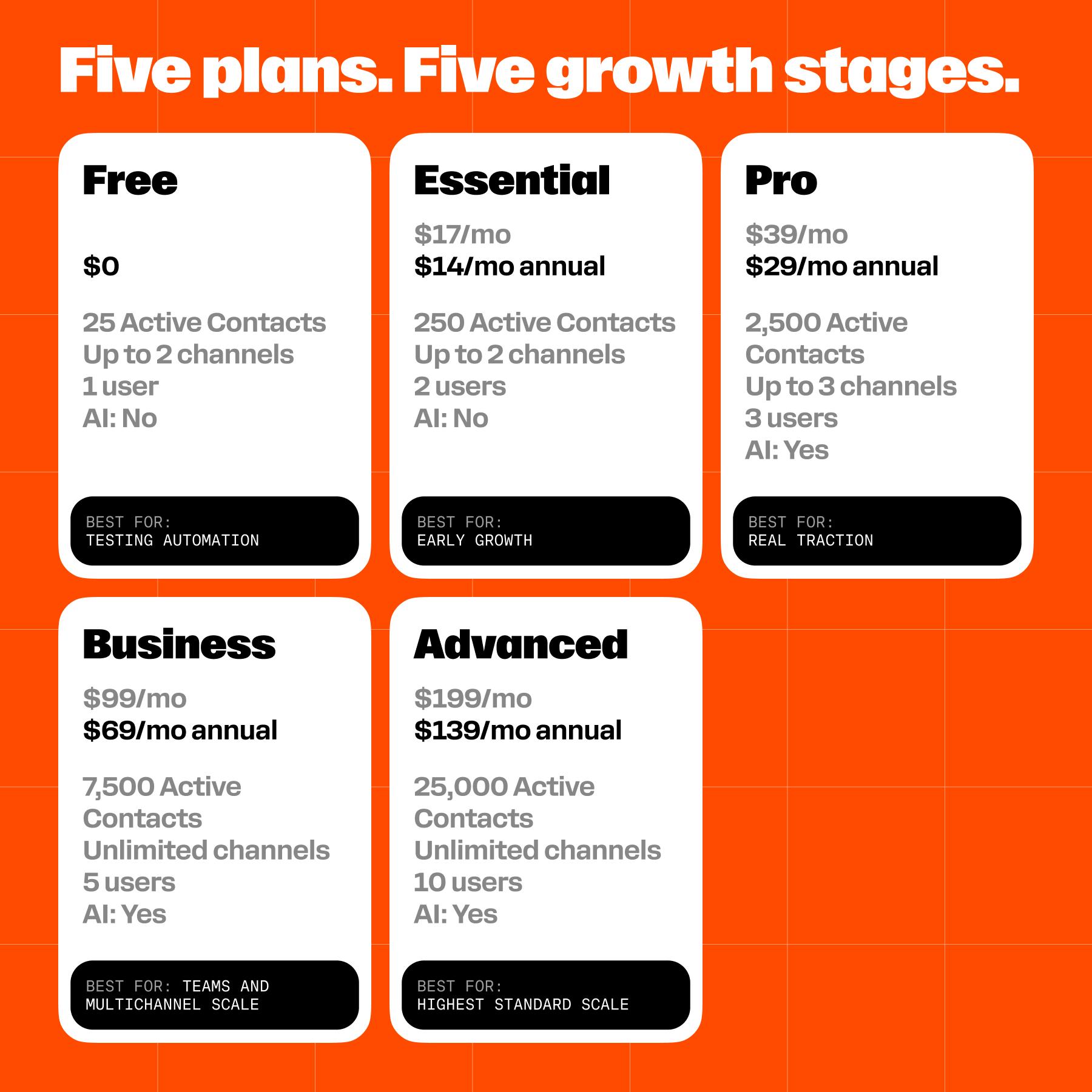
Pricing is now designed to scale with your growth.
That means you can choose the level of features, channels, team access, and Active Contact capacity that fits your business today, then move up when your audience, conversation volume, or complexity says it is time.
How pricing works now
As creators have evolved, so has our understanding of where we deliver the most value. This pricing update is designed to bring that value closer to what you pay by focusing on the people you actually connect with.
That means your total cost is primarily based on:
- Your base plan
- Your monthly Active Contacts
In some cases, your bill may also include:
- Additional Inbox seats (on Pro and above, if you add more team members)
- Applicable sales tax, depending on your location
No pay-per-message nonsense. No penalty for actually having a conversation.
Each plan includes:
- a base monthly or annual price
- an included number of monthly Active Contacts
- a specific level of channels, features, team access, and AI capabilities
If you stay within your included Active Contact amount, your bill stays at your base plan price.
If you go over, you pay a small fee for each additional Active Contact.
And because Manychat pricing is tied to people, not message volume, you can keep the conversation going without watching the meter every time someone replies. You can follow up. Nurture. Qualify. Answer questions. Close the sale. Be helpful. Be human. Be gloriously over-explanatory in the DMs if you want. Your cost is based on who you engage with, not how chatty the conversation gets.
Simple example
- You’re on Essential
- $17/month
- 250 Active Contacts included
This month you hit: 280 Active Contacts → That’s 30 extra
Overage cost: 30 × $0.10 = $3
Total bill: $17 + $3 = $20
Simple math. No hidden goblin fees.
What Active Contacts actually means
An Active Contact is a person you interact with through DMs or automations in a given month.
If the same person messages you 17 times in one month, that still counts as one Active Contact.
If someone does not interact with you that month, they can stay in your account, but they do not count toward your Active Contact total for billing purposes.
And yes, Active Contacts reset monthly, even on annual plans.
This is the biggest philosophical shift in the new pricing model, and honestly, it is the right one. Your contact list still matters. It’s where you store context, tags, and all the data that makes your messaging smarter over time.
But the real value is not in a massive archive of contacts. It’s in the people you’re actively talking to right now. That’s what pricing is built around: real engagement, real conversations, real momentum.
That is what Active Contacts is built to do.
What Active Contacts is not:
- It is not your full contact list
- It is not your follower count
- It is not the number of messages sent
- It is not something you can reduce mid-month by deleting contacts
Deleting contacts will not reduce your Active Contact usage for that month, because Active Contacts are based on who you engaged with during that billing period, not who is sitting in storage.
So no, you do not need to start deleting people like you are cleaning out your closet after a breakup.
How to Keep Costs Predictable
We know the first question people ask when pricing changes is usually some variation of: “Cool. But am I about to get blindsided?”
Fair question. No one enjoys surprise billing.
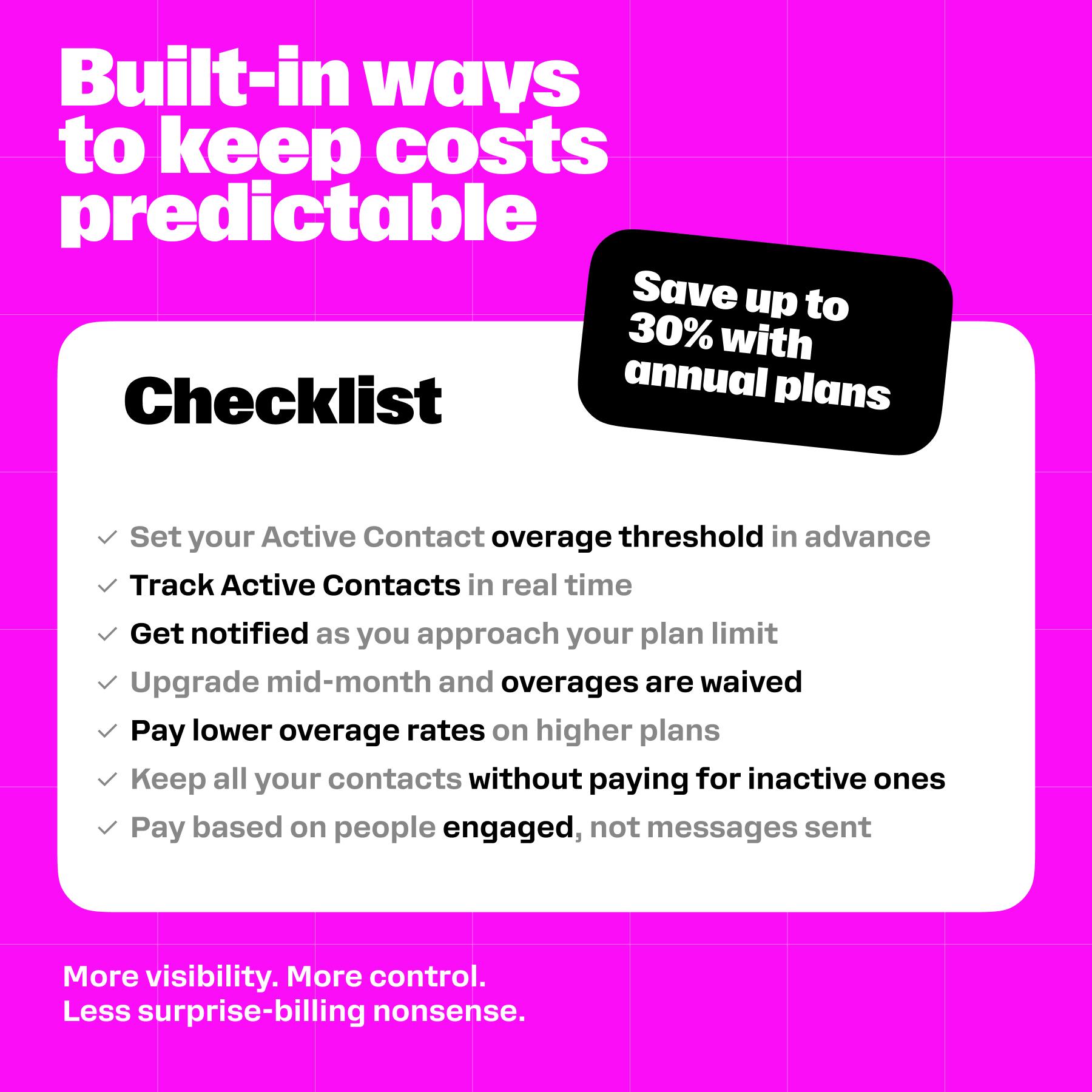
So the new model includes built-in ways to keep costs predictable and give you more control as you scale.
You can cap overages in advance
You can set your Active Contact overage threshold ahead of time, so you decide how much overage you are comfortable with.
You can track usage in real time
You do not have to guess where you stand. You can monitor your Active Contact usage as the month progresses.
You get notified before you hit the wall
Manychat will notify you as you approach your plan limits, so you do not find out after the damage is done.
Upgrading mid-month waives overages
If you exceed your limit and upgrade to a higher plan within the same billing cycle, your overage charges for that month are waived, and your usage rolls over to the new plan.
Overage rates get more efficient as you grow
Higher plans come with lower per-contact overage rates, so scaling doesn’t feel like getting punished for momentum.
Annual plans reduce your base cost
Annual billing can save you up to 30%, depending on the plan.
So yes, the model grows with you. But more importantly, it gives you levers and room to make decisions before anything gets weird.
Learn more about how our pricing works:
Which Plan is Right for You?
There’s no single “best” plan — just the one that fits where you are right now.
Whether you’re testing automation for the first time or running high-volume, multi-channel conversations with a team, there’s a plan built for that stage.
For the full feature-by-feature breakdown, visit our pricing page.
What this means for current Manychat users
If you are already using Manychat, nothing is changing today. The new pricing model is currently only available for new users.
For existing customers, we know pricing changes can feel disruptive. They affect budgeting, planning, team decisions, and sometimes your blood pressure. We do not take that lightly.
So before any changes are required on your account, you will get advance notice through:
- in-product notifications
- clear guidance on what to expect
- instructions on how to understand your options and choose the right plan
No one is getting shoved into a mystery tunnel and told to just vibe. You will have time to review the new plans, understand how they work, and decide what fits your business.
A few important notes
In summary:
- New pricing is available now for new users
- Existing users will have notice before any changes are implemented
- New plans and pricing are available globally except for Brazil. We’ll introduce the new plans to Brazil later this year.
- You can check your current plan anytime
- Go to Settings > Billing > Subscription in your Manychat account
If you want to explore the new options now, head to the pricing page.
Manychat pricing is changing because creators changed first. Our job is to keep building a platform that fits how you actually grow, connect, and sell now, not how software used to think you should.
Frequently asked questions
The new plans are built to better match how creators and social-first businesses actually grow now. That means: more flexibility across different stages of growth, more included features, pricing tied to real engagement, not dormant contacts, access to more advanced capabilities, including AI, more channels, and team tools as your needs evolve, and more visibility and control over costs as you scale. When the new plans become available to you, you’ll be able to review your options and choose what works best for your business.
Your monthly bill can include: your base plan cost, any Active Contact overages, any additional Inbox seats, if applicable, plus any applicable sales tax.
An Active Contact is someone you interact with through messages or automations during a monthly billing period. A person only counts once per month, even if they interact with you multiple times. Active Contacts reset every billing cycle.
No. Deleting contacts does not reduce your Active Contact count for the current month, because Active Contacts are based on who you actually engaged with during that billing period. Your costs are tied to real audience interaction, not contact storage. If you want more control, you can set an Active Contact overage cap in Settings > Billing > Subscription by clicking Set your contact limit.
You can choose monthly billing or annual billing. With annual plans, you pay upfront for the year at a discounted rate, with savings of up to 30% depending on the plan. Even on annual plans, Active Contacts are still calculated monthly, Active Contact overages are still billed monthly, and additional Inbox seats are billed monthly or prorated based on the billing setup.
The easiest move is to visit the pricing page. You can also watch the plan overview video for a fast breakdown of which plan fits which stage.
Go to Settings > Billing > Subscription in your Manychat account.


Originally published: Apr 20, 2026, Updated: Apr 20, 2026
More stories worth reading
More content that's too good to miss