Social Media Comment Automation: What’s Possible on Top Platforms Today?

If you’re managing a social account as a creator or brand, you’ve probably gotten your fair share of comments: “Where’s the link?” “How much does this cost?” “Where do I sign up?” “HELP ME, PLEASE! RIGHT NOW!”
When it comes to comments, the general idea is the more you get, the better. On most social platforms, likes, comments, and shares help the algorithm determine whether your content is worthy of being seen. But without automation, you’ll have to dedicate some hours to responding to everyone yourself. And in this case, the more comments you get, the more time you have to spend in your notifications tab. (And then your thumbs get sore, and your eyes glaze over, and you start to wonder if this was the right career for you.)
Comment automation is how you respond to your audience at scale. But what you can automate depends on which platform you’re posting on. This guide breaks down what’s possible on the most popular social platforms today and offers five practical ways you can get started with comment automation.
TL;DR
- Comment automation is using software to automatically respond to comments on your social posts, either with a public reply or a private direct message.
- Not every social platform fully supports comment automation. Instagram, Facebook (Pages only), TikTok, YouTube, Threads, and Reddit are all automation-friendly. X and Bluesky offer some comment automation capabilities; LinkedIn doesn’t currently allow comment automation.
- Five ways to get started with comment automation, from automatically delivering lead magnets in exchange for an email address to answering frequently asked questions while interest is high.
How Social Media Comment Automation Works

Comment automation occurs when someone comments on your social post, and a response to that comment is sent automatically. That response can be a public reply under their comment, a private DM, or both. You decide which posts it runs on, which words trigger it, and what the reply actually says.
Comments are warmer than likes, and with engagement becoming a scarcer resource every year, each one matters more than ever. Someone stopped scrolling and typed words for you. Responding to them quickly and consistently can make a real difference in your bottom line (see: How Much is a Missed Connection REALLY Costing You?).
And today, the difference between assigning someone (maybe you!) to respond to comments by hand versus letting automation handle it is noticeable.
When someone takes the time to leave you a comment, and you don’t respond promptly, they may feel frustrated or lose interest in your content/whatever you’re selling. Then there are the scrollers who see unanswered comments sitting there, growing cold, and now have preconceived notions about your customer service strategy.
Manual approach | Automated approach | |
|---|---|---|
Response time | Hours to days (or never) | Seconds |
Consistency | Depends on your energy | Same every time |
Scalability | Requires more time as comment volume grows | 1,000+ responses |
Lead capture | Only if you remember to | Comments can trigger a lead capture flow |
Revenue impact | Hit or miss | The right tool can track clicks, signups, and attributed sales |
All this is to say that automating your comments is beneficial (and in many cases, necessary) for your social presence. You should still have someone involved in the day-to-day management of your social inbox, but automating the simple stuff, like delivering links or answering FAQs, is a great way to free up time in your week and speed up the process of responding to and converting interested scrollers.
Which Social Media Platforms Support Comment Automation Today?

Many social platforms support comment automation today, but they don’t all offer the same options. Some are native features; others are third-party tools. Some let you automatically reply in the comments; others only let you send a private message.
Let’s talk about each platform’s specific options:
- TikTok
- YouTube
- Threads
- X
- Bluesky
1. Instagram
Instagram supports comment automation through native features and third-party tools connected to its official API. That includes moderating comments, replying publicly, and sending a private message in response to a comment.
On the native side, Instagram’s Hidden Words feature automatically filters unwanted comments. Meta Business Suite also offers basic comment to message automation for supported accounts. For more customizable workflows, you can use an API-connected platform like Manychat.
One of the most familiar uses is the “comment GUIDE and I’ll DM you the link” setup. Someone comments a keyword, and the automation sends the resource directly to their inbox. The same approach can deliver product information, discount codes, or a signup link. Fresh.
Want to jump in? How to Set Up a Comment-to-DM Automation on Instagram
2. Facebook
Facebook supports comment automation for Pages through both native features and third-party tools that connect to its official API. You can use it to moderate comments, send private Messenger messages, or — with a supported integration — automatically reply underneath a post.
For native options, Meta Business Suite’s comment to message automation sends a preset Messenger response when someone comments with a specified trigger on your Page post. Facebook also offers Moderation Assist, which automatically hides incoming comments that meet criteria you choose, such as containing links or images.
For automated public replies and more customizable messaging workflows, you can use a tool like Manychat. A typical campaign might invite people to comment “MENU” to receive a restaurant’s menu or “DEAL” for an offer, then publicly acknowledge their comment and send the details via Messenger.
These capabilities apply to Facebook Pages; they don’t work for personal profiles or Facebook Groups.
3. TikTok
TikTok Business Accounts can use supported third-party tools to automate public comment replies through TikTok’s official Business API. For example, NapoleonCat lets businesses set up automatic responses to comments on their videos and ads, as well as hide unwanted comments.
Manychat also currently supports TikTok inbox automation, and TikTok offers native automation through its app and TikTok for Business, including welcome messages and keyword replies for eligible accounts, but those features respond to direct messages, rather than public comments.
4. YouTube
YouTube supports comment management and public replies through its official Data API. Third-party tools like NapoleonCat and Brandwise turn those capabilities into automation: NapoleonCat offers rule-based automatic replies, while Brandwise can generate and send AI responses or draft them for your review.
A practical use for comment automation on YouTube is answering questions that keep popping up underneath your videos: where to find a tutorial, which product you’re using, or whether there’s a follow-up episode.
These replies appear in the public comment section. YouTube’s comment API doesn’t provide the Instagram-style comment-to-DM funnel, so think of it as a way to answer viewers and keep conversations moving underneath your content.
5. LinkedIn
LinkedIn is more restrictive about comment automation than platforms like Instagram and Facebook. Its official API allows authorized tools to read and publish comments, but fully automated comments without human intervention aren’t allowed.
LinkedIn doesn’t offer native comment automation features, but it does work with some third-party options; for example, NapoleonCat supports LinkedIn company Pages and offers automatic spam removal, sentiment tagging, team assignments, and AI-generated reply suggestions. You can provide reference material, such as FAQs or help articles, and then review and approve the suggested answers before posting.
6. Threads
Threads supports reading, managing, and publishing replies through its official API. Tools can use that access to help you manage conversations — or, where supported, automatically respond to comments underneath your posts.
For example, MindThread advertises AI-powered automatic replies to comments on your own Threads posts through Meta’s official API. Buffer offers a more hands-on option: its Community feature collects your Threads comments in one place and provides saved replies and AI suggestions, but you still have to click send yourself.
7. X
X allows automated replies via its official API, but the recipient must have requested them or clearly opted in. You must also offer an easy way to opt out and limit automation to one reply per interaction (following your account alone doesn’t count as permission).
For example, an approved event campaign could invite people to reply to a post to automatically receive the registration link. That’s different from monitoring the word “marketing” and dropping your webinar link into strangers’ conversations; X specifically prohibits automatic replies based on keyword searches alone. Brands need approval for auto-response campaigns, and AI reply bots require prior written approval from X.
For a more hands-on option, Buffer’s Community feature brings X replies into a shared workspace and offers saved replies and AI suggestions. You review the response and click Send yourself.
8. Reddit
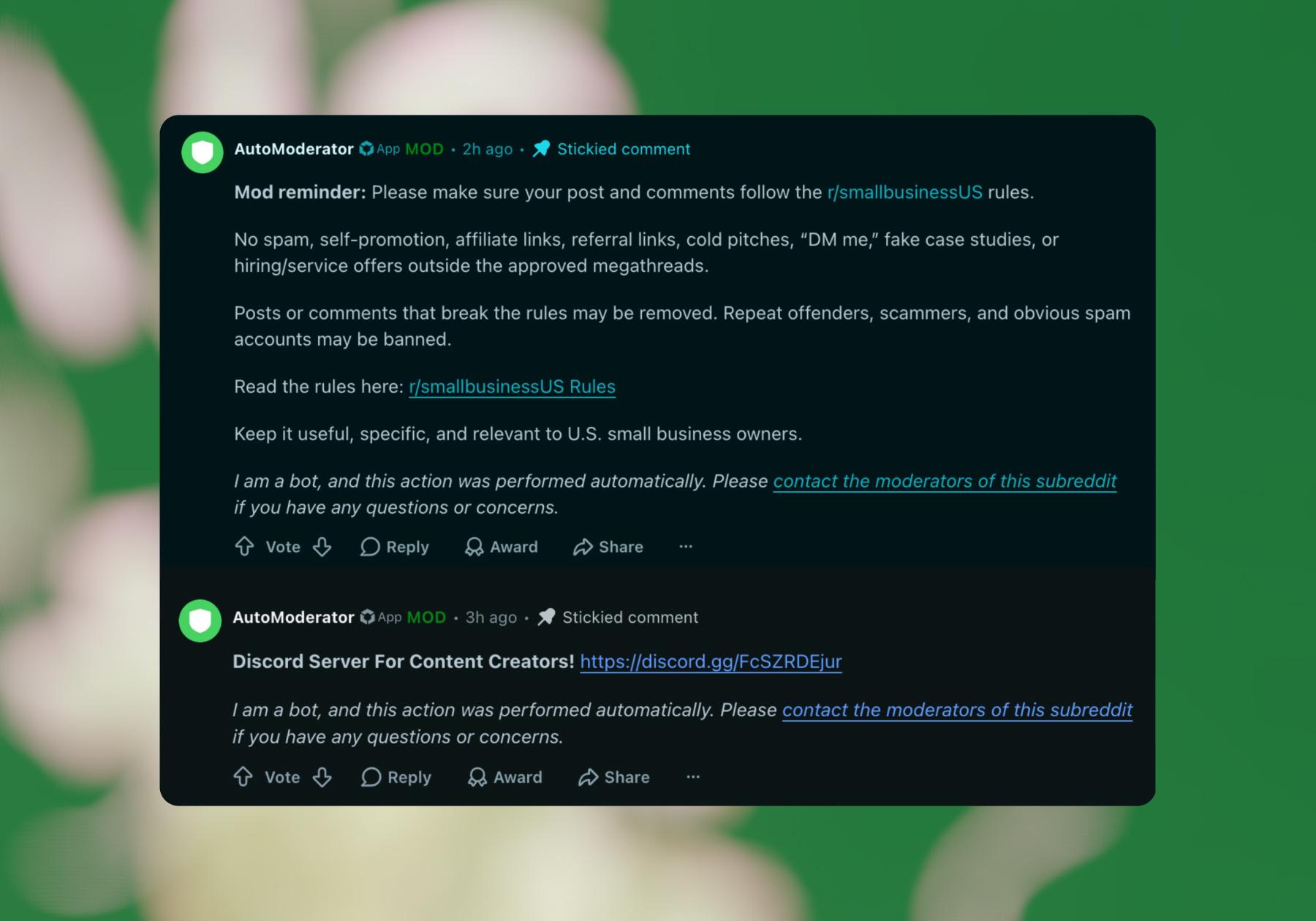
Reddit has a native tool called AutoModerator, which moderators can configure to take action when a post or comment meets certain conditions. In addition to removing or flagging content, it can automatically leave a helpful response.
For example, the mods of r/smallbusinessUS have used the AutoModerator tool to respond to new posts with a reminder of the subreddit rules, and the mods of r/contentcreators use it to share the link to their Discord server.
There are also apps available for installation on Reddit’s Developer Platform. AmputatorBot, for instance, can respond to AMP links with the original webpage link, including when someone summons it. Resource Reply is another tool that Reddit moderators use to save common responses in a “Reply with resource” menu. That way, if a redditor posts a question they’ve answered a hundred times, they can open the menu and fire off a response from their pre-written options.
These tools operate within certain subreddits where moderators control their setup. Reddit’s bot policies and each subreddit’s rules still apply, so a useful community helper isn’t permission to send automated promotional replies across unrelated discussions.
9. Bluesky
Bluesky supports custom bots via its API, and its official "Build an Agent" tutorial shows developers how to automate posts and replies to mentions. This requires coding rather than switching on a built-in setting. Bluesky’s guidance also says bots should interact with people only when those users tag the bot account.
If you want something ready to use, Buffer’s Community feature supports managing Bluesky replies, with saved responses and AI suggestions. You still have to review and send the answer yourself; for fully automatic replies, you’ll need a purpose-built bot or integration using Bluesky’s API.
5 Ways to Get Started with Comment Automation

You don’t need to automate everything to make a real difference in your weekly workload. Start with just one thing that people already ask for (a link, product details, or a way to book) and build a response that gets them to the next step.
Here are five practical examples of how you can put comment automation to work.
1. Deliver lead magnets on request
A CTA like “Comment GUIDE and I’ll send it over” gives people a clear next step while they’re already interested in your content. On Instagram and Facebook Pages, the comment can trigger a DM containing a download link to your PDF, checklist, or template, so they don’t have to hunt through your bio.
With Manychat, you can also ask people to engage with the opening message, then collect their email address before delivering the resource. Make it clear whether they’re signing up for future marketing emails, too (requesting a download isn’t the same as subscribing to your newsletter).
On YouTube or Threads, you can send the link via an automated public reply instead. NapoleonCat supports automatic YouTube comment replies, while MindThread advertises automatic replies to comments on your own Threads posts. If you want to collect an email address first, share a sign-up page link rather than asking someone to post their address publicly.
2. Run giveaways without the inbox chaos
A giveaway can bring in hundreds of comments, but don’t leave people wondering whether their entry counted. Instead, use comment automation to handle the confirmation: ask people to comment “ENTER,” then send a private message acknowledging their entry and sharing the closing date and next steps.
You can do this with Manychat on Instagram and Facebook Pages, or on TikTok or YouTube; you can also use a tool like NapoleonCat to acknowledge entries with an automatic public reply.
Here, comment automation handles responses; checking eligibility and choosing a winner still require a separate process.
3. Answer product questions while interest is high
Someone commenting “price?” is signaling they’re interested in what you’re selling. On Instagram and Facebook Pages, an automation can send a private response with the price, relevant product details, and a shopping link before that person scrolls away.
For example, a jewelry brand could set up an automation for a specific necklace reel that triggers when someone comments “PRICE” or “LINK.” The commenter receives a DM with the necklace’s photo, price, and shopping link. Keeping the automation specific to that reel means someone asking about a different product on another post won’t receive irrelevant information.
On TikTok and YouTube, tools like NapoleonCat can answer recurring questions publicly underneath the video. That’s particularly useful for shipping times, sizing, or product availability: one person asks, but everyone reading the comments gets the answer.
4. Collect waitlist signups from your comments
You don’t have to wait until your course, workshop, or product is ready to start finding interested buyers. Add “Comment WAITLIST to hear when it launches” to a teaser post, then use the automation to collect interest while you’re still getting everything for launch ready.
On Instagram and Facebook Pages, a Manychat DM conversation can collect an email address and permission to send launch updates without directing people to a separate signup page. You could also ask what they’re most interested in — for example, beginner or advanced workshops — to help shape your offer. On YouTube or Threads, an automated public reply can share a waitlist signup link. When launch day arrives, you’ve already got people expecting to hear from you.
5. Automate bookings without the back-and-forth
If you’ve ever spent half an hour trying to schedule a consultation that’ll only take 15 minutes, you know the appeal of a booking link. Comment automation gets that link to someone as soon as they ask about working with you.
A career coach, for example, could end a reel with “Comment CONSULT to book a discovery call.” On Instagram or Facebook Pages, the automation sends a DM explaining what the call covers and includes an appointment scheduling link. If you offer several services, the conversation can first ask which one they need, then send the appropriate booking page.
On YouTube or Threads, a supported tool can instead share the scheduling URL in a public reply. The person chooses an available slot, and your scheduling tool handles the confirmation, without the back-and-forth discussion.
Put Your Comment Section to Work

If you’re ready to automate, browse our guide to the best social media automation tools to compare options based on your channels and goals.
Then kick off your automation strategy with a question or request you regularly receive on social media. Pick one post, set up a relevant response, and test the experience from the commenter’s side. Does the message answer their question? Does the link take them where they expect? Give that first automation a clear job before adding more.
And if you’re posting on Instagram, Facebook, or TikTok…
Frequently asked questions
Social media comment automation uses software to respond automatically when someone comments on your content. Depending on the platform and tool, it can post a public reply, send a private message, or trigger a conversation based on a specific keyword.
Instagram, Facebook, and YouTube support automated comment replies through their official APIs, although the available features differ. Instagram and Facebook support comment-triggered private messages as well as public replies, while YouTube’s API supports public replies to comments. Before choosing a tool, check that it supports your platform, account type, and the specific action you want to automate.
Yes, you can automatically send a DM when someone comments on an Instagram post or a supported Facebook Page post using a tool like Manychat. You can set the automation to respond to a keyword, such as “LINK,” and deliver the relevant resource or offer. On Instagram, that first private reply doesn’t automatically open an ongoing conversation: the recipient needs to reply or interact with a qualifying button before follow-up automation can continue within the messaging window.
Comment automation is allowed when it uses platform-supported features and complies with its rules. Manychat, for example, is a Meta-approved tool designed to comply with Instagram’s automation policies. However, using an approved tool doesn’t exempt your account from rules around spam, content, or messaging limits. Keep replies relevant to the person's comment and follow the platform’s requirements for sending additional messages.
To set up comment automation, connect an eligible social media account to a tool that supports your chosen platform. Select the posts you want to automate, choose a trigger keyword, and write the public reply or private message people will receive.


Originally published: Nov 18, 2021, Updated: Oct 20, 2026
More stories worth reading
More content that's too good to miss